

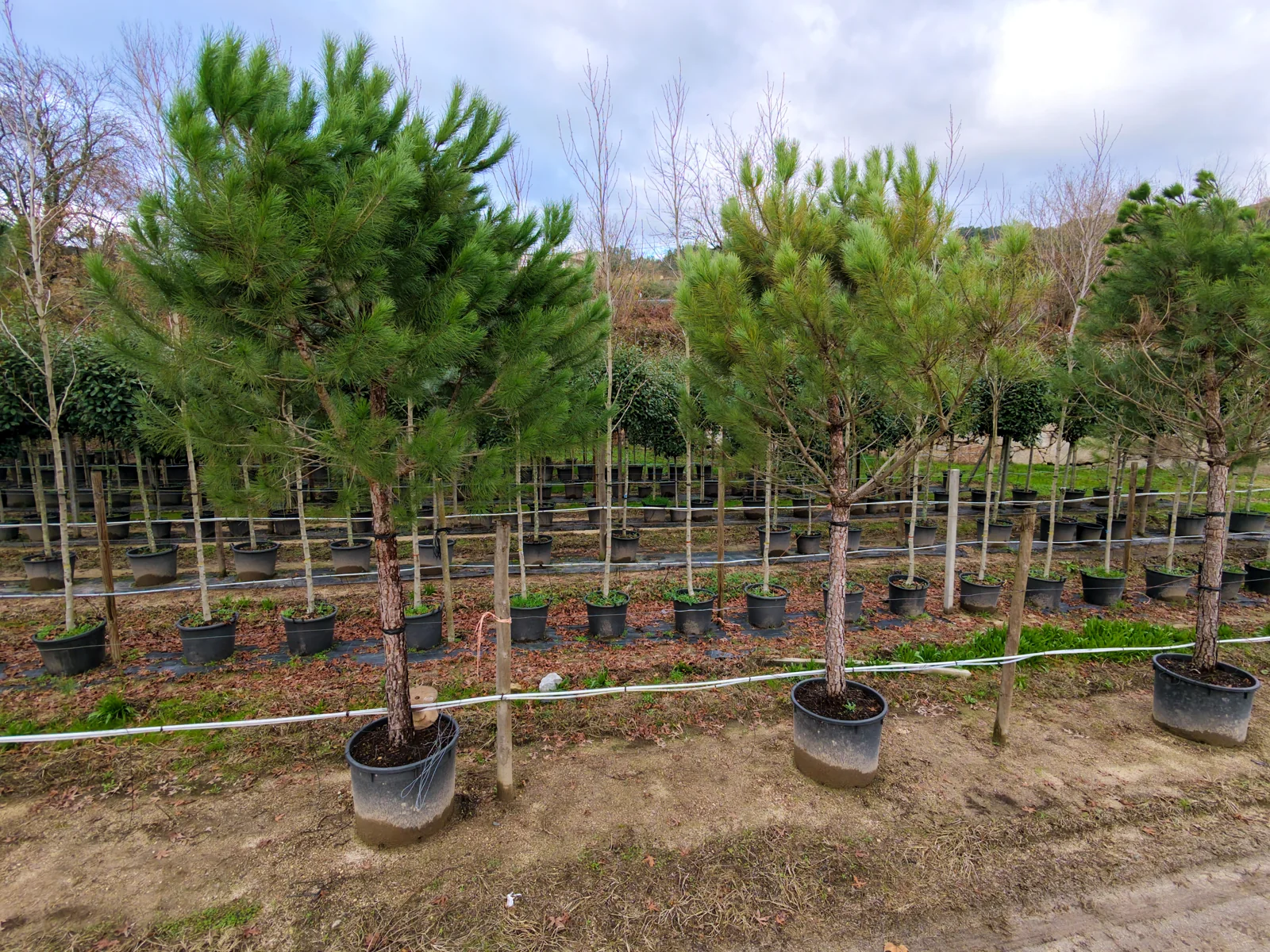
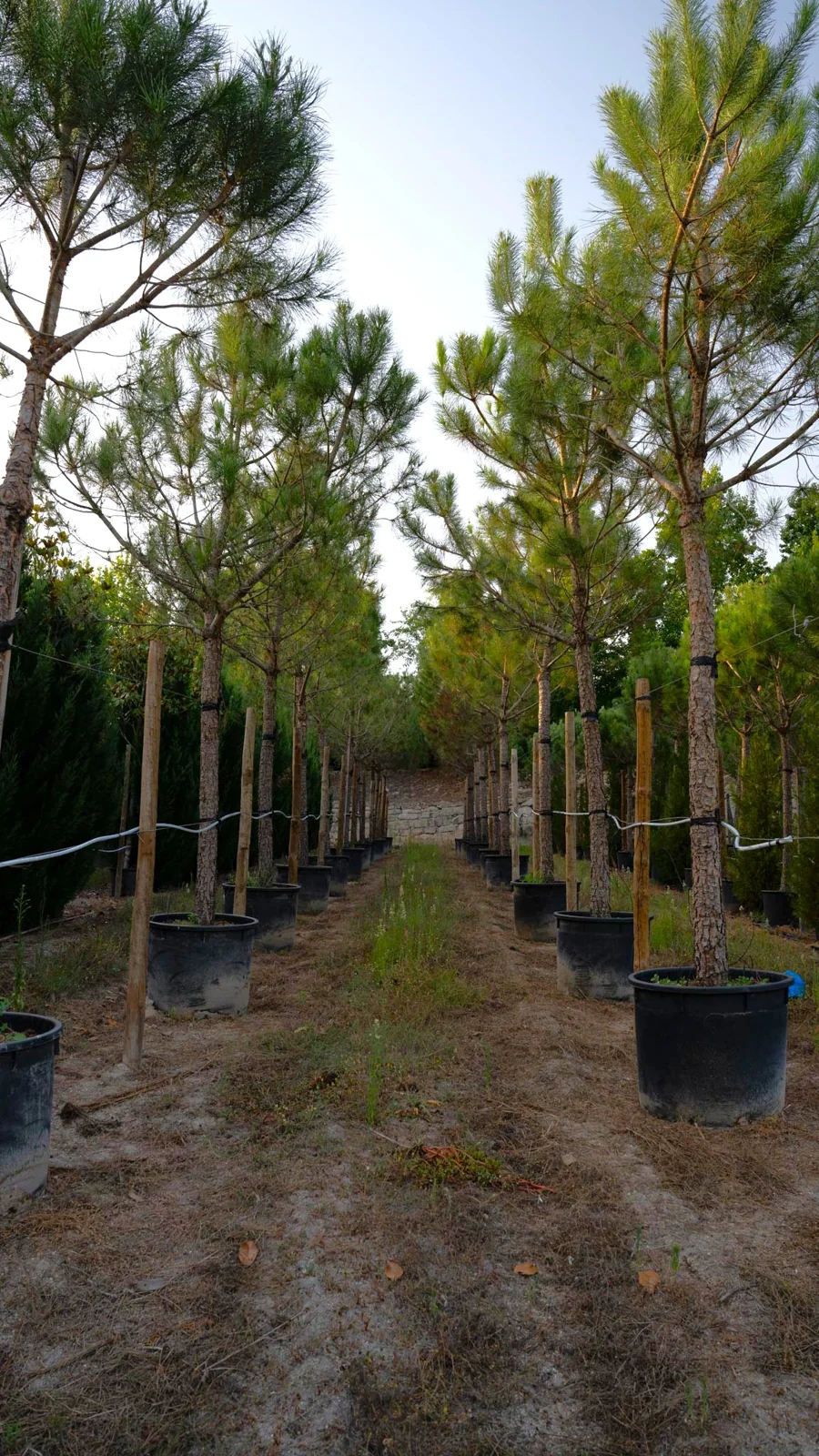
Heat- and salt-tolerant evergreen for low-water schemes
Stone Pine · Pinus pinea
A Mediterranean parasol pine specified for sunlit terraces, coastal alignments, and southern parkland schemes where its broad, flat crown at maturity is the design feature. Reliable and thriving across mild Atlantic and Mediterranean climates.
About this Species
Pinus pinea is the umbrella pine of the western Mediterranean: a juvenile globe that opens, by mid-age, into the flat-topped parasol crown familiar from the Via Appia and the Italian coastal park. Mature specimens typically reach 12 to 20 m in height with a broad crown over 8 m wide; exceptional trees pass 25 m. Paired mid-green needles of 10 to 20 cm sit…
Read more
Show less
Pinus pinea is the umbrella pine of the western Mediterranean: a juvenile globe that opens, by mid-age, into the flat-topped parasol crown familiar from the Via Appia and the Italian coastal park. Mature specimens typically reach 12 to 20 m in height with a broad crown over 8 m wide; exceptional trees pass 25 m. Paired mid-green needles of 10 to 20 cm sit above thick, deeply fissured red-brown bark that develops into broad vertical plates with age.
The climate envelope is genuinely Mediterranean. Reliable hardiness sits at about minus 12 °C; trees take prolonged summer maxima above 35 °C without distress thanks to a deep root system and waxy needle cuticle. The species performs along the Atlantic seaboard as far as southern Scotland in sheltered coastal microclimates, but is not a defensible specification for continental sites east of a line through the Rhône-Saône corridor, for central or eastern European projects, or for boreal and subboreal latitudes. Below minus 15 °C, losses are routine.
Site requirements are narrow but well defined. Full sun is essential; soils should be free-draining, sandy to loamy, slightly acidic to neutral; waterlogging is not tolerated. Salt tolerance is high, which suits coastal dune consolidation and seafront planting; what the species does not tolerate is heavy clay, alkaline calcareous loam in any depth, or exposed inland sites where the broad crown becomes a sail against winter wind.
Wind damage is the structural risk to plan for: the parasol crown develops weight and leverage out of proportion to the trunk. Pest pressure across the Mediterranean now includes the invasive western conifer seed bug (Leptoglossus occidentalis), which affects nut yield more than tree health, and locally Pestalotiopsis pini, recorded as an emerging shoot-blight pathogen. Maintenance is otherwise low. Specified as a single specimen on a sunlit terrace, as a coastal alignment, or as the framework tree of a southern parkland scheme, the umbrella silhouette is the visual asset that justifies the specification.



Advice on this species
Want to know more about Pinus pinea?
Tell us about your project and we'll advise you on this species — where it thrives, which size makes sense, and what to expect once planted.
- Produção própria
- Exemplares adultos
- Resposta em 1–2 dias
Sem compromisso · orçamento personalizado