

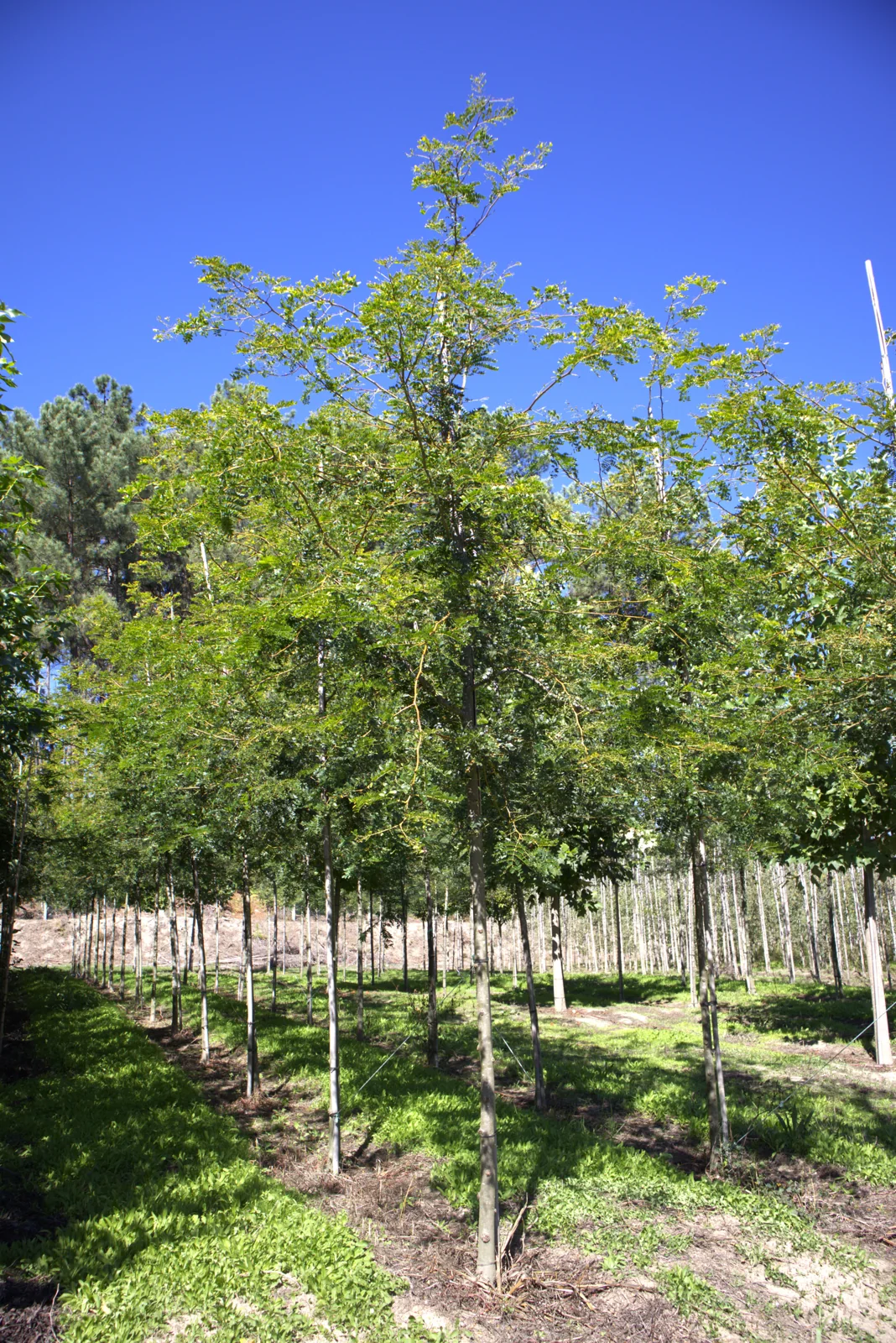
Thornless urban canopy tree for the full European climate range
Honey Locust ‘Inermis’ · Gleditsia triacanthos ‘Inermis’
A thornless, fast-growing deciduous canopy tree specified across the European urban canon for streets, squares, and parkland, with a hardiness range covering the continent from the Mediterranean coast to boreal capitals.
Key Facts
About this Cultivar
The cultivar 'Inermis' carries the form and physiology of Gleditsia triacanthos without the species' branched thorns, removing the principal reason the parent is excluded from public-space specifications. Habit is broad and slightly irregular, with an airy crown of finely bipinnate foliage that filters light rather than blocking it. Mature stature reaches…
Read more
Show less
The cultivar 'Inermis' carries the form and physiology of Gleditsia triacanthos without the species' branched thorns, removing the principal reason the parent is excluded from public-space specifications. Habit is broad and slightly irregular, with an airy crown of finely bipinnate foliage that filters light rather than blocking it. Mature stature reaches 12 to 18 m in height and 10 to 15 m in spread, with fast establishment on a wide soil envelope.
The climate envelope is unusually broad for a canopy tree of this calibre. Reliably winter-hardy to about minus 34 °C (USDA zone 3b) at the cold end and through zone 9 at the warm end, the cultivar carries no meaningful northern or eastern limit within Europe: it is defensible from the Mediterranean and Aegean coasts through the Po valley and Pannonian basin to southern Scandinavia, the Baltic states and the inland continental fringe. Heat tolerance extends to prolonged summer maxima above 35 °C, and the deep taproot supports reliable drought tolerance once established below 500 mm annual rainfall.
Behaviour on difficult urban substrates is the cultivar's central professional case. It accepts compacted, alkaline or acid, sandy or clay soils, tolerates pavement to the trunk, withstands de-icing salt at northern street pits, and registers minimal damage from urban air pollution. Within the shared European urban canon of Platanus, Tilia, Acer platanoides, Quercus robur and Sophora japonica, 'Inermis' fills the lighter-shade niche where a dense Platanus or Tilia canopy would oversail underplanting or pedestrian sightlines.
Pinnate foliage emerges late in spring and turns clear yellow to gold through autumn, giving a defined seasonal phase without heavy leaf-litter mass. The fragrant greenish flowers of May and June are minor ornamentally but support pollinators. Care is low once established; the principal pressures to verify against the project site are honeylocust plant bug, mimosa webworm where present, and Ganoderma root rot on stressed specimens.
Advice on this species
Want to know more about Gleditsia triacanthos 'Inermis'?
Tell us about your project and we'll advise you on this species — where it thrives, which size makes sense, and what to expect once planted.
- Produção própria
- Exemplares adultos
- Resposta em 1–2 dias
Sem compromisso · orçamento personalizado