

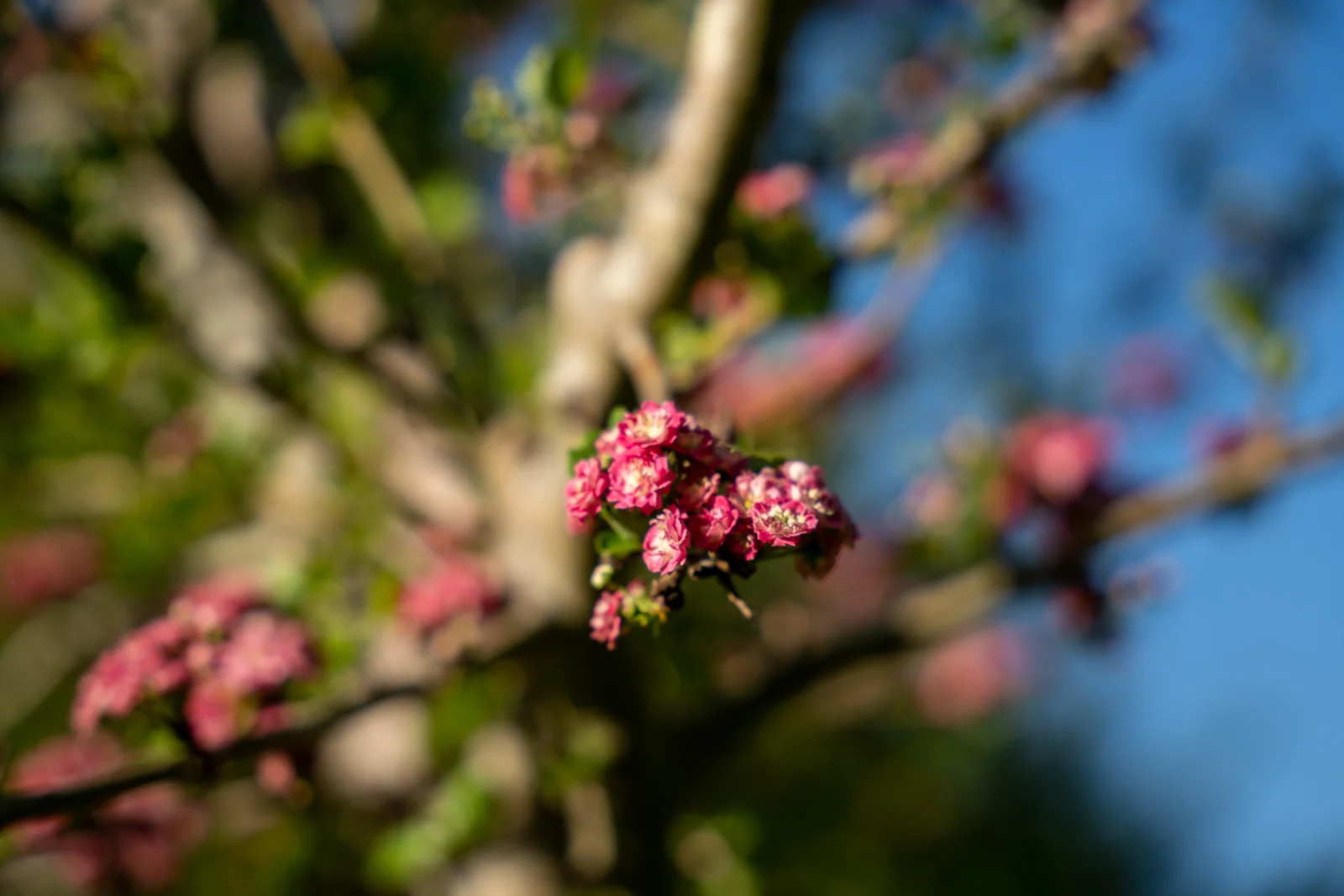
Compact double-flowered hawthorn for temperate alignments and tree pits
Midland Hawthorn ‘Paul‘s Scarlet’ · Crataegus laevigata ‘Paul‘s Scarlet’
A small deciduous tree carrying dense corymbs of double scarlet flowers over a rounded, well-branched crown of 5 to 7 metres. Selected for urban tolerance and reliable performance across temperate Europe.
Key Facts
About this Cultivar
Crataegus laevigata 'Paul's Scarlet' is a slow-growing cultivar of the European Midland hawthorn, derived from hybrids within Crataegus × media and long held in European cultivation. Mature specimens settle at 5 to 7 metres in height with a spread of 4 to 7 metres, forming a dense, rounded crown on a single short stem. The selection's distinguishing trait…
Read more
Show less
Crataegus laevigata 'Paul's Scarlet' is a slow-growing cultivar of the European Midland hawthorn, derived from hybrids within Crataegus × media and long held in European cultivation. Mature specimens settle at 5 to 7 metres in height with a spread of 4 to 7 metres, forming a dense, rounded crown on a single short stem.
The selection's distinguishing trait is its prolonged April-to-May flowering: tight corymbs of double scarlet to deep-pink flowers held against dark, glossy, shallowly lobed foliage. Compared with the wild type, fruiting is sparse, which removes the pavement-staining and self-seeding load that limits Crataegus monogyna in formal urban settings. Autumn foliage carries warm tones before leaf-fall.
Cold hardiness is broad. The parent species is documented across western and central Europe from Britain to Romania and Ukraine, and 'Paul's Scarlet' performs reliably to roughly minus 25 °C; the cultivar is grown without protection through the German, Polish and southern Scandinavian urban canon, with sheltered sites in colder zones also reported. Heat tolerance is moderate; the tree withstands prolonged summer maxima above 30 °C provided root run is not compacted, but is less suited than Quercus robur or Tilia cordata to the driest Pannonian and inland Iberian conditions without irrigation establishment.
Site tolerance is wide. The tree accepts acidic to neutral soils across sandy, loamy and clay textures, requires drainage rather than depth, and is unbothered by urban air pollution and exposure to wind. Pavement tolerance is full, which supports use in narrow tree pits and paved squares. Pollinators visit the flowers despite their doubled form.
In specification, 'Paul's Scarlet' fills the small-stature flowering-tree slot in avenues, residential streets, courtyards and parkland edges across the Atlantic, Continental and warm-temperate zones, where a Tilia or Acer platanoides would over-scale the site. Principal phytosanitary watch in the genus is fire blight (Erwinia amylovora) in years of conducive weather.
Advice on this species
Want to know more about Crataegus laevigata 'Paul's Scarlet'?
Tell us about your project and we'll advise you on this species — where it thrives, which size makes sense, and what to expect once planted.
- Produção própria
- Exemplares adultos
- Resposta em 1–2 dias
Sem compromisso · orçamento personalizado