

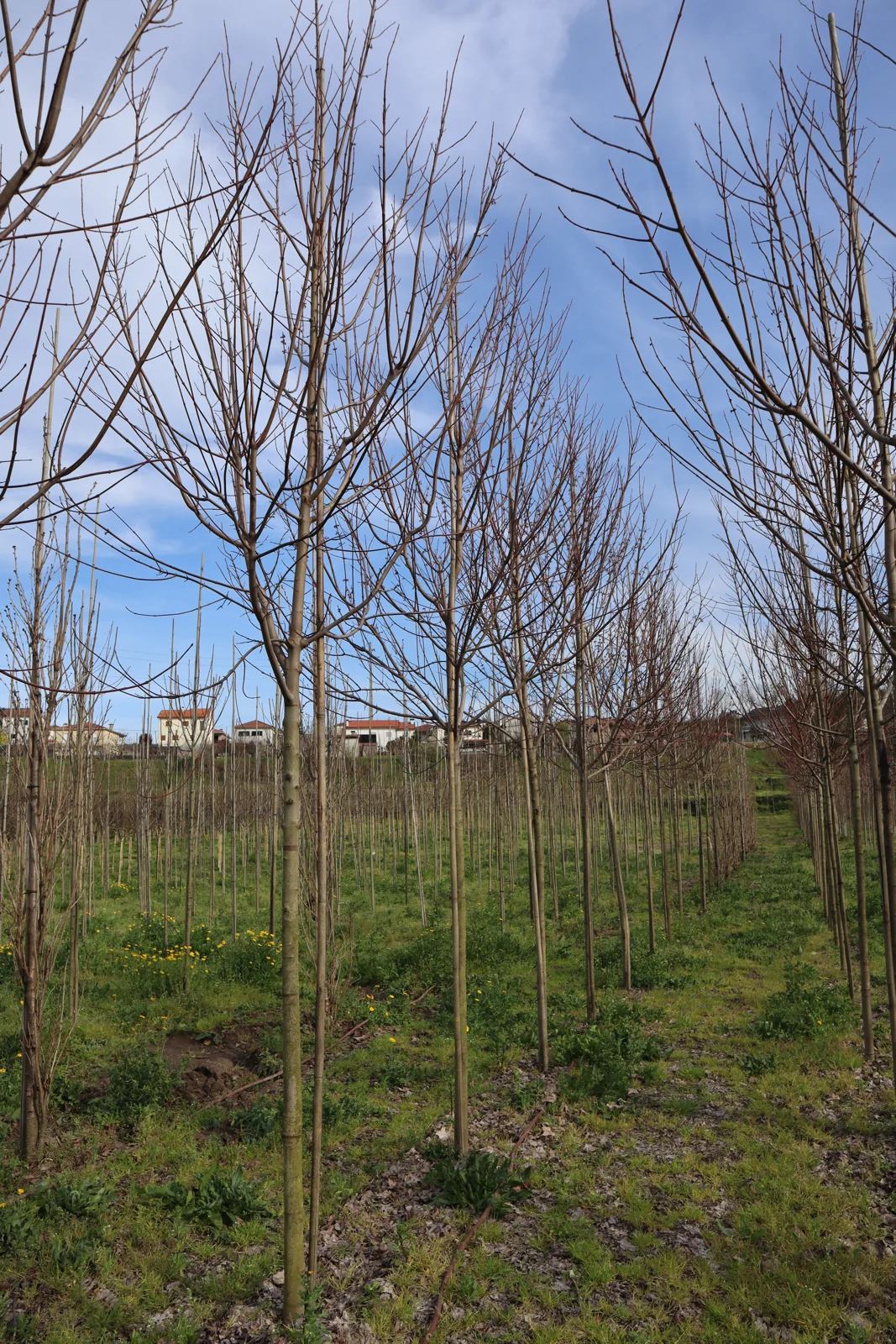
Large-canopy shade tree for cool-temperate Europe
Sycamore Maple · Acer pseudoplatanus
{# A tabela de LOTES (§C, «zoom no lote») foi movida para baixo das características (botânica em cima, lotes em baixo — reunião 24/07). Ver #crm-lotes mais abaixo. #}A vigorous broad-crowned deciduous tree for cool and humid temperate sites, Acer pseudoplatanus delivers fast canopy in parkland, avenues, and wind-exposed coastal projects across most of continental and northern Europe.
About this Species
Acer pseudoplatanus matures at 25 to 35 m with a broad rounded crown spreading 12 to 20 m, reaching useful canopy faster than most large temperate species. The five-lobed leaves are leathery and dark green above, paler beneath, holding cleanly through summer but contributing no autumn colour worth specifying. Mature bark flakes in rectangular plates to reveal warmer inner tones, which gives winter structure value in deciduous schemes where the species carries the months between leaf fall and bud break.
The climate envelope sits firmly in cool and humid temperate Europe. Reliably hardy to about minus 34 °C (USDA zones 4 to 7), with proven performance across the Atlantic seaboard, the British Isles, the Low Countries, southern Scandinavia, and the montane belts of the Alps, Carpathians, Pyrenees, and Balkans where it is native. It does not perform well south of USDA zone 7 or in prolonged summer maxima above 35 °C; specifiers in the Mediterranean basin and the warmer parts of the…
Acer pseudoplatanus matures at 25 to 35 m with a broad rounded crown spreading 12 to 20 m, reaching useful canopy faster than most large temperate species. The five-lobed leaves are leathery and dark green above, paler beneath, holding cleanly through summer but contributing no autumn colour worth specifying. Mature bark flakes in rectangular plates to reveal warmer inner tones, which gives winter structure value in deciduous schemes where the species carries the months between leaf fall and bud break.
The climate envelope sits firmly in cool and humid temperate Europe. Reliably hardy to about minus 34 °C (USDA zones 4 to 7), with proven performance across the Atlantic seaboard, the British Isles, the Low Countries, southern Scandinavia, and the montane belts of the Alps, Carpathians, Pyrenees, and Balkans where it is native. It does not perform well south of USDA zone 7 or in prolonged summer maxima above 35 °C; specifiers in the Mediterranean basin and the warmer parts of the Iberian and Italian peninsulas should look elsewhere. Annual rainfall of at least 700 mm distributed through the season suits it best, though established trees tolerate moderate summer drought once the deep, spreading root system has anchored.
Salt tolerance is high, which has made it a default specification on Atlantic and North Sea coastal projects exposed to salt-laden wind. It tolerates loam, clay, and a wide range of well-drained soils, accepts urban air pollution, and is wind-tolerant at maturity, all of which extend its use into avenues, shelterbelts, and infrastructure planting.
Two concerns now sit on the specification record. Cryptostroma corticale (sooty bark disease) has emerged as a significant pathogen on stressed trees across continental Europe following the dry summers of 2018 to 2022, with the strongest pressure observed in Germany; site selection should favour positions where summer water stress is unlikely. Hypoglycin A in the seeds and seedlings causes atypical equine myopathy where stabled horses can access fallen samaras, so the species is contraindicated near paddocks. In British and Irish woodland contexts it is treated as locally invasive.
Disponibilidade & preço
Interested in Acer pseudoplatanus?
Our team can help you select the perfect specimen for your project. Get in touch for availability and pricing.
- Produção própria
- Exemplares adultos
- Resposta em 1–2 dias
Sem compromisso · orçamento personalizado