

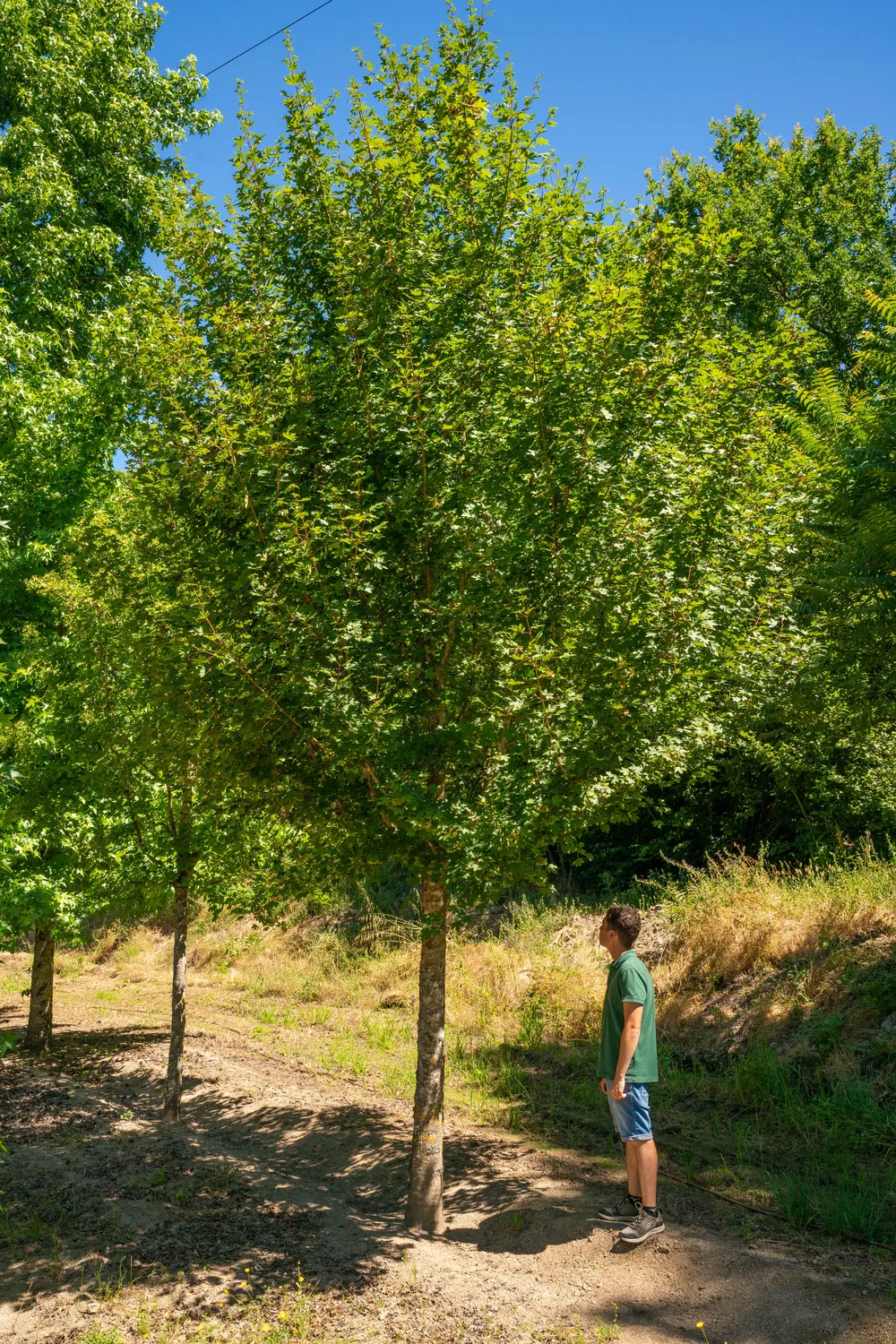
Compact native hardwood for urban planting across temperate Europe
Field Maple · Acer campestre
A widely native European maple of modest mature stature, suited to street pits, parks, and structural hedging from the Mediterranean coast to southern Scandinavia, reliably hardy across most of continental Europe and tolerant of difficult urban soils.
About this Species
Acer campestre is among the most widely distributed maples of the western Palaearctic, native from the Atlas Mountains through Iberia and the British Isles east to the Caucasus and northern Iran, and north to Denmark, southern Sweden, and Belarus. This biogeography sets its specification envelope: reliably winter-hardy across USDA zones 5 to 8, withstanding…
Read more
Show less
Acer campestre is among the most widely distributed maples of the western Palaearctic, native from the Atlas Mountains through Iberia and the British Isles east to the Caucasus and northern Iran, and north to Denmark, southern Sweden, and Belarus. This biogeography sets its specification envelope: reliably winter-hardy across USDA zones 5 to 8, withstanding sustained minima of approximately minus 23 °C (zone 5b) on open sites and short excursions toward minus 28 °C (zone 5a) under snow cover, while equally functional through warm-temperate and Mediterranean summers with prolonged maxima above 35 °C, provided rooting volume is adequate.
It performs from the inland Balkans and the Pannonian basin to coastal Atlantic Europe, with no meaningful northern or eastern limit short of the boreal zone.
In habit it is a compact, low-branched deciduous tree, typically 8 to 12 m at maturity with potential for larger specimens, a rounded crown and a dense canopy carried on finely fissured, often corky bark. Five-lobed leaves with blunt, rounded apices emerge after the yellow-green spring flowers and turn a soft yellow in autumn, occasionally flushing red.
The crown casts dense shade, which limits underplanting but suits the species for screening, alignment, and parkland use where structural mass matters.
Site tolerance is broad, which is the primary reason it is specified for difficult urban work. It accepts neutral to alkaline substrates, tolerates heavy clay, compaction, periodic drought, and air pollution, and responds without distress to severe pruning, including formal hedging.
It prefers full sun but accepts partial shade, particularly in its early years. Powdery mildew and verticillium wilt are reported but rarely consequential in well-aerated sites.
As an insect-pollinated native across most of Europe, it contributes meaningfully to local pollinator and bird communities, an increasingly load-bearing consideration under the EU's biodiversity framework.



Advice on this species
Want to know more about Acer campestre?
Tell us about your project and we'll advise you on this species — where it thrives, which size makes sense, and what to expect once planted.
- Produção própria
- Exemplares adultos
- Resposta em 1–2 dias
Sem compromisso · orçamento personalizado