

Shade and silver foliage for a warm Portuguese garden
Silver Lime · Tilia tomentosa
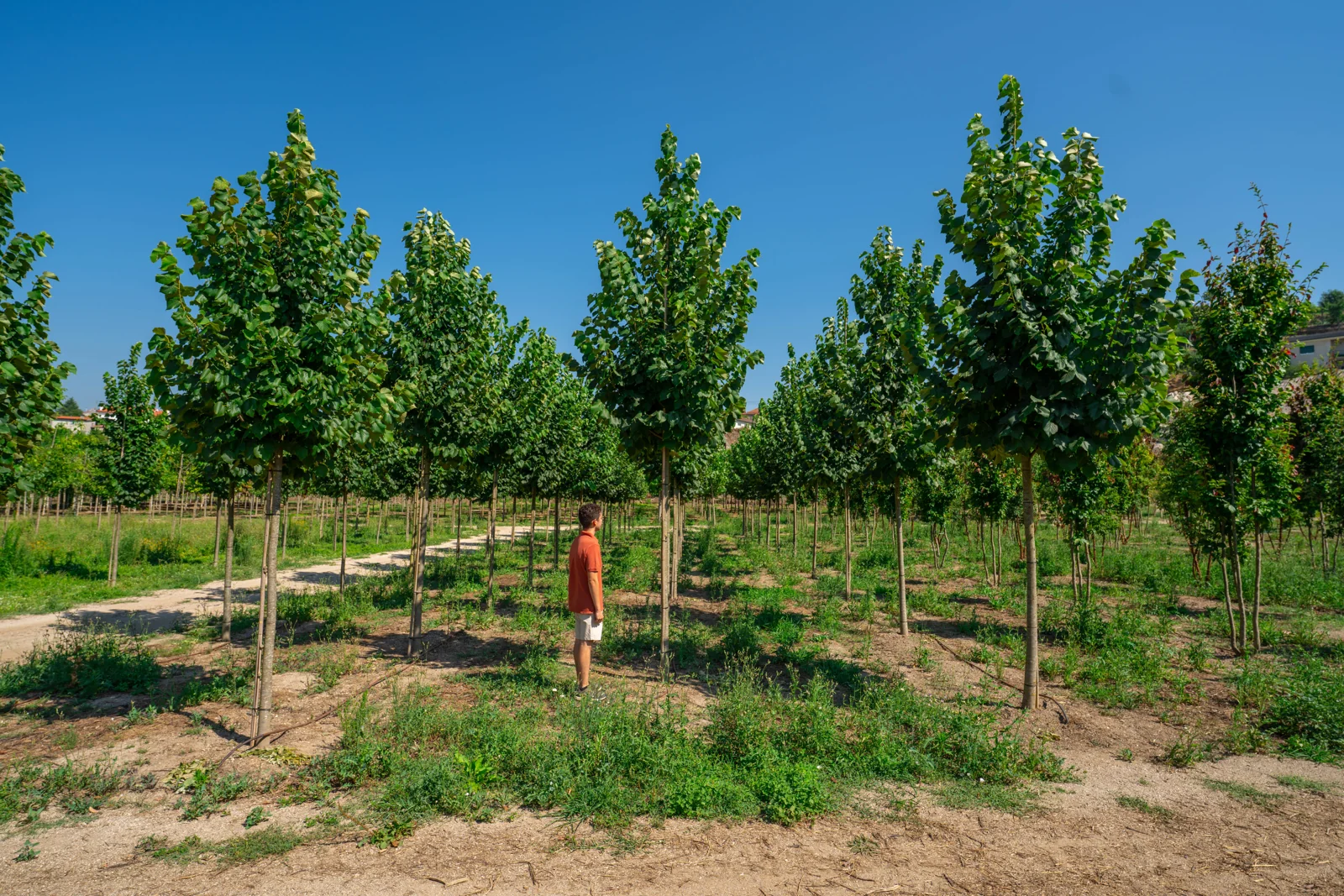
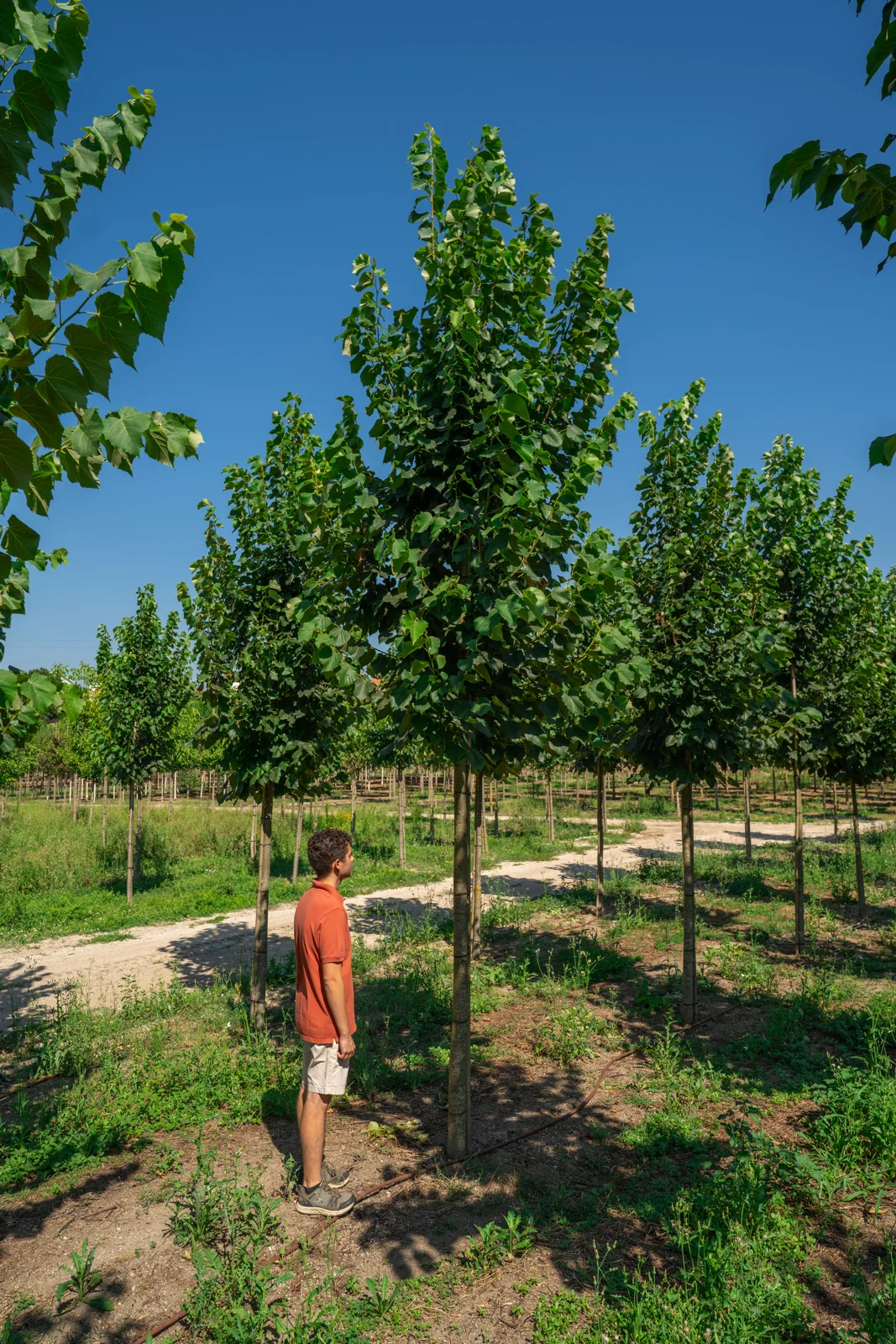
Broadly conical when young and rounding with age, it carries a dense crown of glossy leaves whose silvery undersides flash in summer heat. Specifiers reach for it where avenues and squares need a resilient, shade-casting framework tree.
- Dense rounded crown casts deep, even summer shade
- Silver-backed leaves shimmer and pale in the lightest breeze
- Fragrant cream flowers in high summer draw bees in numbers
About this Species
The silver lime (tília-prateada) builds a dense, broadly conical crown in youth that rounds out at maturity, reaching roughly 15 to 25 m in height and 10 to 15 m across. It is grown as a single-stemmed standard with erect branching, which suits it to street alignments (arruamentos), public squares (praças), and large garden settings where a structural shade…
Read more
Show less
The silver lime (tília-prateada) builds a dense, broadly conical crown in youth that rounds out at maturity, reaching roughly 15 to 25 m in height and 10 to 15 m across. It is grown as a single-stemmed standard with erect branching, which suits it to street alignments (arruamentos), public squares (praças), and large garden settings where a structural shade tree is required. Growth is medium-paced, so canopy closure along an alignment is achieved at a measured rate rather than within a few seasons.
Its defining performance trait is heat resilience. In summer heat and drought the tree angles its leaves so the felted silvery undersides face outward, reflecting solar radiation, lowering leaf temperature, and reducing water loss through transpiration. This makes it well suited to reflected heat from pavement in urban Lisbon and to the hot, dry summers of the interior Alentejo, where deep planting and irrigation through the first summers support establishment. Drought tolerance is moderate to good once the root system is developed, but on the driest calcareous and sandy sites of the coastal Algarve a single establishment irrigation cycle remains advisable.
The species accepts loamy, clay, and well-drained soils across a wide pH range, including the limestone-derived soils common around Lisbon, and tolerates urban air and a moderate degree of salt. It performs across the milder Atlantic conditions of the Minho and Douro as readily as the warmer south, full sun being its consistent requirement. Hardiness is not a constraint anywhere in Portugal.
Maintenance is straightforward. Formative pruning develops a strong structure, after which the tree needs only periodic crown lifting over paved areas, and basal sprouts should be removed as they appear. It is notably resistant to aphids relative to other limes, which reduces the honeydew and sooty mould that compromise paved surfaces beneath susceptible street trees. Fragrant cream flowers in July and August draw bees, and the foliage turns pale yellow before leaf fall.



Advice on this species
Want to know more about Tilia tomentosa?
Tell us about your project and we'll advise you on this species — where it thrives, which size makes sense, and what to expect once planted.
- Produção própria
- Exemplares adultos
- Resposta em 1–2 dias
Sem compromisso · orçamento personalizado