

An upright flowering tree for narrow garden spaces
Callery Pear ‘Chanticleer’ · Pyrus calleryana ‘Chanticleer’
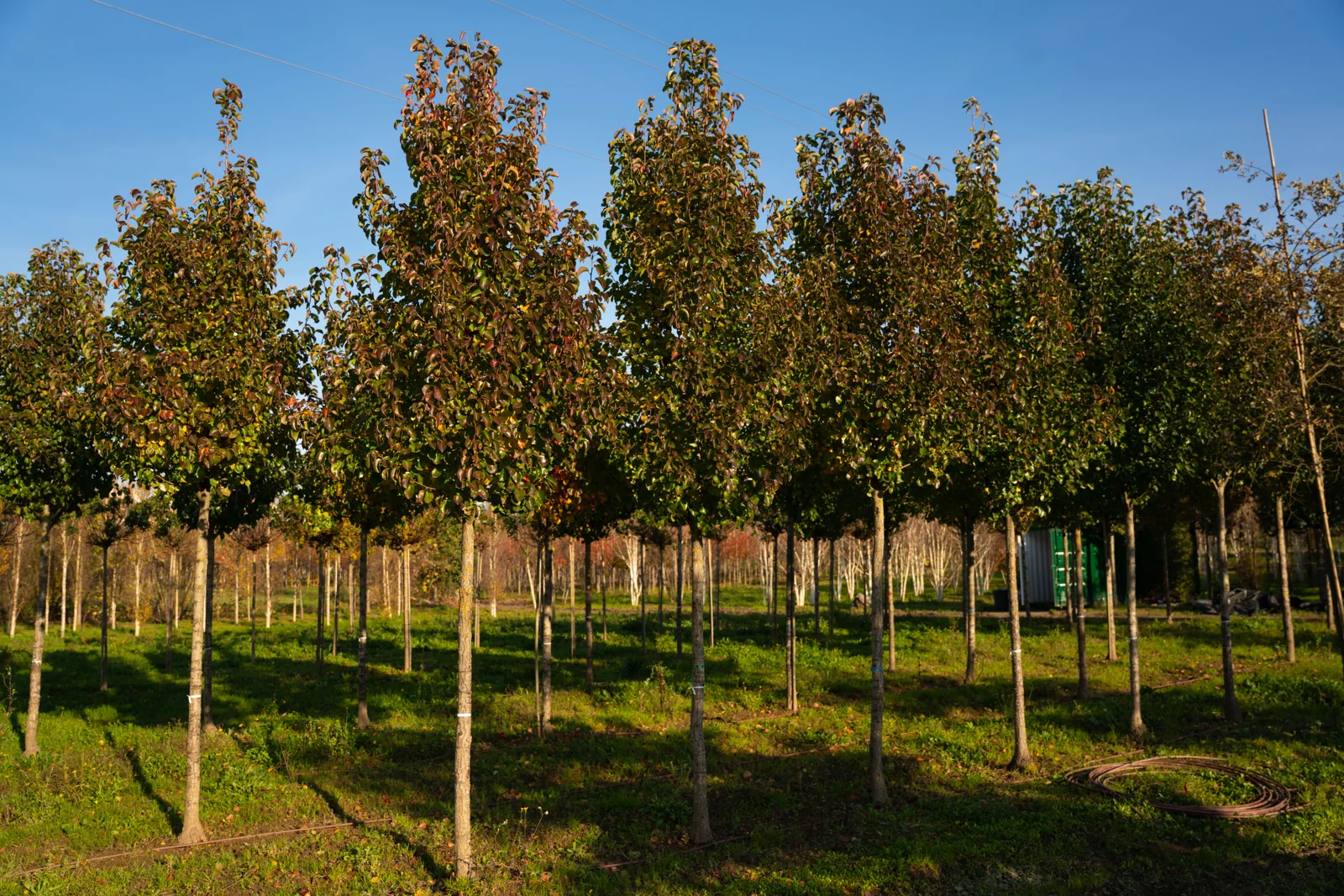
Specifiers needing vertical shade where lateral space is tight will find a tree built for the task: a narrow, upright pear that lines streets and squares cleanly, flowers white in spring, and colours red and orange before leaf fall.
- Narrow upright crown gives height without claiming lateral space
- Abundant white spring blossom draws bees and pollinators
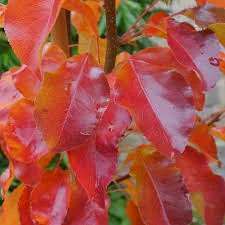
- Glossy foliage turns red, purple, and orange through autumn
Key Facts
About this Cultivar
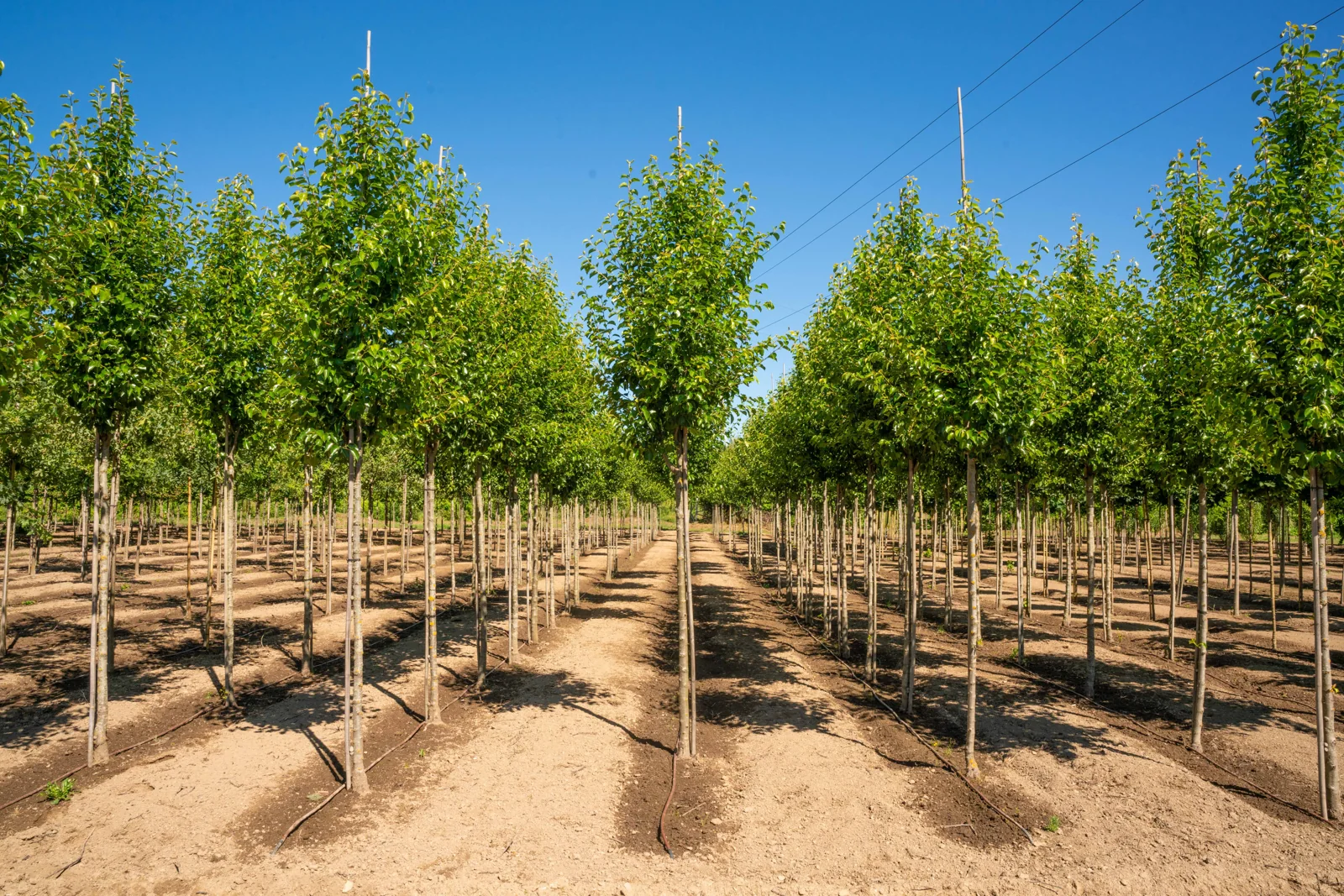
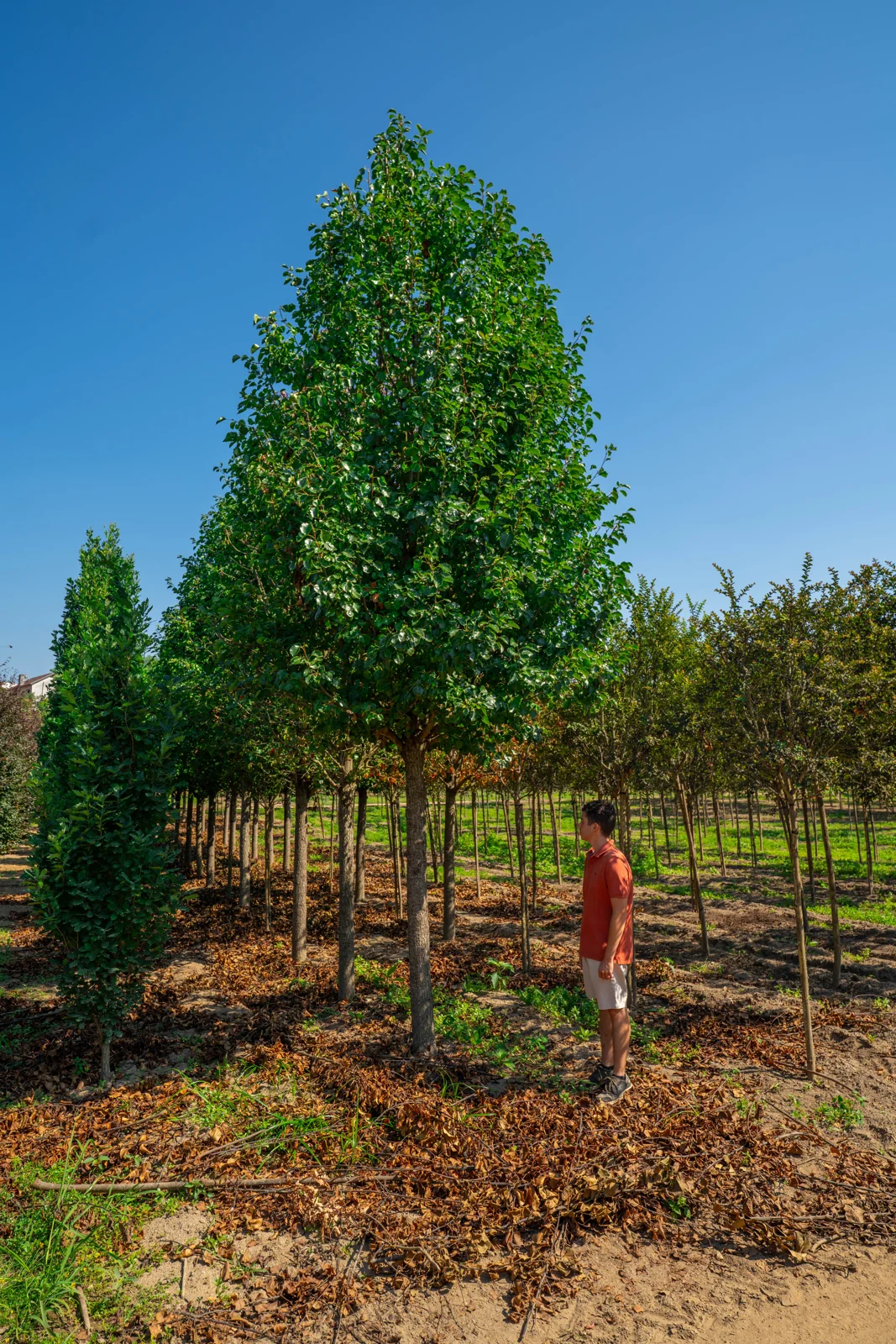
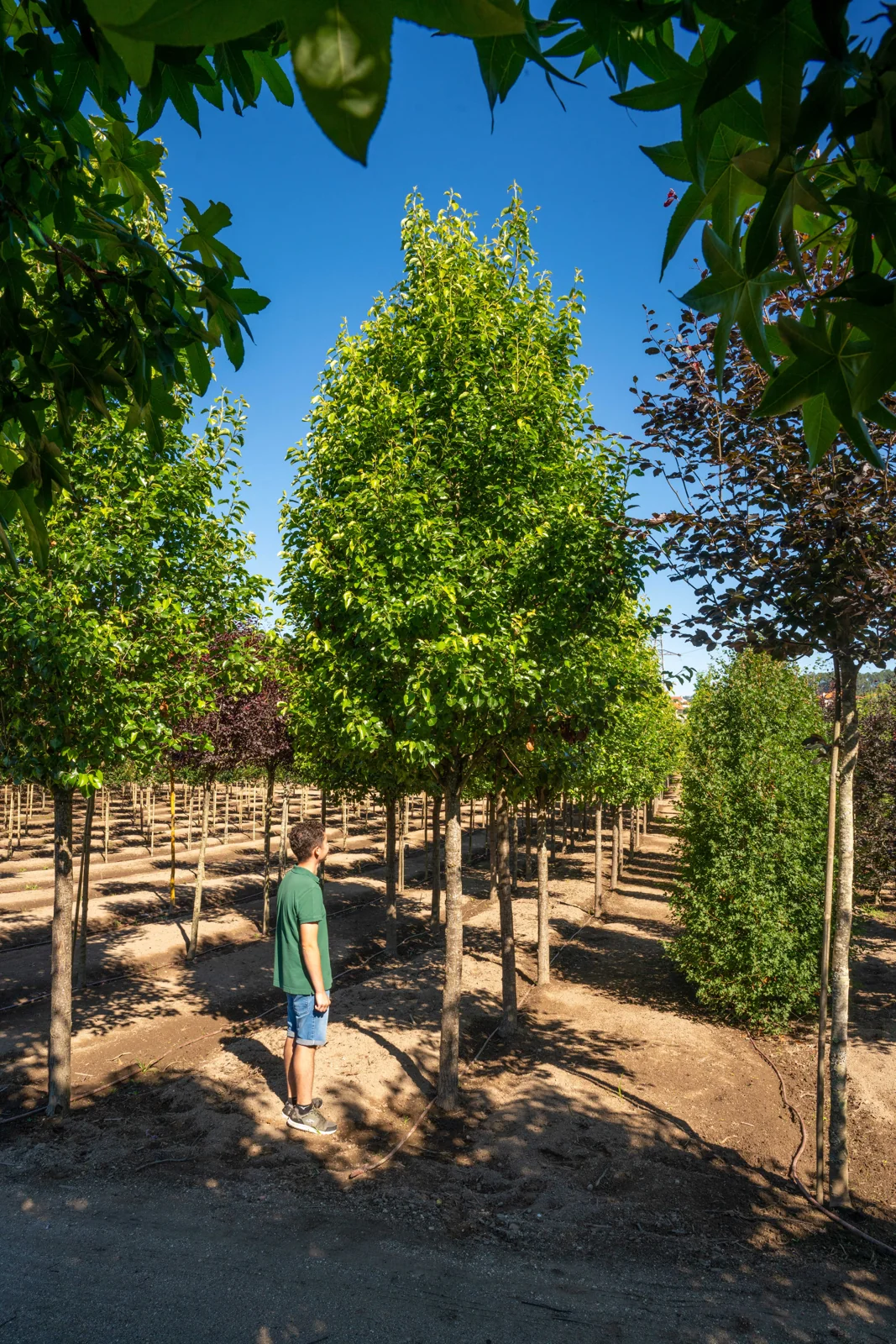
Where a scheme needs vertical shade in a confined footprint, this cultivar answers with a narrow, upright crown that holds its line as it matures. It carries a pyramidal to columnar habit on a single clean stem, reaching roughly 10 to 12 metres in height and only 4 to 6 metres in spread in Portuguese cultivation. That proportion suits street alignments…
Read more
Show less
Where a scheme needs vertical shade in a confined footprint, this cultivar answers with a narrow, upright crown that holds its line as it matures. It carries a pyramidal to columnar habit on a single clean stem, reaching roughly 10 to 12 metres in height and only 4 to 6 metres in spread in Portuguese cultivation. That proportion suits street alignments (arruamentos), narrow medians, and the edges of a public square (praça) where a plane (plátano) or lime (tília) would overhang the available space.
The ornamental sequence is reliable. Dense corymbs of small white flowers open in early spring as the glossy dark-green foliage unfolds, drawing pollinators, and the leaves turn red, purple, and orange in autumn, extending the display into late season. Fruit is small and inconspicuous, so litter on paving and parking surfaces stays low. Growth is moderate to fast, which brings the crown to a working canopy within a few seasons of planting.
Field-grown in Amarante, under roughly 950 mm of annual rainfall, mild winters, and dry summers, the cultivar establishes readily across much of Portugal. It tolerates urban pollution, reflected heat, and the limestone-derived soils of Greater Lisbon, and grows on acid, alkaline, sandy, and clay ground provided drainage is sound. In the coastal Algarve it carries short drought once established; in the interior Alentejo, where summers run hot and dry, deep planting and a single establishment irrigation cycle through the first summers are advisable.
In the humid Minho and Douro the cultivar accepts the higher rainfall on free-draining sites, where its resistance to atmospheric pollution and tolerance of compacted ground make it a dependable framework tree. Maintenance is modest: formative pruning in the early years to confirm a sound central leader and a crown lift to clear traffic are usually all that is required. The combination of narrow form, seasonal interest, and broad soil tolerance accounts for its wide use as a structural street tree across European cities.
Advice on this species
Want to know more about Pyrus calleryana 'Chanticleer'?
Tell us about your project and we'll advise you on this species — where it thrives, which size makes sense, and what to expect once planted.
- Produção própria
- Exemplares adultos
- Resposta em 1–2 dias
Sem compromisso · orçamento personalizado