

A refined native evergreen for screens and formal structure
Portuguese Laurel ‘Angustifolia’ · Prunus lusitanica ‘Angustifolia’
Narrow-leaved and densely upright, this evergreen forms a refined formal screen or a clipped feature specimen, an Iberian-native alternative to imported hedging where a project needs year-round structure on free-draining ground.
- Glossy dark evergreen foliage held densely through every season
- Narrower, finer leaves than the ordinary Portuguese laurel
- Naturally upright crown that clips into a formal hedge or screen
About this Cultivar
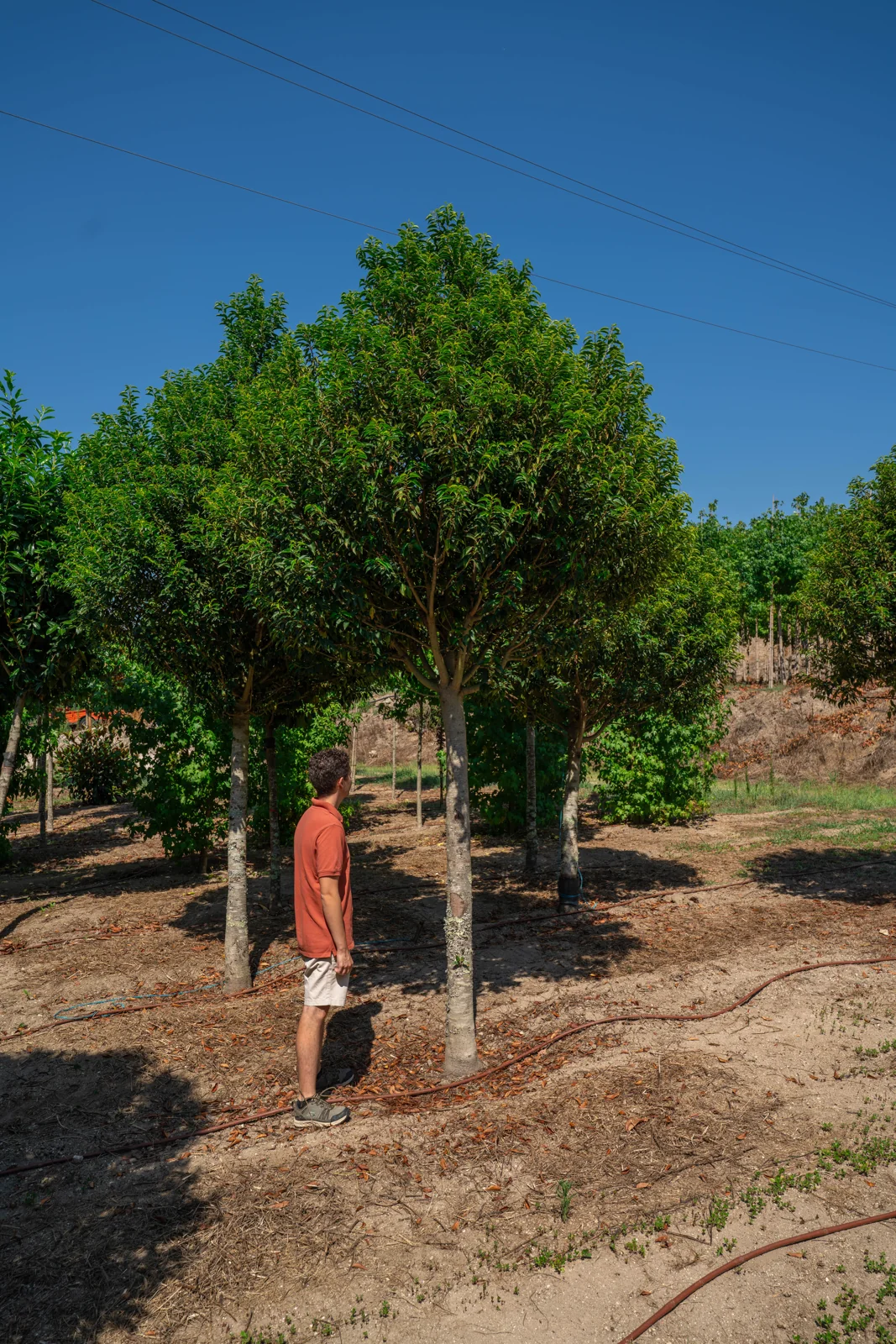
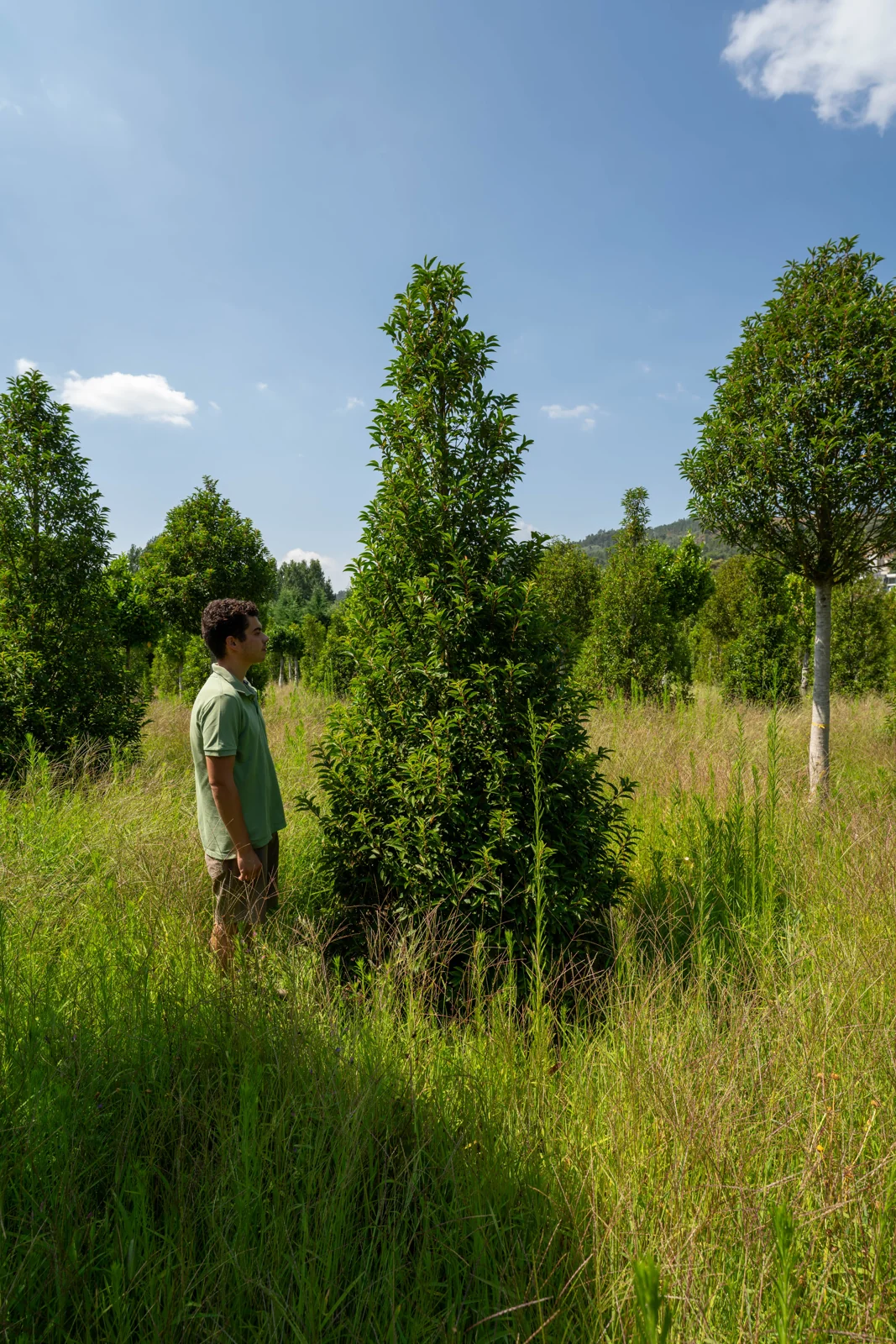
Narrow, glossy dark-green leaves and a dense, upright crown give this evergreen a more refined outline than the species type, whose foliage is broader. Reaching 4 to 6 m tall and 2 to 3 m wide at maturity, it holds a well-structured, columnar-to-rounded form that suits formal screening, high boundaries, and clipped enclosure within a scheme. For the…
Read more
Show less
Narrow, glossy dark-green leaves and a dense, upright crown give this evergreen a more refined outline than the species type, whose foliage is broader. Reaching 4 to 6 m tall and 2 to 3 m wide at maturity, it holds a well-structured, columnar-to-rounded form that suits formal screening, high boundaries, and clipped enclosure within a scheme.
For the international specifier working in Portugal, this is a domestic alternative to Prunus laurocerasus and to imported screening stock: an Iberian native (azereiro) grown to maturity at the Diaplant fields in Amarante, where roughly 950 mm of annual rainfall, mild winters, and dry summers approximate the conditions of much of the country.
In spring and early summer it carries erect racemes of small, fragrant white flowers that draw bees and other pollinators, followed by oval fruit that ripens from red to black and is taken readily by birds. The persistent foliage holds colour through winter, so the screen reads as solid structure (estrutura) across the year rather than thinning in the cold months.
Performance across Portuguese zones is broad. It establishes well in the humid Minho and Douro and through Greater Lisbon and Greater Porto on any free-draining soil, in full sun or partial shade, and tolerates urban pollution and reflected pavement heat. Drought tolerance is moderate rather than absolute: in the hot interior Alentejo and on the coastal Algarve, a single establishment irrigation cycle and free-draining ground carry it through the first dry summers, after which water demand falls.
Maintenance is low. Moderate growth and a strong response to pruning let crews shape it into compact, even screens or hold a feature specimen to a set height, and it is hardier than the cherry laurel, withstanding the frosts of inland sites without foliage damage on well-drained ground.
Advice on this species
Want to know more about Prunus lusitanica 'Angustifolia'?
Tell us about your project and we'll advise you on this species — where it thrives, which size makes sense, and what to expect once planted.
- Produção própria
- Exemplares adultos
- Resposta em 1–2 dias
Sem compromisso · orçamento personalizado