

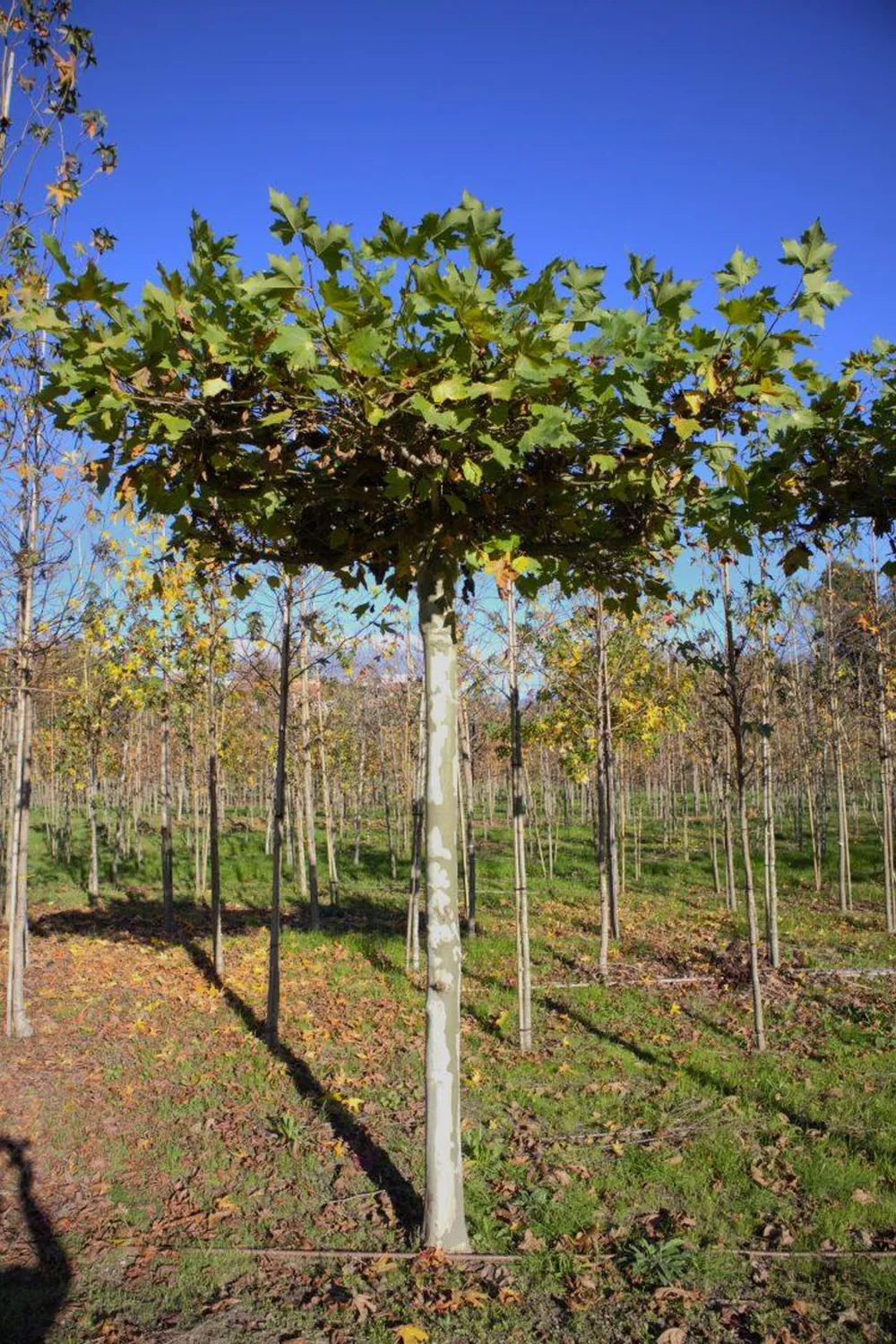
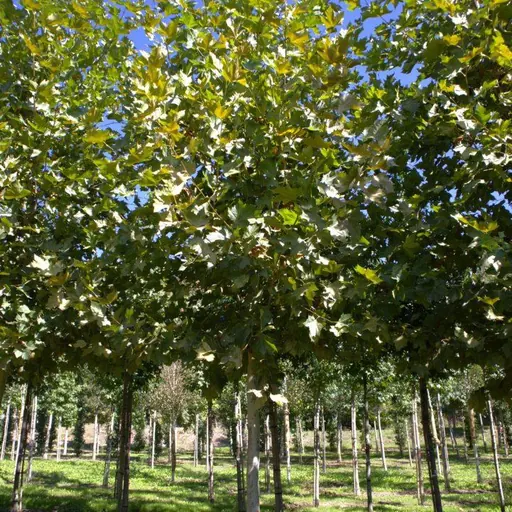
Cooling summer shade and pale dappled bark
London Plane · Platanus × hispanica
Few deciduous trees match its scale for civic shade: a fast-growing framework specimen that fills an avenue or praça with a tall, densely leafy crown, tolerates compacted urban soils and reflected heat, and reveals mottled exfoliating bark once leafless.
- Deep, even summer shade over a terrace or drive
- Pale flaking bark and patterned limbs for winter interest
- Heat-tolerant and at ease in salt air and poor soil
About this Species
This is a large deciduous shade tree, reaching 20 to 35 m in height and 15 to 25 m across at maturity, pyramidal when young and opening into a high, spreading crown with age. Its scale and fast growth make it a framework tree for avenue planting (arruamento), public squares (praça), and parking shade, where a tall canopy is wanted within one to two decades…
Read more
Show less
This is a large deciduous shade tree, reaching 20 to 35 m in height and 15 to 25 m across at maturity, pyramidal when young and opening into a high, spreading crown with age. Its scale and fast growth make it a framework tree for avenue planting (arruamento), public squares (praça), and parking shade, where a tall canopy is wanted within one to two decades rather than a generation. The pale outer bark exfoliates in irregular plates to expose a creamy olive inner layer, giving the bare winter trunk a mottled patina that carries the tree through the leafless months; autumn foliage turns a muted yellow-brown rather than a strong colour.
The species is well suited to much of Portugal. It tolerates summer heat, reflected pavement warmth, and saline air, which supports its use in Greater Lisbon and on the estuary, and it accepts heavy clay as readily as loam. Drought tolerance is moderate rather than absolute: across the warm interior and the Algarve a single establishment irrigation cycle through the first summers is advisable, after which an established specimen carries the dry season on a deep, vigorous root system. In the humid Minho and Douro it grows strongly, though fungal pressure rises in wetter air.
The principal disease concern in southern Europe is canker stain (Ceratocystis platani), which can be fatal and spreads through pruning wounds and fused roots along lines, so spacing and tool hygiene in avenue planting reduce risk; anthracnose and massaria branch loss also occur. Plan for substantial leaf, twig, and fruit-ball litter on paved areas, and site the tree in grass or planted beds rather than narrow pits, since the flared trunk and surface roots lift paving.
Given room, it offers a long, dependable useful life as a civic specimen, and behaves well under formative pruning and pollarding where space is constrained.



Advice on this species
Want to know more about Platanus × hispanica?
Tell us about your project and we'll advise you on this species — where it thrives, which size makes sense, and what to expect once planted.
- Produção própria
- Exemplares adultos
- Resposta em 1–2 dias
Sem compromisso · orçamento personalizado