

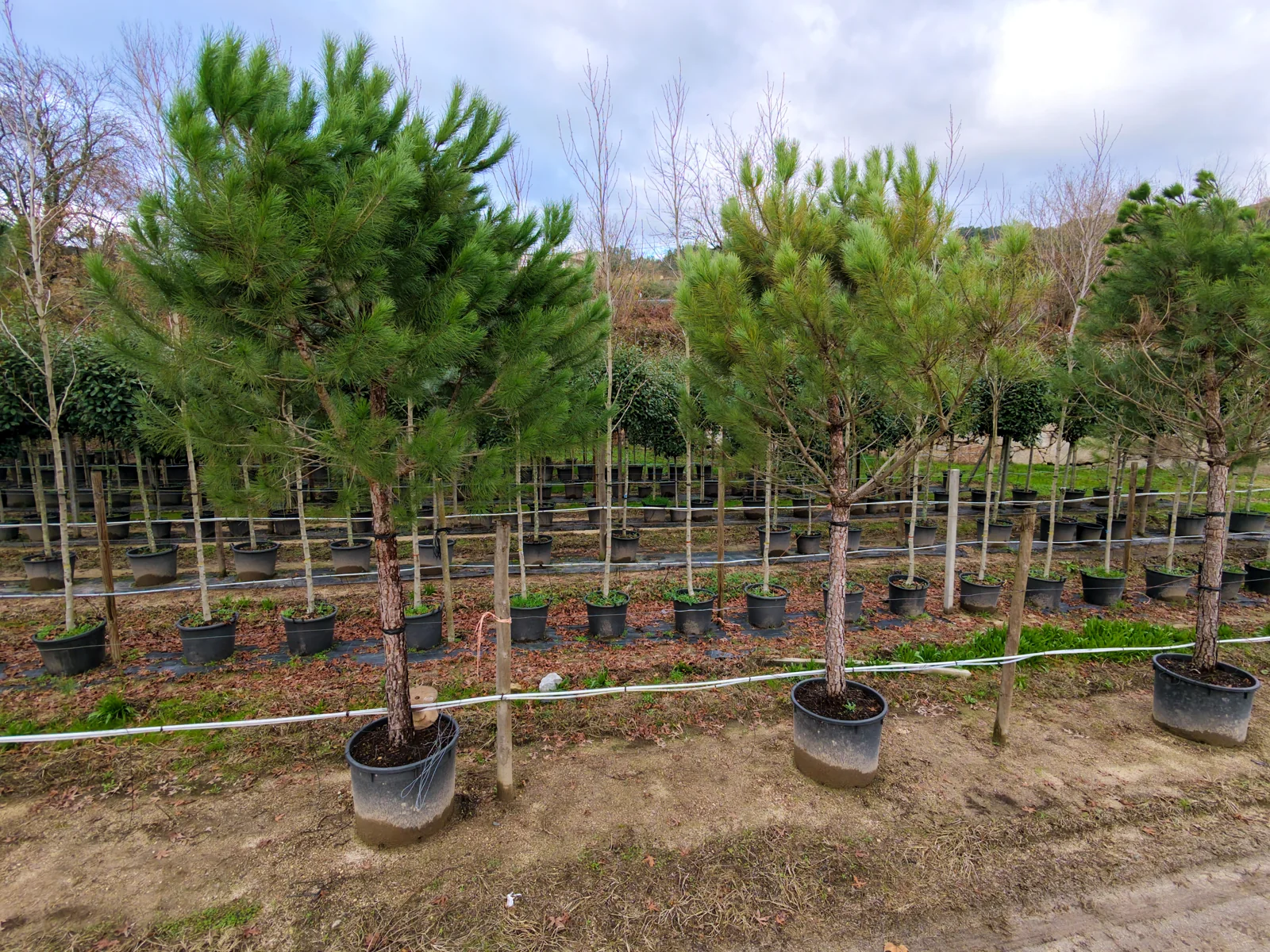
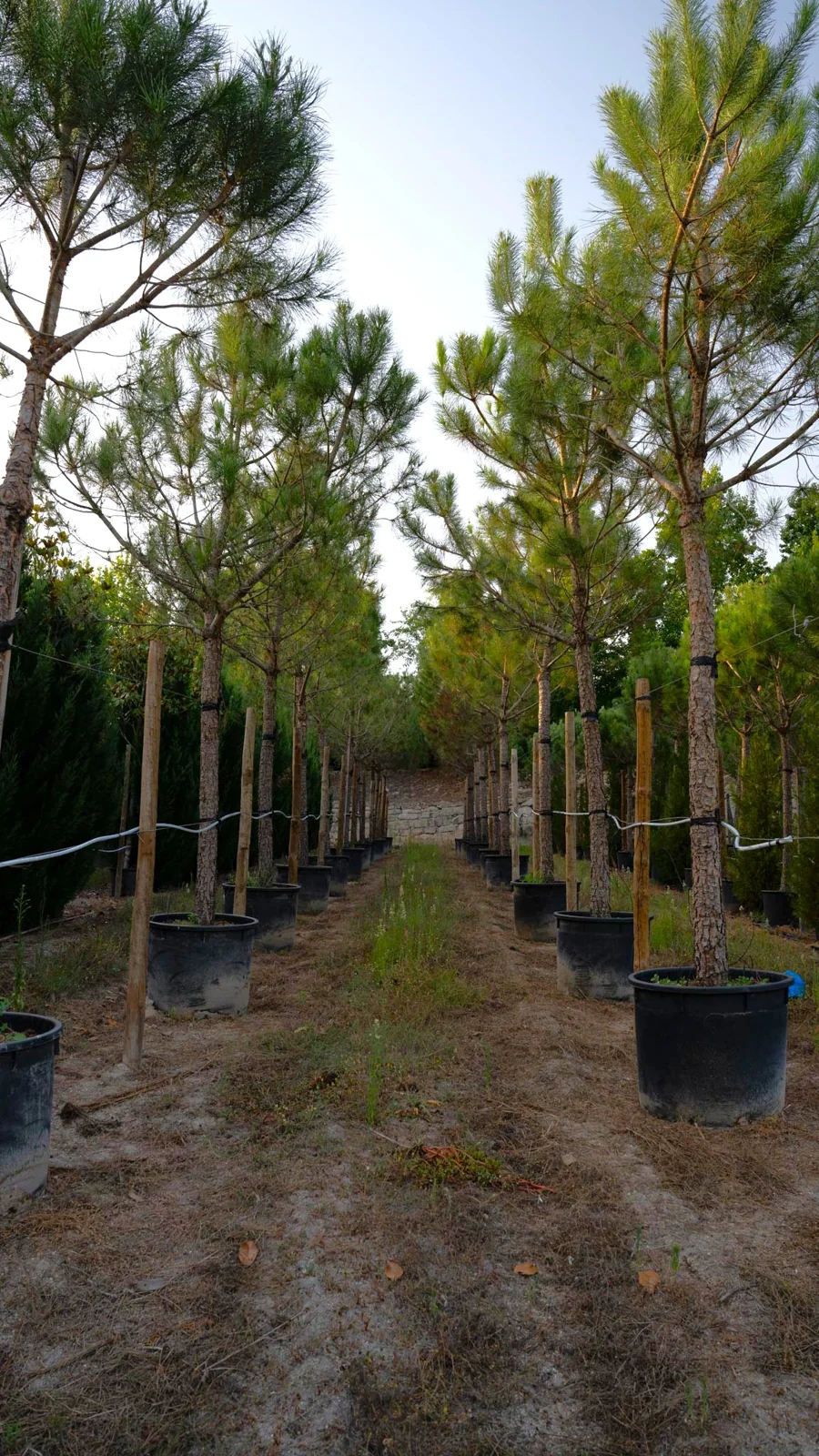
Umbrella crown for the wide horizon
Stone Pine · Pinus pinea
A specifier-grade evergreen for Portuguese projects where mature silhouette is the design point: street alignment, public square, coastal scheme, garden specimen. Native, drought-tolerant, salt-tolerant, and operationally familiar to every paisagista and municipal contact.
- Iconic umbrella silhouette of the Portuguese coast at maturity
- Deep roots give reliable drought tolerance after the third summer
- Tolerates salt wind, sandy soils, and full coastal exposure
About this Species
Pinus pinea (pinheiro-manso) is among the most recognisable trees in the Portuguese landscape, reaching 12 to 20 m with an eventual flat, spreading crown often wider than tall. In youth it carries a dense globose form on a short trunk; the umbrella silhouette develops from the third decade as lower branches are shed and the upper scaffold radiates outward.…
Read more
Show less
Pinus pinea (pinheiro-manso) is among the most recognisable trees in the Portuguese landscape, reaching 12 to 20 m with an eventual flat, spreading crown often wider than tall. In youth it carries a dense globose form on a short trunk; the umbrella silhouette develops from the third decade as lower branches are shed and the upper scaffold radiates outward. It functions as a single-stem framework tree or solitary specimen where the mature outline can be read against the sky.
Drought tolerance is reliable once established and is supported by a deep anchoring root system that exploits the full soil profile. The species performs across coastal Algarve schemes without supplementary irrigation after the third summer, and tolerates the prolonged summer drought of the interior Alentejo provided the planting pit reaches free-draining subsoil. In the humid Minho and Douro, growth is faster but the same drainage requirement applies, since waterlogging causes root failure.
Soils should be well drained, sandy to loam, with a preference for slightly acidic pH; it accepts the limestone-derived substrates of Greater Lisbon where the planting pit is deep. Salt tolerance is high, suiting estuarine and coastal exposure. The eventual crown spread of 8 to 15 m precludes specification close to facades or under overhead services, and cone fall in autumn and winter is heavy enough to require planning over paved surfaces and parking bays.
Two pressures merit attention on Portuguese specifications. The invasive Leptoglossus occidentalis (percevejo americano-do-pinheiro) has materially reduced pine-nut yield across the country since the late 1990s; the impact is commercial rather than structural, and ornamental specimens remain healthy. Pestalotiopsis pini, recorded on Portuguese stone pines from 2020, causes shoot blight on stressed trees and reinforces the case for free-draining ground and minimal mechanical injury during establishment.
Native to the Iberian peninsula and planted along Portuguese roads, in monastic precincts, and on coastal dunes for centuries, it consolidates sandy substrates through deep rooting. It functions at the scale of a praça or a Mediterranean garden axis, and substitutes for plane (Platanus x acerifolia) on schemes that require evergreen presence and lower water demand.



Advice on this species
Want to know more about Pinus pinea?
Tell us about your project and we'll advise you on this species — where it thrives, which size makes sense, and what to expect once planted.
- Produção própria
- Exemplares adultos
- Resposta em 1–2 dias
Sem compromisso · orçamento personalizado