


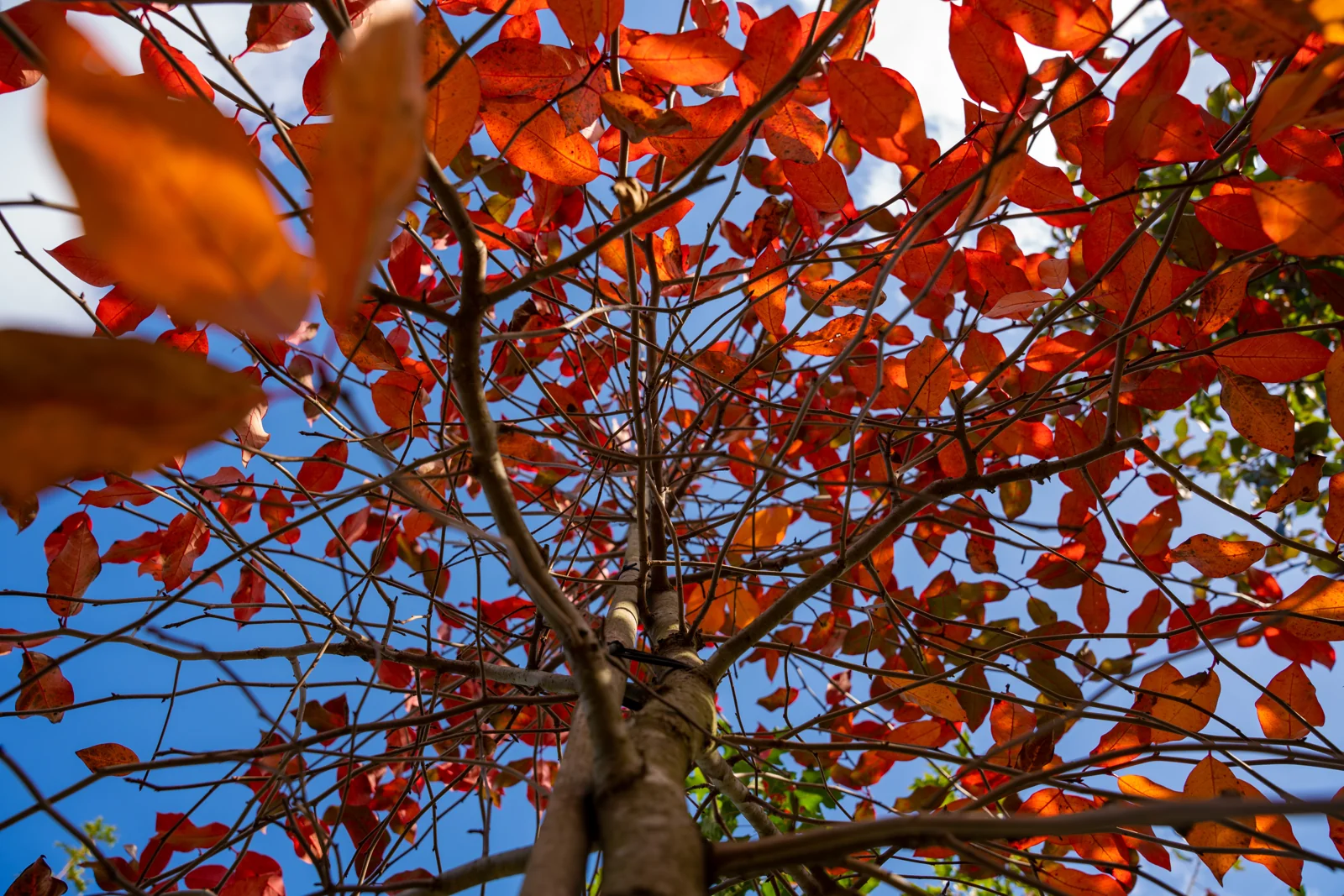

Deciduous fire in autumn, sculptural bark through winter
Black Tupelo · Nyssa sylvatica
Slow-growing and deciduous, this is the tree to specify where reliable autumn colour is required on acidic, moist ground. Its conical form, disease resistance, and tolerance of waterlogged soils make it strong for riparian schemes across northern Portugal.
- Autumn colour in scarlet and amber, holding for several weeks
- Deeply furrowed bark gives strong winter structure
- Thrives on the acidic soils of northern Portugal and the Sintra corridor
About this Species
Nyssa sylvatica develops a conical to upright crown, reaching 10 to 20 m in height with a spread of 6 to 10 m at maturity. Growth is slow, typically 3 to 4 m in the first ten years, but the species is among the longest-lived deciduous trees in cultivation, with documented individuals exceeding 650 years. The trunk carries deeply furrowed, near-black bark…
Read more
Show less
Nyssa sylvatica develops a conical to upright crown, reaching 10 to 20 m in height with a spread of 6 to 10 m at maturity. Growth is slow, typically 3 to 4 m in the first ten years, but the species is among the longest-lived deciduous trees in cultivation, with documented individuals exceeding 650 years. The trunk carries deeply furrowed, near-black bark that develops a distinctive blocky pattern with age, providing strong winter structure. Branches extend at right angles to the central leader, creating a layered silhouette that works as a focal specimen or secondary canopy element in mixed plantings.
The defining ornamental attribute is autumn foliage. Leaves turn through yellow, orange, scarlet, and purple, often displaying several colours simultaneously on a single crown. Colour intensity is strongest on trees grown in full sun on acidic soils, conditions that align directly with the granite and schist substrates of the Minho and Douro valleys. Field-grown at Amarante, where annual rainfall approaches 950 mm and soils are naturally acidic, Diaplant trees develop the dense root systems that support reliable establishment on project sites. This domestic growing context addresses the species' principal specification risk: Nyssa sylvatica forms a deep taproot that makes late transplanting difficult, so sourcing field-grown specimens with a properly formed torrao is critical.
Soil pH is the primary limiting factor for Portuguese projects. The species requires acidic to neutral ground (pH below 7.0) and is intolerant of calcareous substrates. This rules out most schemes in urban Lisbon, where limestone-derived soils dominate, and coastal Algarve sites on calcareous sand. In the humid north, from Greater Porto through the Minho, the species performs reliably without supplementary irrigation once established. In transitional zones with mildly acidic soils, a single establishment irrigation cycle through the first dry summer is sufficient.
Maintenance demands are low. The species shows strong resistance to both pests and fungal disease in Atlantic climates. Formative pruning to establish a clear trunk is advisable in the first years; thereafter, minimal intervention is required. Leaf litter is moderate and the small drupes, produced only on female trees, attract birds but do not create significant debris on paved surfaces. Root behaviour is non-aggressive, with the deep taproot posing no documented risk to pavements or underground services.
As a specification reference, Nyssa sylvatica fills the role of a long-lived autumn-colour tree on sites where the more commonly specified Liquidambar styraciflua would also perform, but where slower growth and a narrower crown are preferred. For northern Portuguese projects on acidic ground, it is a viable alternative to Acer rubrum, which faces greater availability constraints from European nursery sources.



Advice on this species
Want to know more about Nyssa sylvatica?
Tell us about your project and we'll advise you on this species — where it thrives, which size makes sense, and what to expect once planted.
- Produção própria
- Exemplares adultos
- Resposta em 1–2 dias
Sem compromisso · orçamento personalizado