

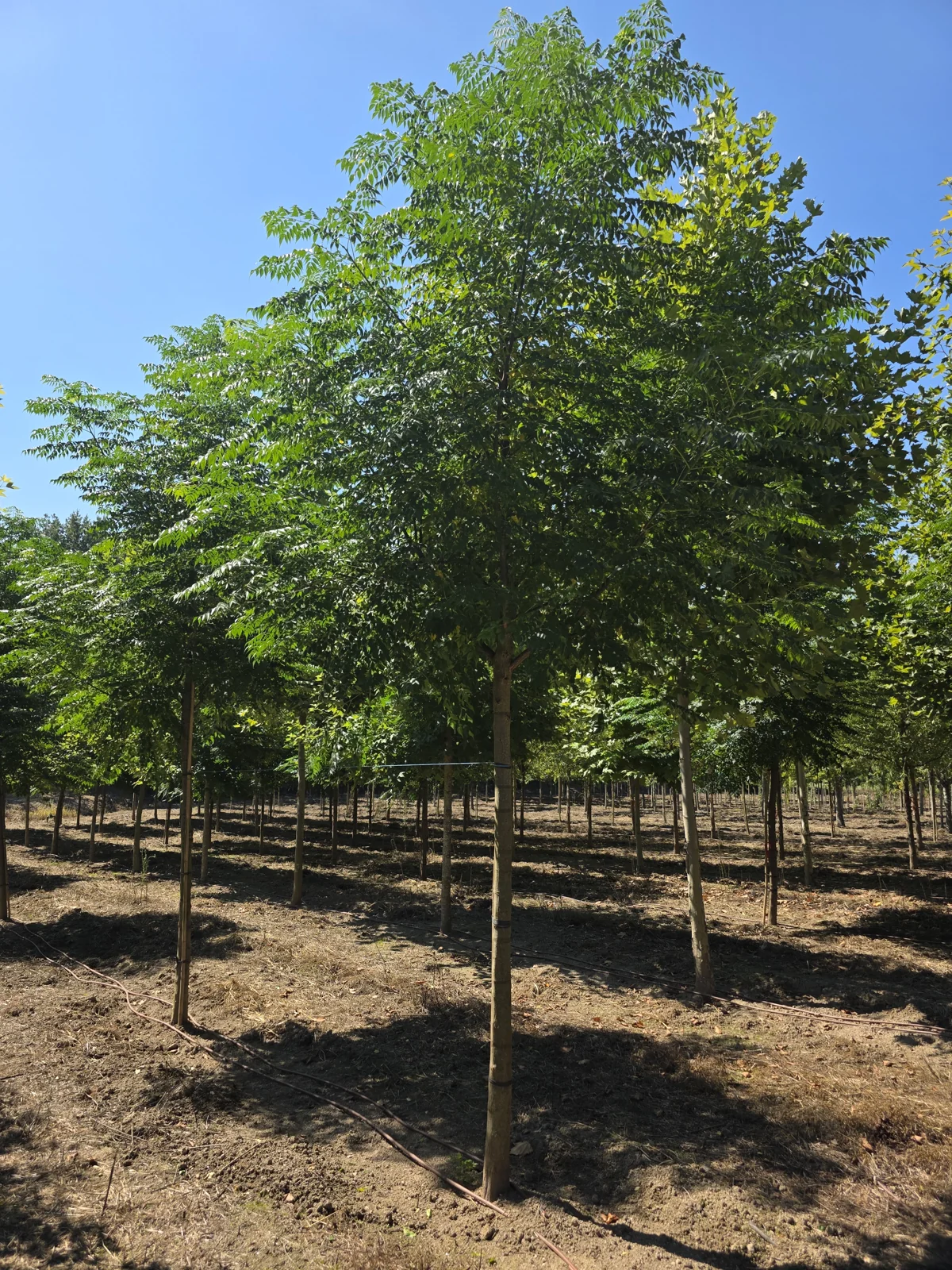
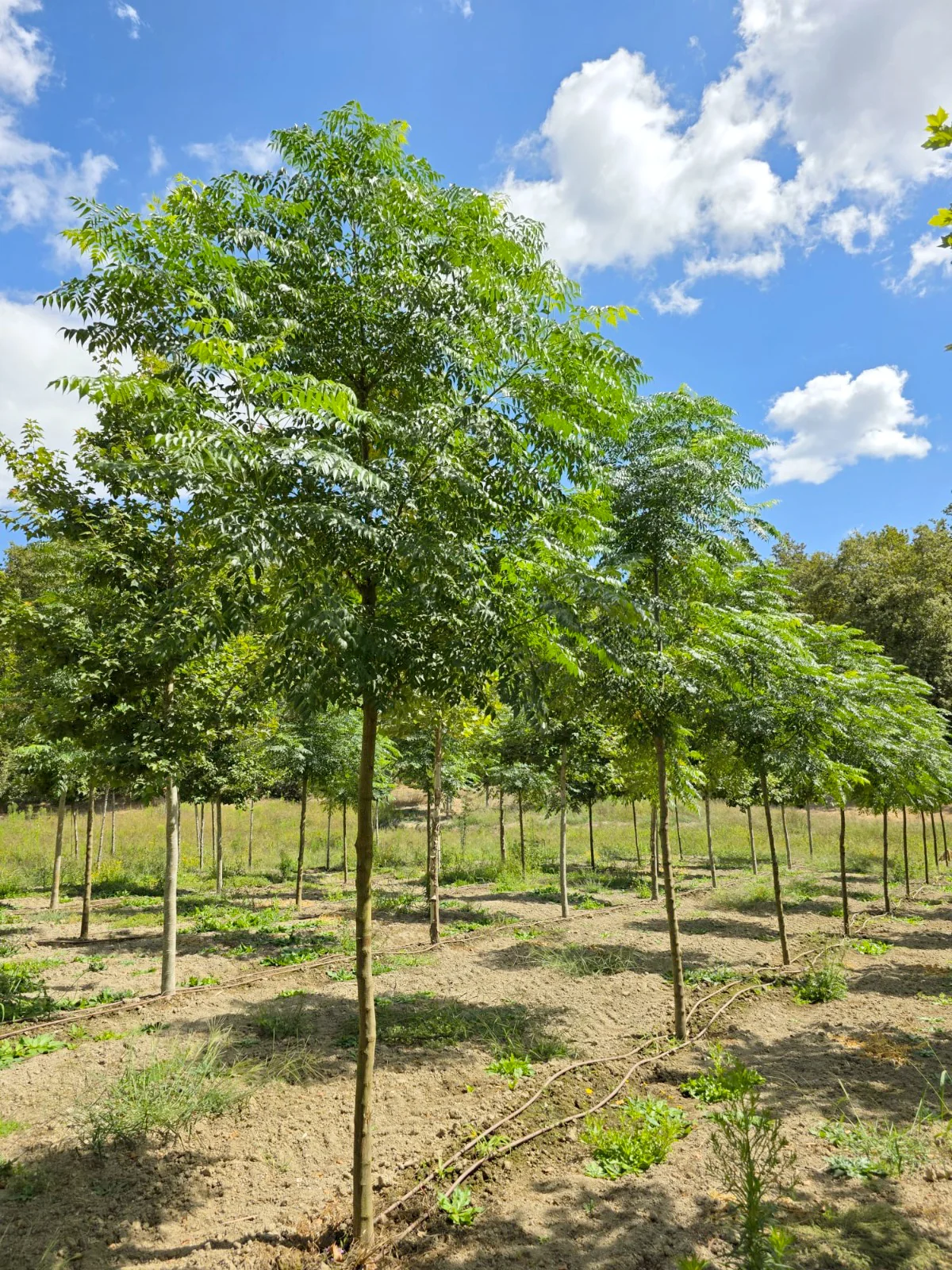
Fragrant shade from a fast, graceful canopy
Chinaberry Tree · Melia azedarach
Fast-growing and deciduous, this tree delivers rapid canopy closure and summer shade across warm, dry Portuguese project sites. Its tolerance of heat, drought, and varied soils makes it a practical framework tree for urban alignments (arruamentos) and parking areas.
- Fast establishment, reaching full canopy within five to eight years
- Fragrant lavender flowers from April through June
- Persistent golden fruit extending winter interest on bare branches
About this Species
Melia azedarach, known in Portugal as melia, develops a broad, rounded crown reaching 8 to 15 metres in height with a spread of 6 to 10 metres. Growth is fast, and field-grown specimens can deliver useful canopy cover within three to five years of planting. The bipinnate foliage is fine-textured, casting a filtered shade suited to pedestrian zones and…
Read more
Show less
Melia azedarach, known in Portugal as melia, develops a broad, rounded crown reaching 8 to 15 metres in height with a spread of 6 to 10 metres. Growth is fast, and field-grown specimens can deliver useful canopy cover within three to five years of planting. The bipinnate foliage is fine-textured, casting a filtered shade suited to pedestrian zones and seating areas. In spring, fragrant lavender panicles appear from April through June, providing seasonal interest at a scale visible from a distance.
The species performs reliably across most Portuguese climate zones. In urban Lisbon and coastal Algarve, it tolerates reflected pavement heat, extended summer drought, and moderate salt-laden air without supplementary irrigation once established. In interior Alentejo, where summer temperatures regularly exceed 40 degrees C, it remains functional provided planting sites offer some soil depth. In the humid Minho and Douro, adequate drainage is the main requirement; waterlogged soils are not tolerated, but the species shows good resistance to fungal pressure in Atlantic conditions. It accepts well-drained, loamy, and sandy substrates and is indifferent to soil pH within normal Portuguese ranges.
Maintenance considerations are important for specification. The wood is comparatively brittle, and formative pruning to establish a sound branch structure is essential in the early years, particularly for street alignments where clearance heights must be maintained. The marble-sized drupes, yellow at maturity, persist through winter and create litter on paved surfaces; this must be factored into maintenance schedules for pracas and pedestrian areas. All parts of the fruit are toxic to humans, cats, and dogs, which is a relevant consideration for school grounds, playgrounds, and residential schemes where children or domestic animals are present. Specifiers should note this when briefing clients.
Useful urban lifespan averages around 20 years, positioning melia as a medium-term component rather than a long-rotation framework tree. Where the project brief calls for rapid green infrastructure with an anticipated replacement cycle, this is an asset rather than a limitation. For longer-horizon schemes, it pairs well with slower-maturing species such as sobreiro (Quercus suber) or pinheiro-manso (Pinus pinea), providing canopy cover during their establishment phase.
Native to a broad range across South and Southeast Asia, the species has a long history of urban planting in Mediterranean climates and is widely established in Portuguese towns.



Advice on this species
Want to know more about Melia azedarach?
Tell us about your project and we'll advise you on this species — where it thrives, which size makes sense, and what to expect once planted.
- Produção própria
- Exemplares adultos
- Resposta em 1–2 dias
Sem compromisso · orçamento personalizado