

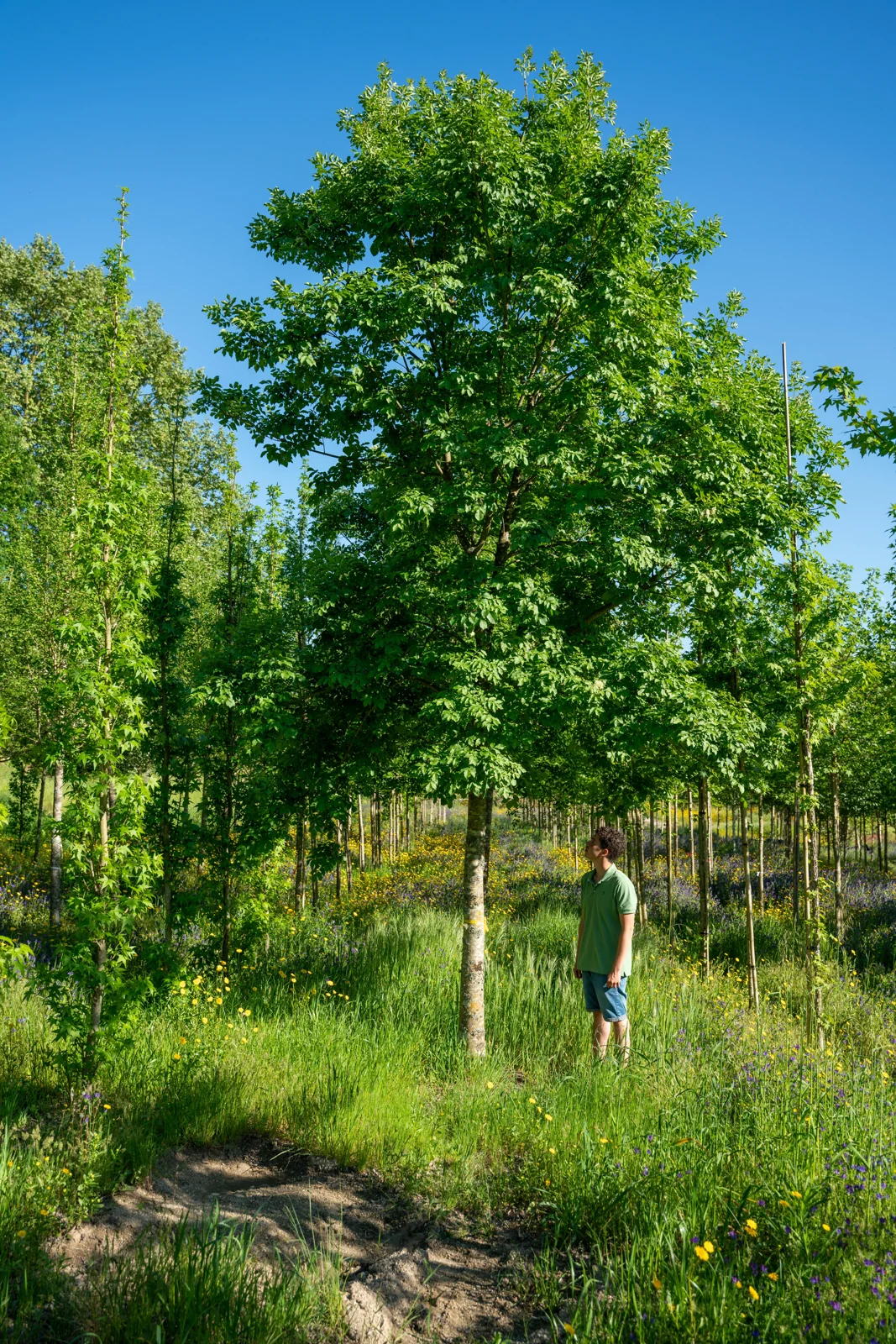
A flowering ash for the dry Portuguese garden
Manna Ash · Fraxinus ornus
A medium deciduous framework tree (freixo-de-flor) for Portuguese schemes that need spring flower interest, summer shade and reliable performance on calcareous soils across Lisbon, the Algarve and interior Alentejo.
- Reliable through Algarve and Alentejo summers once established
- Mature canopy of eight to fifteen metres, manageable for private gardens
- Cream flower clusters for two to three weeks in late May
About this Species
Mature height reaches 8 to 15 m with a spread of 6 to 10 m, forming a rounded crown on a single clean stem. Specifiers can write it into a plant schedule as a feature specimen, a secondary canopy under taller framework trees, or a continuous street alignment (arruamento) where a more compact ash is required. Growth rate is medium; on a well-prepared pit a…
Read more
Show less
Mature height reaches 8 to 15 m with a spread of 6 to 10 m, forming a rounded crown on a single clean stem. Specifiers can write it into a plant schedule as a feature specimen, a secondary canopy under taller framework trees, or a continuous street alignment (arruamento) where a more compact ash is required. Growth rate is medium; on a well-prepared pit a 20 to 25 cm calibre tree will close canopy in a praca within eight to ten years.
In May and June the new shoots carry dense terminal panicles of creamy white flowers above the emerging foliage, giving a brief but legible ornamental moment that suits both municipal avenues and the disciplined geometry of an alameda. Autumn colour is variable, yellowing to purplish before leaf drop. The samara fruit is light and disperses cleanly; litter pressure on paved surfaces is moderate, lower than in Platanus.
Performance across Portuguese zones is consistent. The species is native to southern Europe and Asia Minor and tolerates the calcareous soils of Greater Lisbon, the sandy calcareous profiles of the coastal Algarve, and the schist and alluvial soils of the interior Alentejo. Heat tolerance is high and drought tolerance, once established, is high; the tree requires one to two establishment irrigation cycles, then performs without supplementary irrigation on inland sites with 400 to 600 mm of annual rainfall. Salt tolerance is low, which restricts use on the immediate estuarine edge and on exposed Algarve coastal strips.
Maintenance is straightforward for a municipal espacos verdes team. Formative pruning in the first three winters sets a clear stem to 2.2 m for pedestrian clearance; subsequent crown lifting is occasional. Root behaviour is non-aggressive, which suits planting near kerbs and shallow services. Disease pressure in Portugal is lower than for Fraxinus excelsior, with Hymenoscyphus fraxineus pressure recorded but less severe on F. ornus.



Advice on this species
Want to know more about Fraxinus ornus?
Tell us about your project and we'll advise you on this species — where it thrives, which size makes sense, and what to expect once planted.
- Produção própria
- Exemplares adultos
- Resposta em 1–2 dias
Sem compromisso · orçamento personalizado