

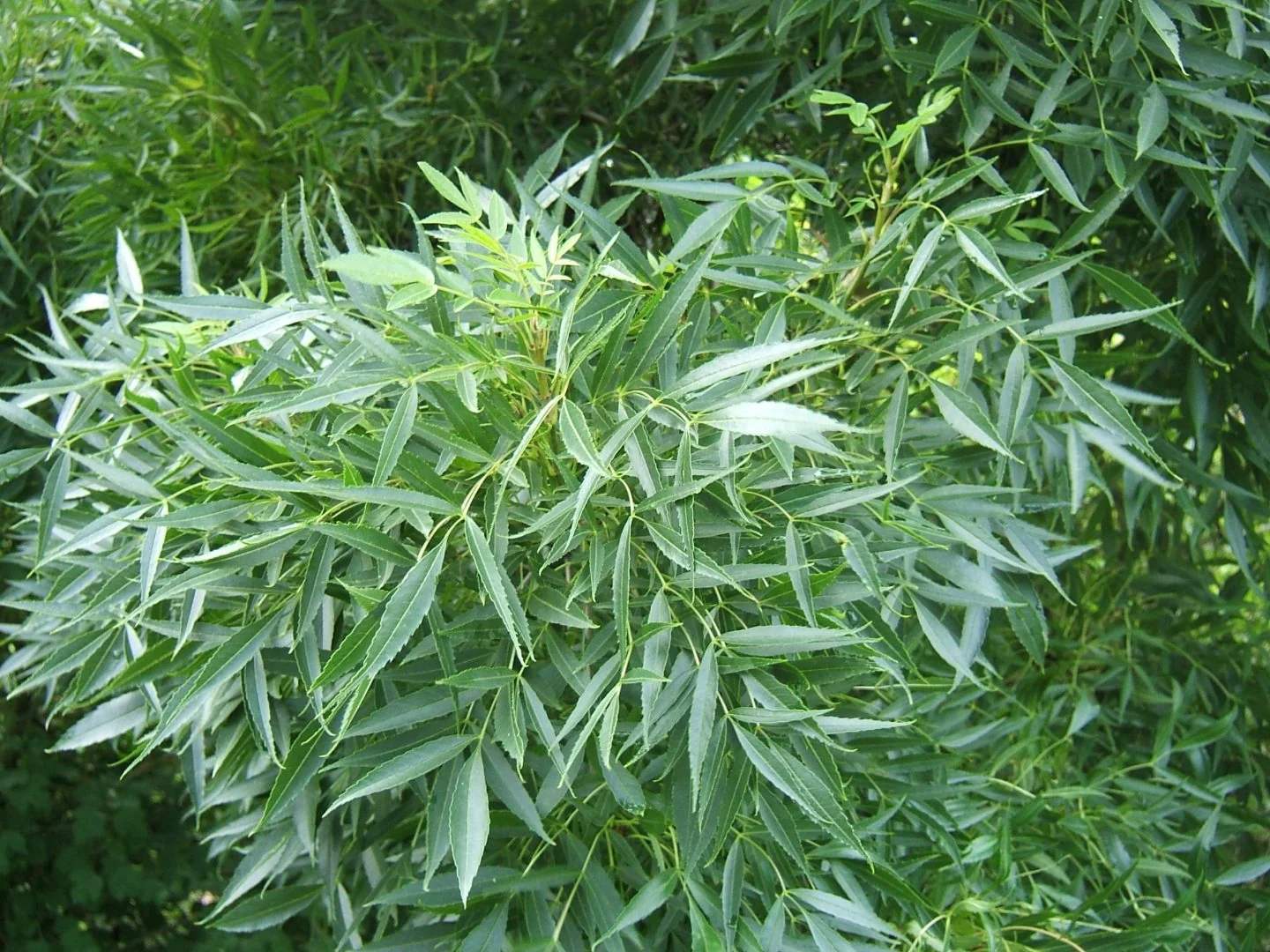
A native ash for the Portuguese riparian garden
Narrow-leaved Ash · Fraxinus angustifolia
A fast-growing deciduous species (freixo) that landscape architects specify across Portugal for riparian corridors, urban alignments, and structural shade, wherever a tolerant, broadly site-flexible framework tree is required.
- Native Portuguese ash, at home on quintas and riverbanks
- Light, feathery crown lets understorey plantings continue to thrive
- Clear amber autumn colour through October across most of Portugal
About this Species
Fraxinus angustifolia is the native Iberian freixo, a deciduous framework tree reaching 15 to 25 m with a spreading, rounded crown and slender pinnate foliage that distinguishes it cleanly from the heavier Fraxinus excelsior. Pale grey bark fissures into a square pattern with age, and brown winter buds confirm identification once the leaves drop. Flowering…
Read more
Show less
Fraxinus angustifolia is the native Iberian freixo, a deciduous framework tree reaching 15 to 25 m with a spreading, rounded crown and slender pinnate foliage that distinguishes it cleanly from the heavier Fraxinus excelsior. Pale grey bark fissures into a square pattern with age, and brown winter buds confirm identification once the leaves drop. Flowering occurs in early spring before leaf emergence, with autumn colour shifting through yellow and bronze.
The species is well adapted to Portuguese conditions across every market zone. Along the riparian corridors of the Tejo, Mondego and Sado, it functions as a naturally occurring species and accepts seasonally waterlogged ground. In drier interior settings such as the Alentejo, the deep pivoting root system supports established trees through prolonged summer drought once the first two cycles of irrigation are complete. Hardy to roughly minus 20 C, it withstands continental winter frosts without difficulty.
Soil tolerance is broad. The species accepts heavy clay, alluvial loam and schist-derived ground, which makes it useful on Greater Lisbon and Greater Porto sites where substrate varies across a single parcel. Specifiers use it as a street alignment (arruamento) tree, as secondary canopy in larger public squares (praças), and as a structural specimen in private quintas. It pairs cleanly with sobreiro (Quercus suber) and choupo in mixed riparian schemes.
Growth is fast for an ash, with reliable canopy closure within eight to ten years on well-prepared planting pits. Formative pruning in the first three winters establishes a clean stem for urban use; mature crowns require only light maintenance thereafter. Hymenoscyphus fraxineus pressure remains lower in Portugal than in northern Europe, but project teams should monitor incoming stock and avoid co-planting with stressed Fraxinus excelsior.



Advice on this species
Want to know more about Fraxinus angustifolia?
Tell us about your project and we'll advise you on this species — where it thrives, which size makes sense, and what to expect once planted.
- Produção própria
- Exemplares adultos
- Resposta em 1–2 dias
Sem compromisso · orçamento personalizado