

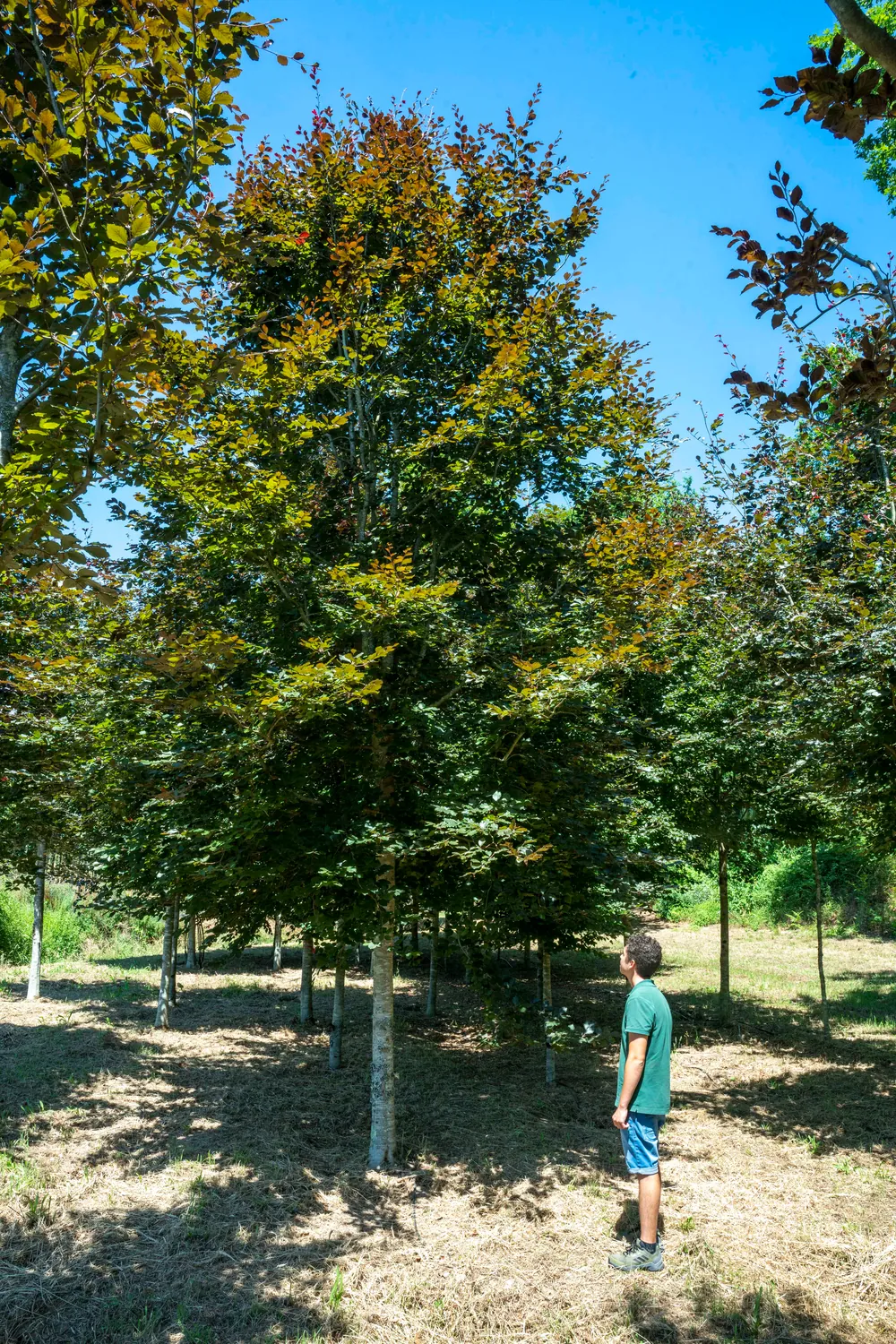
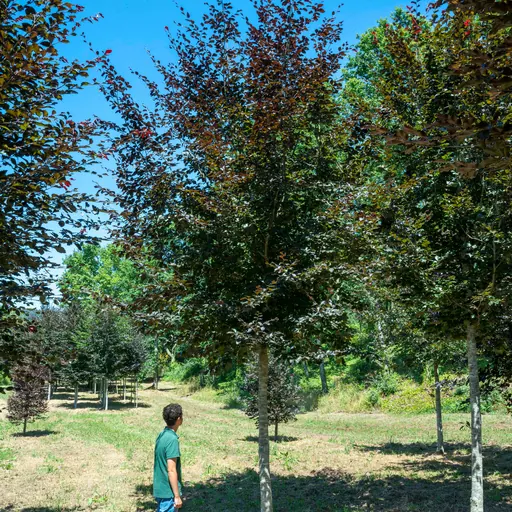
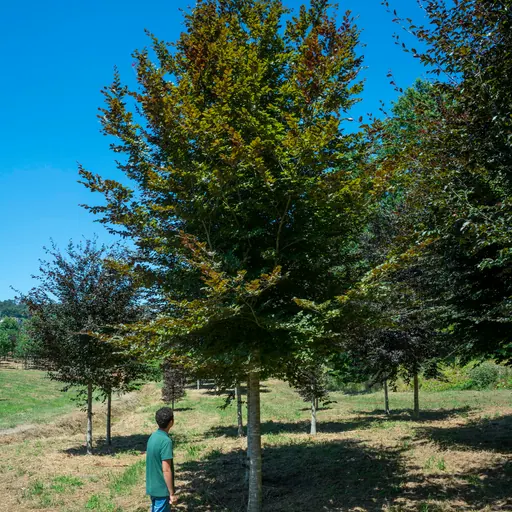
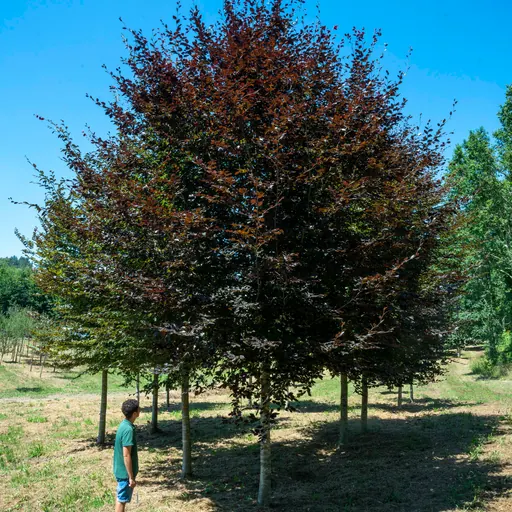


Deep purple foliage for the open garden
European Beech ‘Atropurpurea’ · Fagus sylvatica ‘Atropurpurea’
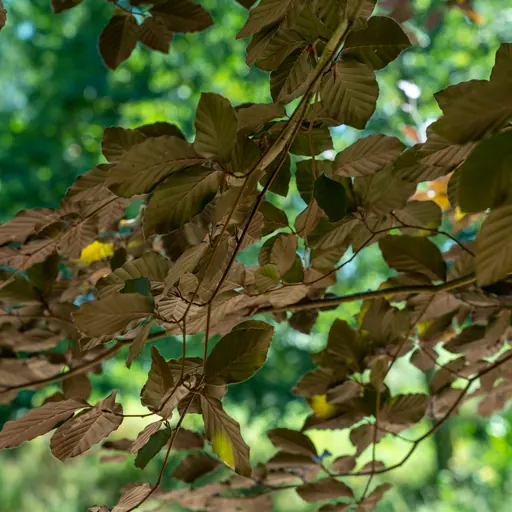
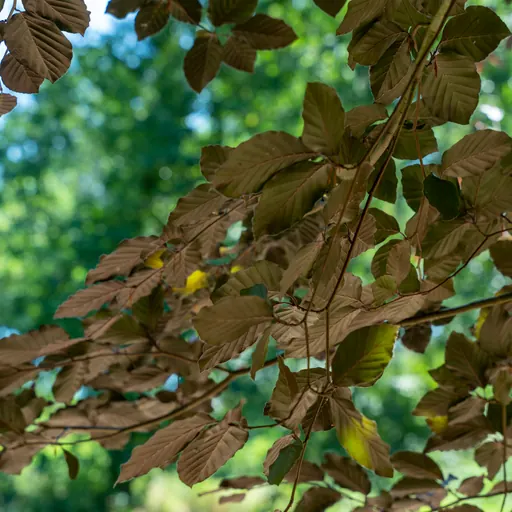
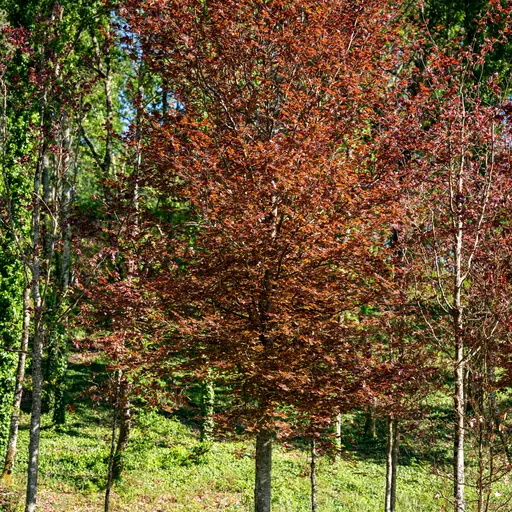
Deep purple summer foliage turning copper and scarlet in autumn anchors a long ornamental season for parks and large gardens. It carries the broad rounded crown of European beech on a clean grey stem, best in open, well-watered positions.
- Deep purple leaves in summer turning copper and scarlet in autumn
- A broad, rounded crown reaching twenty to twenty-five metres at maturity
- Smooth grey trunks and a dense canopy that reads from a distance
Key Facts
About this Cultivar
This purple-leaved selection of European beech (faia) holds the dark, glossy foliage from spring through summer, then shifts to copper and deep scarlet in autumn, giving a long ornamental season that contrasts strongly against green-leaved planting. In Portuguese cultivation it reaches 20 to 25 m in height and 12 to 18 m across, forming a wide, rounded,…
Read more
Show less
This purple-leaved selection of European beech (faia) holds the dark, glossy foliage from spring through summer, then shifts to copper and deep scarlet in autumn, giving a long ornamental season that contrasts strongly against green-leaved planting. In Portuguese cultivation it reaches 20 to 25 m in height and 12 to 18 m across, forming a wide, rounded, dense crown on a straight, smooth grey trunk. Growth is slow to moderate, so it reads as a single feature specimen for parks, estates, and large gardens rather than a street or alignment tree.
Beech is a cool-temperate species, and this governs where it performs in Portugal. It is most reliable in the humid Minho and Douro, where Atlantic rainfall of 1200 to 1800 mm and cooler summers match its preference for fresh, moist ground. Diaplant grows it field-grown (cultivado em pleno solo) in Amarante, around 950 mm of annual rainfall with mild winters and dry summers, which gives a specimen already conditioned to northern Portuguese sites. Winter cold is not a constraint; the species tolerates well below zero.
The limiting factor is summer heat and drought rather than soil type. Prolonged dry heat stresses and can kill established beech, so the hot, low-rainfall interior Alentejo and the drought-prone Algarve ask for deliberate siting: a fresh, deep, well-drained soil, afternoon shade or a north aspect, and supplementary irrigation through the dry months. In urban Lisbon it suits an irrigated park or garden position away from reflected pavement heat.
Where the climate suits it, maintenance is low. The species takes well to pruning and crown lifting, casts dense shade that suppresses underplanting, and drops only light leaf and small triangular nuts (fágueos) that feed wildlife. It carries no serious pest or disease pressure in Portugal. Give it room for the root system and the spreading crown, and it forms a long-lived, structural specimen.
Advice on this species
Want to know more about Fagus sylvatica 'Atropurpurea'?
Tell us about your project and we'll advise you on this species — where it thrives, which size makes sense, and what to expect once planted.
- Produção própria
- Exemplares adultos
- Resposta em 1–2 dias
Sem compromisso · orçamento personalizado