

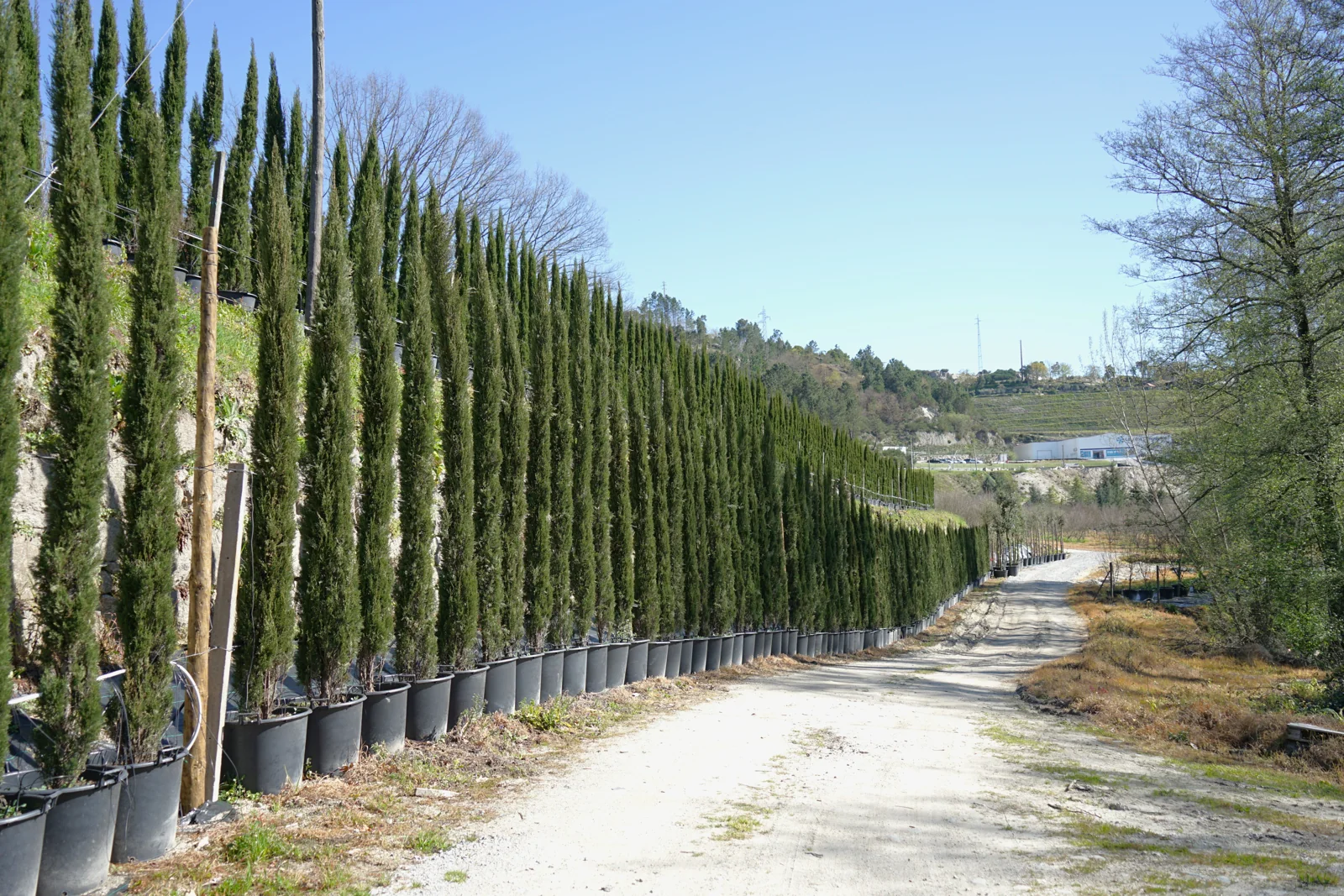
The vertical line of the Mediterranean garden
Italian Cypress ‘Stricta’ · Cupressus sempervirens ‘Stricta’
Strictly columnar evergreen for projects that require vertical punctuation: cemetery alignments, entrance markers, axial avenues, and the framing of perspectives in Mediterranean and contemporary schemes across Portuguese sites.
- Narrow columnar form, 15 to 20 metres tall on a 2 to 3 metre base
- Reliable across the Algarve, Lisbon coast, Silver Coast and Douro
- Drought and heat tolerant once three summers into the ground
Key Facts
About this Cultivar
Mature specimens reach 15 to 20 metres in height with a crown of only 2 to 3 metres at full development, holding a near-cylindrical fastigiate form. The dense, dark green scale-foliage on erect branchlets reads as a single sculptural mass, which suits the cultivar to use as a feature specimen, a paired entrance marker, or structural planting along an…
Read more
Show less
Mature specimens reach 15 to 20 metres in height with a crown of only 2 to 3 metres at full development, holding a near-cylindrical fastigiate form. The dense, dark green scale-foliage on erect branchlets reads as a single sculptural mass, which suits the cultivar to use as a feature specimen, a paired entrance marker, or structural planting along an alameda or arruamento.
The species tolerates the full range of Portuguese conditions when soil drainage is adequate. It performs in coastal Algarve schemes on calcareous to sandy soils without supplementary irrigation once established, withstands the continental summers of the interior Alentejo above 40 degrees C, and accepts the limestone-derived soils and reflected heat of urban Lisbon. In the humid Minho and Douro it requires sharp drainage; waterlogged ground shortens its useful life.
Hardiness extends to roughly minus 12 degrees C, covering all Portuguese inland frost pockets. Salt tolerance is moderate: the cultivar accepts estuarine air on the Tagus and the Sado but is best set back from direct Atlantic spray. Performance under Portuguese summer aridity is reliable once the root system has run three full seasons in the ground.
Maintenance is low. Formative pruning is unnecessary because the columnar habit is genetically fixed, and crown lifting is rarely required. The principal phytosanitary concern is cypress canker (Seiridium cardinale), which favours stressed and mechanically wounded trees; specifications should call for clean stock, adequate spacing for air movement, and disinfected tools. Root behaviour is non-aggressive, which suits the cultivar to planting near paving and underground services.
The Italian cypress has a long documented presence in Portuguese horticulture, from the cloisters and quintas of the seventeenth and eighteenth centuries to twentieth-century cemetery design, giving the specifier a defensible track record when briefing a municipal or private client.
Advice on this species
Want to know more about Cupressus sempervirens 'Stricta'?
Tell us about your project and we'll advise you on this species — where it thrives, which size makes sense, and what to expect once planted.
- Produção própria
- Exemplares adultos
- Resposta em 1–2 dias
Sem compromisso · orçamento personalizado