

A hedgerow native equally at home in Portugal
Common Hawthorn · Crataegus monogyna
Specified across Portuguese schemes for its low-water tolerance and naturalistic character, Crataegus monogyna sits at the scale between shrub and tree, providing edge structure, May blossom, and persistent autumn fruit on demanding sites.
- Hardy and drought-tolerant once established across the Silver Coast and Greater Lisbon
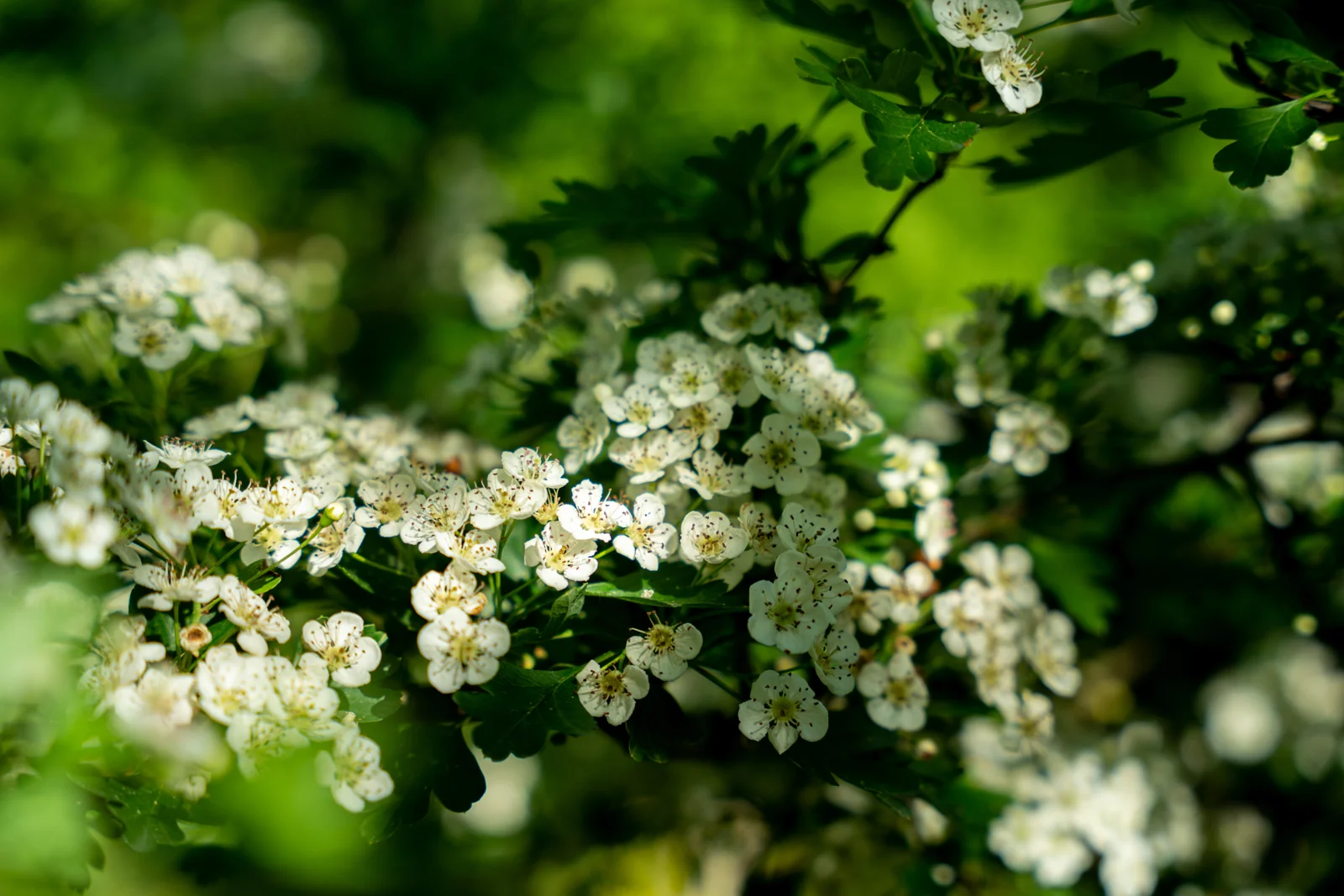
- White May blossom followed by red autumn haws that hold into winter
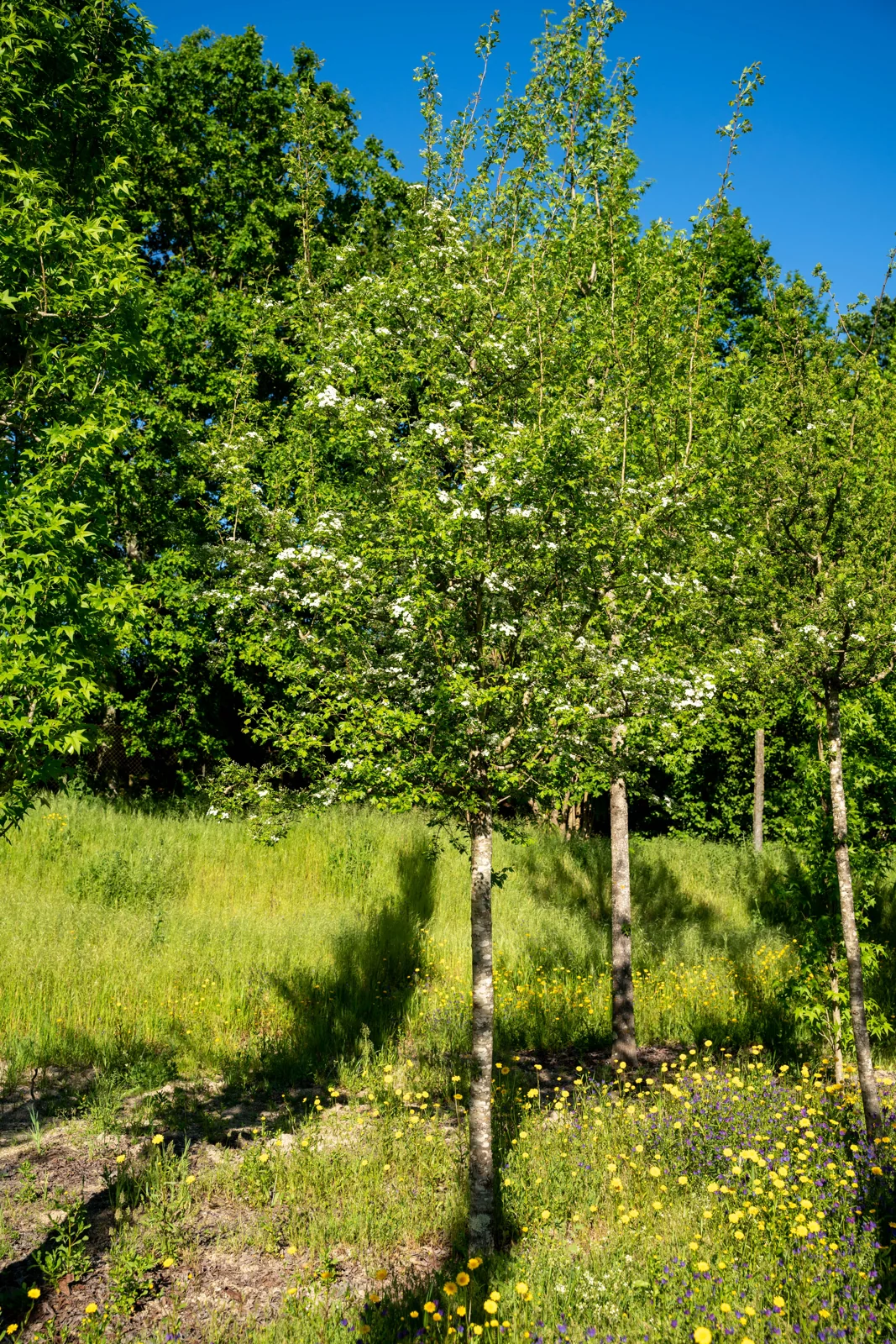
- Mature canopy of five to ten metres within fifteen to twenty years
About this Species
Crataegus monogyna (pilriteiro-bravo) is a small deciduous tree reaching 5 to 10 m in height with a 4 to 8 m spread, carrying a rounded crown on a single stem or a low-branched multi-stem frame. The trunk develops dull brown bark with vertical orange fissures, and younger wood bears sharp thorns that make the species a defensive choice as well as an…
Read more
Show less
Crataegus monogyna (pilriteiro-bravo) is a small deciduous tree reaching 5 to 10 m in height with a 4 to 8 m spread, carrying a rounded crown on a single stem or a low-branched multi-stem frame. The trunk develops dull brown bark with vertical orange fissures, and younger wood bears sharp thorns that make the species a defensive choice as well as an ornamental one. White corymb flowers open through May and into early June, followed by dark red haws that persist into autumn and feed thrushes and other passerines.
Native across Europe, northwest Africa, and western Asia, the species tolerates summer heat and prolonged drought once a deep root system is established, and it accepts saline air on coastal sites. It performs across the climatic range of Portuguese projects: from the humid Minho and Douro, where it occurs as a hedgerow tree, to the limestone soils of Greater Lisbon and the calcareous and sandy substrates of the Algarve. In the interior Alentejo, a single establishment irrigation cycle and a deep planting hole aid the first two summers.
In specification, the tree functions as a secondary canopy or feature specimen at the edge of montado restoration, beside heavier framework species such as sobreiro (Quercus suber) and azinheira (Quercus rotundifolia). It pairs naturalistically with medronheiro (Arbutus unedo) and Pyrus cordata in mixed hedgerows and transition zones, and provides early structure where a full alameda specimen would be out of scale.
Soil tolerance is broad, covering clay, loam, chalk, and sand provided drainage is adequate. Pest and disease pressure is low in Portuguese conditions, and the species tolerates hard pruning, allowing formative shaping in the first three years and routine crown lifting thereafter. Litter from the small haws is minimal and does not stain paved surfaces.



Advice on this species
Want to know more about Crataegus monogyna?
Tell us about your project and we'll advise you on this species — where it thrives, which size makes sense, and what to expect once planted.
- Produção própria
- Exemplares adultos
- Resposta em 1–2 dias
Sem compromisso · orçamento personalizado