

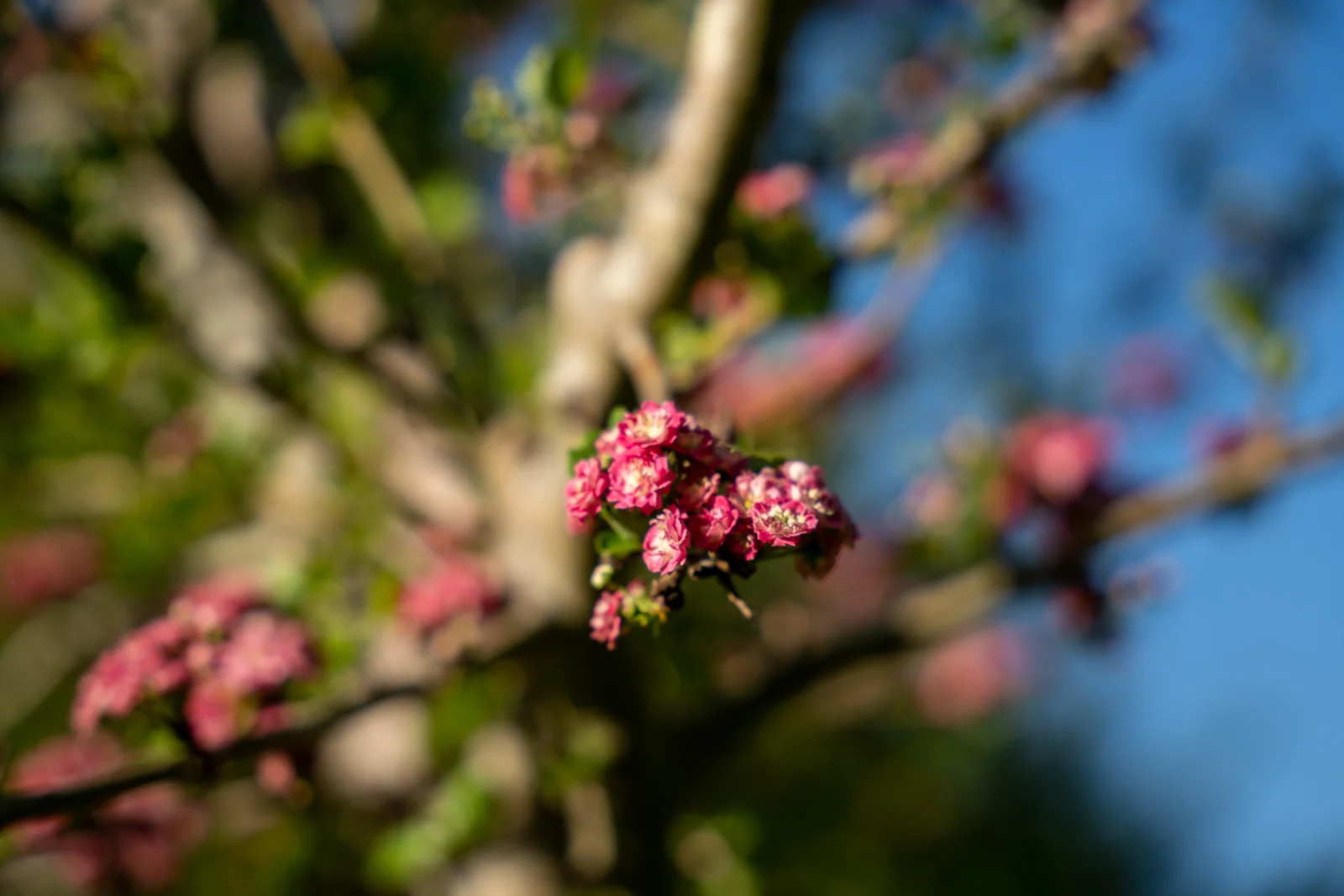
A small spring-flowering tree for walled gardens and courtyards
Midland Hawthorn ‘Paul‘s Scarlet’ · Crataegus laevigata ‘Paul‘s Scarlet’
A small deciduous tree of pilriteiro origin, selected for dense scarlet double flowers in mid-spring. Suited to street alignments, residential courtyards, and constrained planters across Portuguese projects.
- Double scarlet flowers held for several weeks in spring
- Compact rounded crown of 5 to 7 metres at maturity
- Reliable across Greater Lisbon, the Silver Coast, and the cooler Algarve
Key Facts
About this Cultivar
Crataegus laevigata 'Paul's Scarlet' reaches 5 to 7 metres in height and 4 to 6 metres in spread at maturity, forming a rounded, densely ramified crown. Growth is slow once the framework is set, which keeps the tree in scale on narrow arruamentos and small praças without recurring crown-reduction cycles. The form lends itself to specification as a feature…
Read more
Show less
Crataegus laevigata 'Paul's Scarlet' reaches 5 to 7 metres in height and 4 to 6 metres in spread at maturity, forming a rounded, densely ramified crown. Growth is slow once the framework is set, which keeps the tree in scale on narrow arruamentos and small praças without recurring crown-reduction cycles. The form lends itself to specification as a feature specimen, a secondary canopy tree under taller alignments of plátano or tília, or a low ornamental hedge.
In mid-spring the crown carries dense corymbs of double scarlet flowers over several weeks, set against dark green, lobed foliage. Autumn foliage takes warm tones; fruiting is sparse relative to the species type, which is an advantage on paved surfaces where pome litter is unwelcome. Pollinators visit the flowers despite their double form.
The cultivar tolerates a wide range of well-drained soils, including the acidic granite and schist substrates of the Minho and Douro, the clay-loams of the Lisbon hinterland, and the calcareous soils of the Algarve interior. It withstands urban air quality, wind, and winter cold (rated to about minus 25 °C), and accepts full sun to partial shade. Performance in the prolonged summer drought of the interior Alentejo requires a deeper torrão and one establishment irrigation cycle; in Atlantic Portugal, supplementary irrigation can be withdrawn within two summers.
Maintenance is limited to formative pruning and occasional crown lifting; the tree responds well to renewal cuts and persists usefully in urban plantings for several decades. Phytosanitary watch covers fire blight (Erwinia amylovora) and Gymnosporangium rusts, neither under significant epidemic pressure in current Portuguese conditions. In project terms it anchors the secondary planting layer of a residential street, a quinta forecourt, or a Lisbon hinterland praça where a Tilia or Quercus suber would over-scale the surrounding built kerb. Specifiers reach for it where domestic-scaled spring colour is required against a hardier urban performance envelope than Prunus serrulata can offer.
Advice on this species
Want to know more about Crataegus laevigata 'Paul's Scarlet'?
Tell us about your project and we'll advise you on this species — where it thrives, which size makes sense, and what to expect once planted.
- Produção própria
- Exemplares adultos
- Resposta em 1–2 dias
Sem compromisso · orçamento personalizado