

A small flowering tree for the cooler Portuguese garden
Japanese Dogwood ‘Venus’ · Cornus kousa ‘Venus’
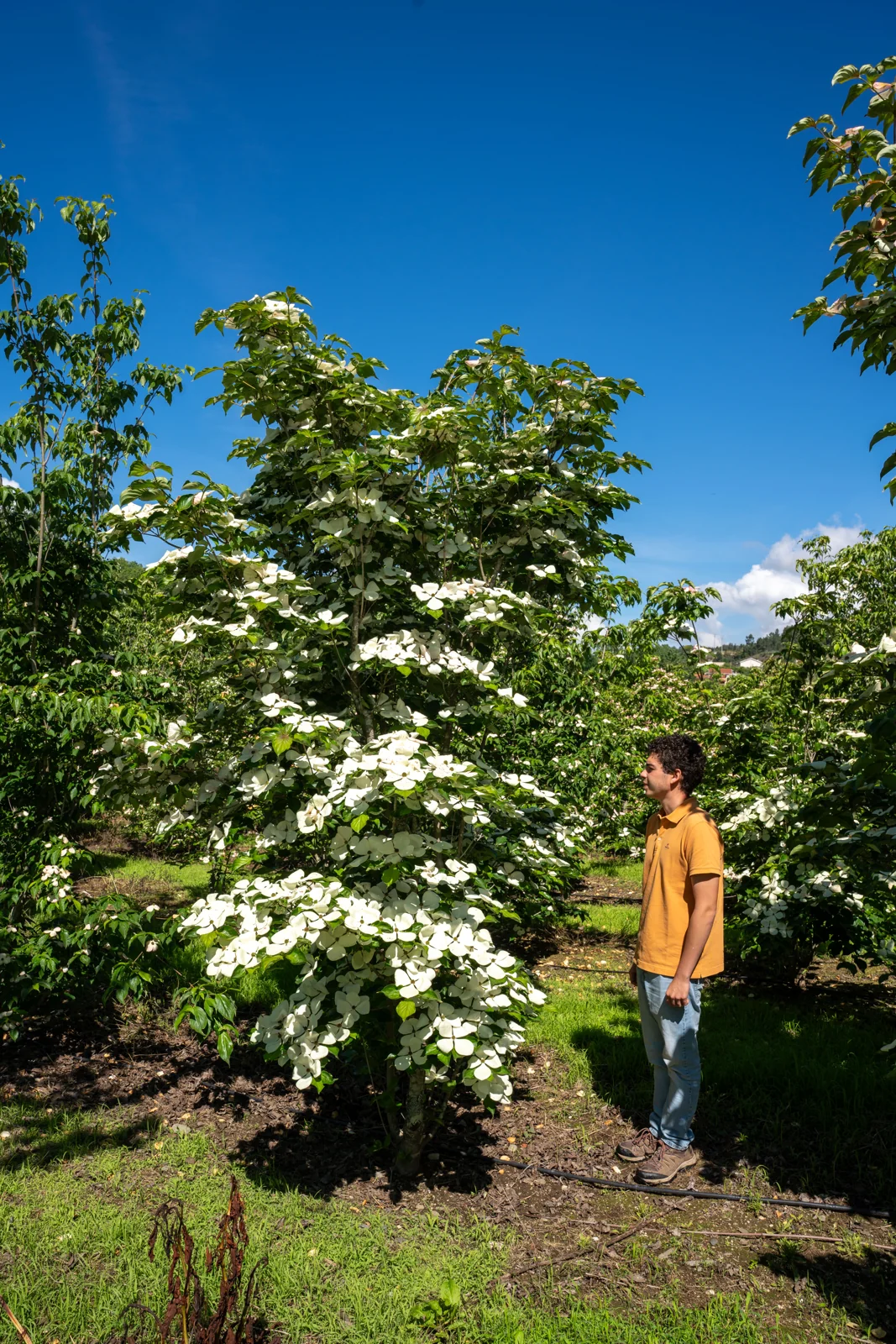
A moderate-growing hybrid dogwood specified where a spring flowering event of unusual scale anchors a courtyard, quinta entrance, or designed garden. Reaches 5 to 7 m on fresh, slightly acidic soils across Portugal.
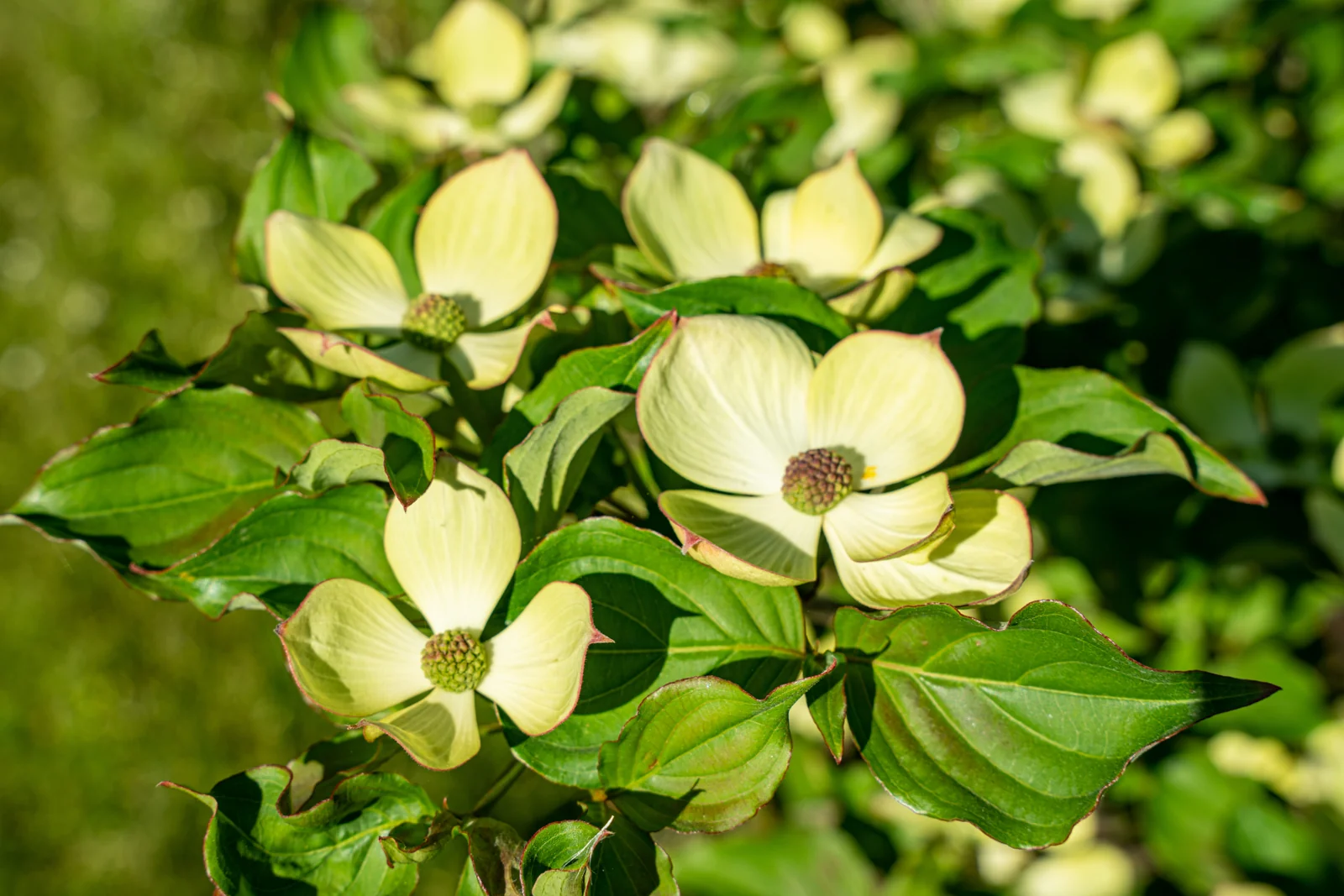
- Exceptionally large white bracts in late spring, often above 12 cm across
- Mature size of five to seven metres, suited to a courtyard or clearing
- Reliable autumn colour in deep red and purple, followed by mottled winter bark
Key Facts
About this Cultivar
A complex hybrid of Cornus kousa, C. nuttallii, and C. chinensis, 'Venus' (Corniso-japonês in Portuguese) carries the largest white bracts of any commercially available dogwood, frequently exceeding 12 cm across. In the spring flowering event, the bracts sit above fresh foliage and read at distance, giving the tree a presence that justifies its use as…
Read more
Show less
A complex hybrid of Cornus kousa, C. nuttallii, and C. chinensis, 'Venus' (Corniso-japonês in Portuguese) carries the largest white bracts of any commercially available dogwood, frequently exceeding 12 cm across. In the spring flowering event, the bracts sit above fresh foliage and read at distance, giving the tree a presence that justifies its use as a feature specimen rather than as secondary canopy. Mature dimensions settle at 5 to 7 m in height with a 4 to 6 m spread and a rounded, balanced crown.
Growth is moderate, the habit multi-stemmed or low-branched depending on early training. Summer foliage is glossy mid-green; autumn colour shifts to deep red and purple over three to five weeks, and the globose scarlet drupes that follow extend ornamental interest into early autumn and draw passerines. Exfoliating bark on older stems adds winter structure. The species offers four seasons of legible interest, which is the practical justification for its higher unit cost on a plant schedule (caderno de encargos).
'Venus' performs reliably in the Atlantic-influenced north (Minho, Douro, Greater Porto) and in irrigated schemes around Greater Lisbon, where fresh, slightly acidic, well-drained soils suit it best. In the interior Alentejo and the coastal Algarve, deep planting, an organic mulch, and a maintained establishment irrigation cycle through the first three summers are required; in unirrigated dryland sites it is not the right choice. Cold hardiness is not a limiting factor anywhere in mainland Portugal.
The tree tolerates partial shade and full sun, with light afternoon shade beneficial on the hottest exposures. Salt tolerance is low, which excludes direct coastal positions but does not preclude inland Algarve gardens. Resistance to dogwood anthracnose and to the pest and disease pressures common in Portuguese cultivation is strong; root behaviour is non-aggressive, which suits its specification near pavements and shallow services. Formative pruning in the first three years sets the crown; thereafter, maintenance is limited to deadwood removal. Suitable as a feature specimen in a private garden, an alameda terminus, a praça corner under light shade, or a refined planting at a hotel or quinta.
Advice on this species
Want to know more about Cornus kousa 'Venus'?
Tell us about your project and we'll advise you on this species — where it thrives, which size makes sense, and what to expect once planted.
- Produção própria
- Exemplares adultos
- Resposta em 1–2 dias
Sem compromisso · orçamento personalizado