

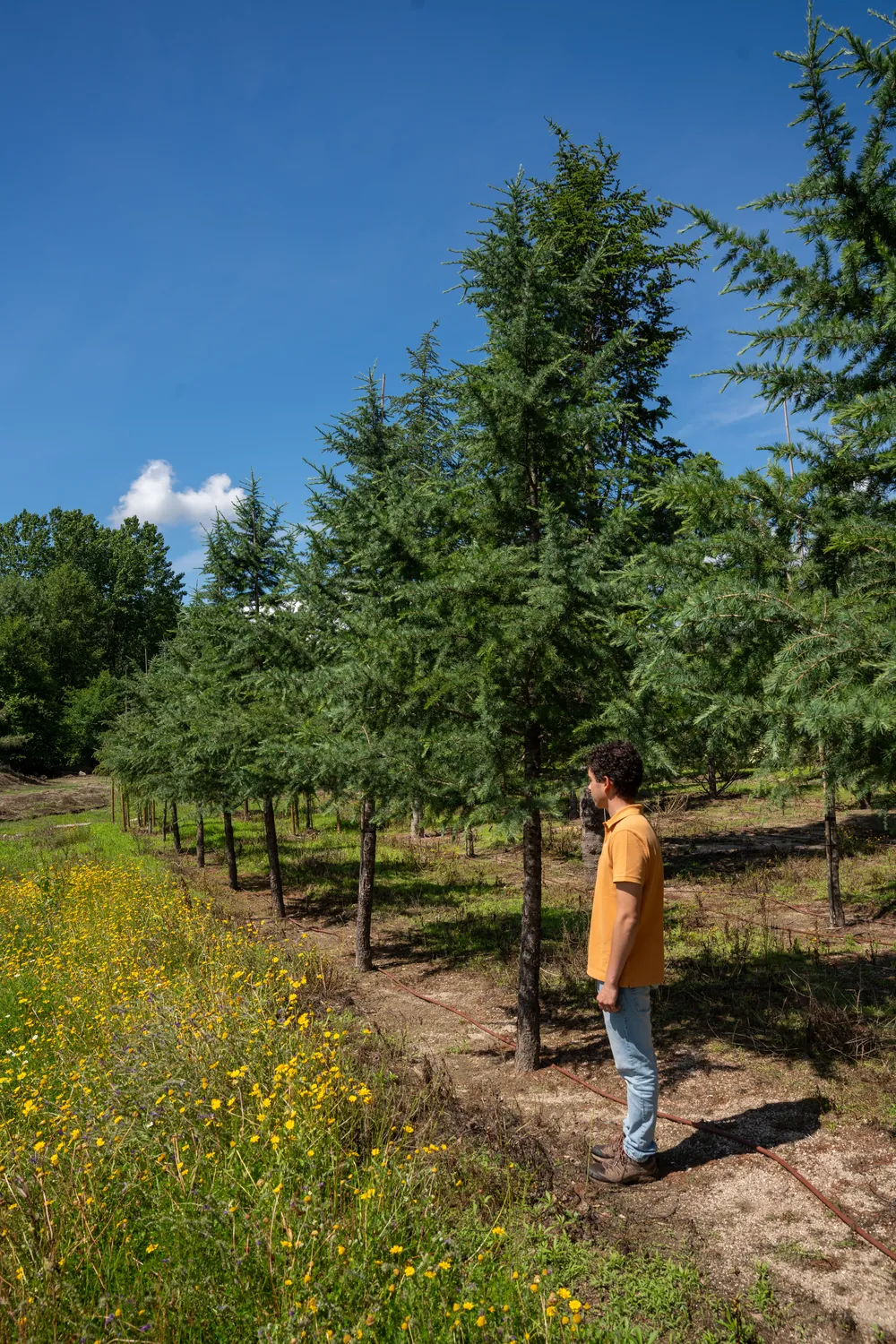
An evergreen presence with the weight of a Sintra cedar
Deodar Cedar · Cedrus deodara
{# A tabela de LOTES (§C, «zoom no lote») foi movida para baixo das características (botânica em cima, lotes em baixo — reunião 24/07). Ver #crm-lotes mais abaixo. #}A long-lived feature specimen for Portuguese projects with the space to accommodate its mature scale, Cedrus deodara carries restored historic gardens, municipal parks and the larger residential quinta as a permanent evergreen anchor.
- Broad, flat-topped crown with the pendulous tips that distinguish the species
- Reliable across Greater Lisbon, the Silver Coast, and the central Algarve
- Self-sufficient on rainfall after three summers in most coastal zones
About this Species
Cedro-do-himalaia reaches 20 to 40 metres in height with an 8 to 12 metre spread under Portuguese conditions, broadly pyramidal in youth and developing a wide, flat-topped crown with horizontally spreading branches as it ages. The drooping branchlets and pendent tips give the species a recognisable architectural silhouette that registers from a distance, making it a defensible feature specimen on public squares (praças), within the Portuguese alameda tradition, and as a focal element on extensive lawns.
The species establishes well across the humid Minho and Douro, where Atlantic-influenced rainfall of 1,200 to 1,800 millimetres and mild winters suit it closely. Diaplant field-grows the tree in Amarante under approximately 950 millimetres of annual rainfall, dry summers, and frosts that remain above minus 7 degrees Celsius. It performs in Greater Lisbon and Greater Porto schemes on well-drained loams, and adapts to the interior Alentejo where deep planting and a single establishment…
Cedro-do-himalaia reaches 20 to 40 metres in height with an 8 to 12 metre spread under Portuguese conditions, broadly pyramidal in youth and developing a wide, flat-topped crown with horizontally spreading branches as it ages. The drooping branchlets and pendent tips give the species a recognisable architectural silhouette that registers from a distance, making it a defensible feature specimen on public squares (praças), within the Portuguese alameda tradition, and as a focal element on extensive lawns.
The species establishes well across the humid Minho and Douro, where Atlantic-influenced rainfall of 1,200 to 1,800 millimetres and mild winters suit it closely. Diaplant field-grows the tree in Amarante under approximately 950 millimetres of annual rainfall, dry summers, and frosts that remain above minus 7 degrees Celsius. It performs in Greater Lisbon and Greater Porto schemes on well-drained loams, and adapts to the interior Alentejo where deep planting and a single establishment irrigation cycle are advisable.
Coastal Algarve schemes within the salt-spray band require caution: tolerance of saline air is low, and a protected siting inland of the immediate coast is the safer specification. The species requires acidic to neutral, well-drained loamy or sandy soils and does not tolerate poorly drained or seasonally waterlogged ground. Tip blight and root rot can occur on compromised sites; otherwise the species shows reliable resistance to common pests and is documented as deer-resistant where browsing pressure applies.
Maintenance over the long term is moderate. Formative pruning establishes a clean stem where the tree functions as a street alignment (arruamento) subject, and crown lifting allows pedestrian and vehicle clearance beneath; the pendent lower branches otherwise persist to ground level. Cone shed produces seasonal litter that the specification should account for on paved surfaces. The species has a documented track record in nineteenth-century Portuguese estate plantings, including the Sintra cultural landscape, and reliably exceeds 30 metres in mature specimens.
Disponibilidade & preço
Interested in Cedrus deodara?
Our team can help you select the perfect specimen for your project. Get in touch for availability and pricing.
- Produção própria
- Exemplares adultos
- Resposta em 1–2 dias
Sem compromisso · orçamento personalizado