

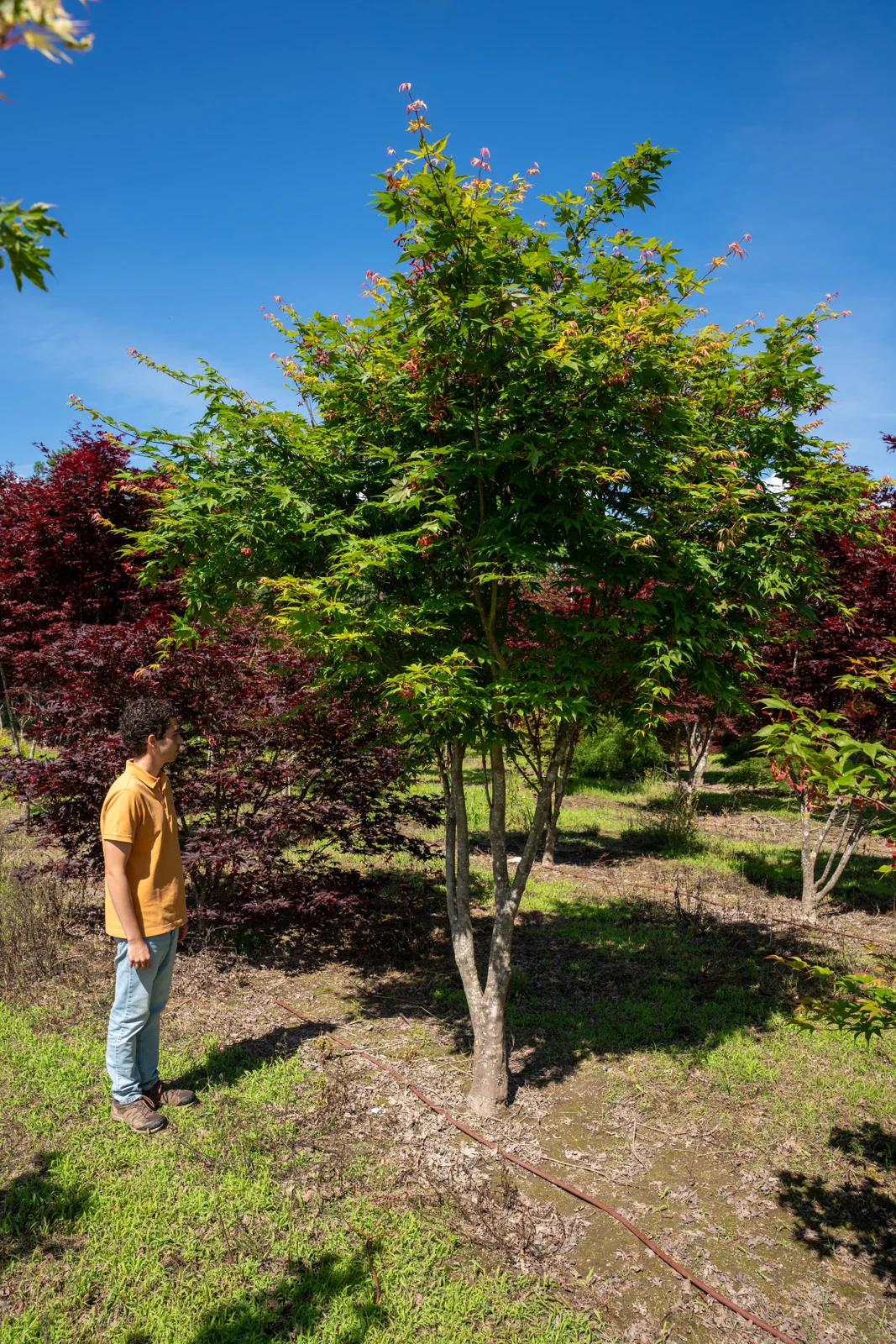
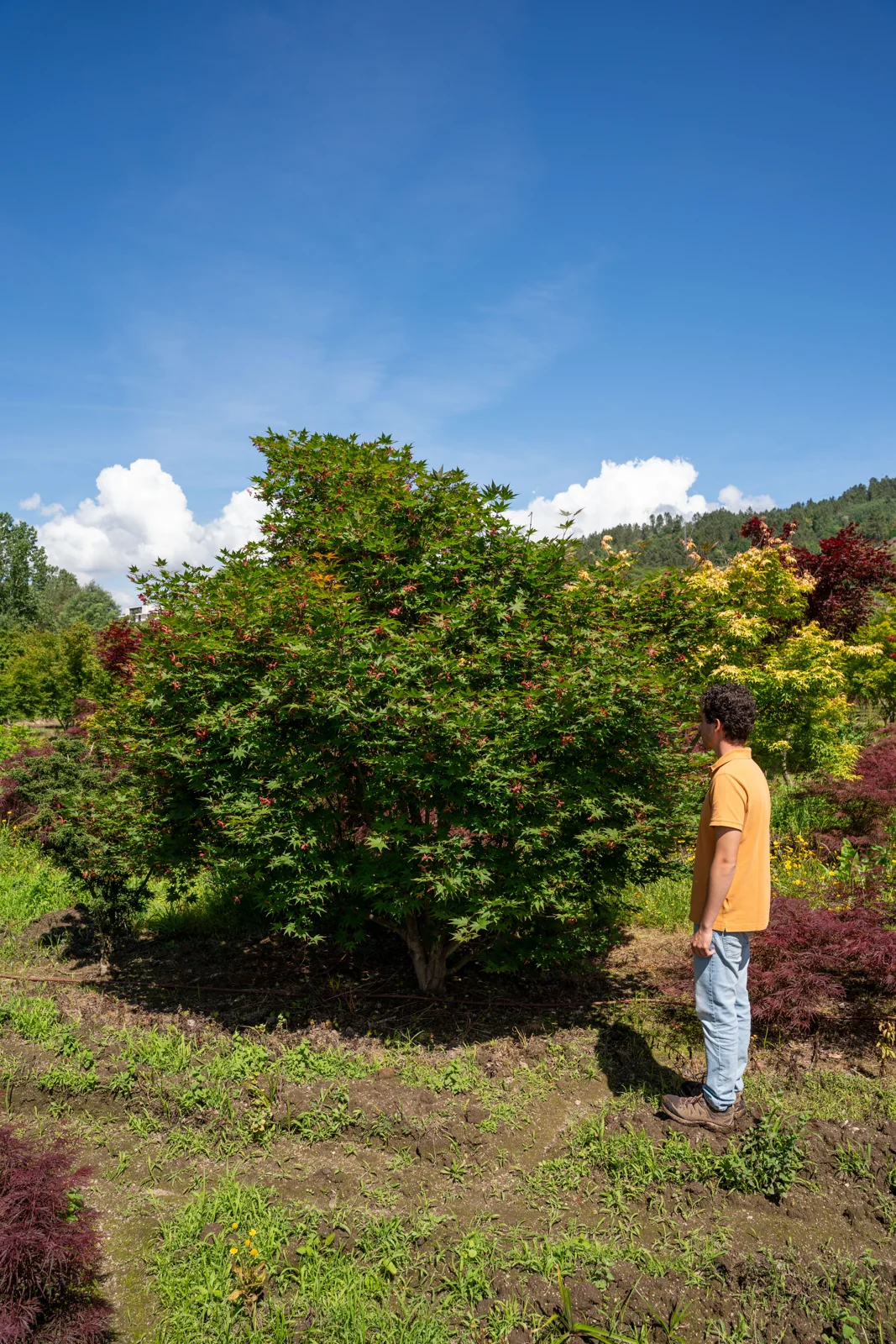
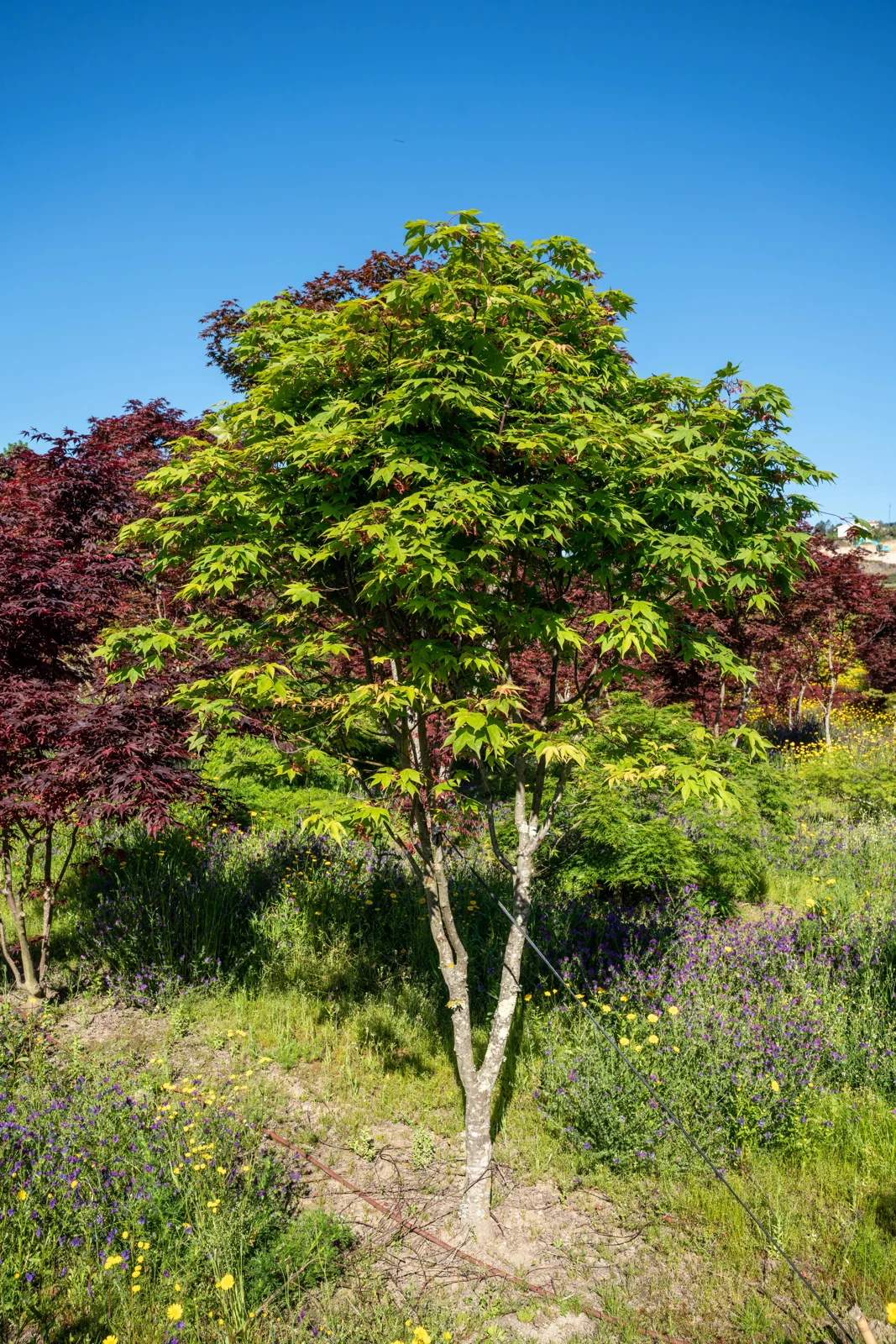
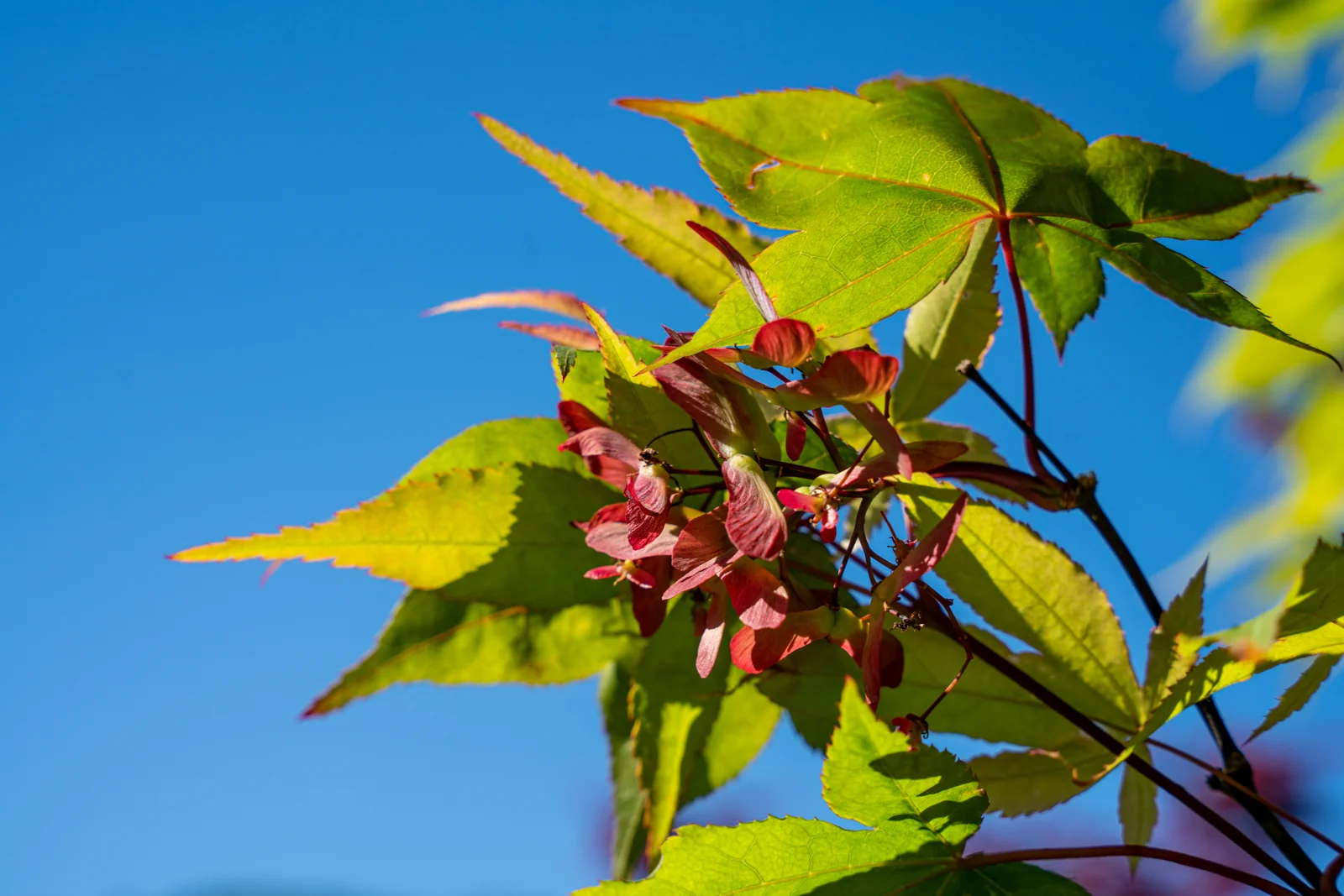
The Japanese maple chosen for its fierce scarlet autumn
Japanese Maple ‘Osakazuki’ · Acer palmatum ‘Osakazuki’
A cultivar specifiable where autumn colour is a project criterion: palmate (not dissected) leaves, vase to rounded habit, scarlet autumn colour among the most intense within the species, sustained for several weeks each season.
- Scarlet autumn foliage, among the most intense in the species
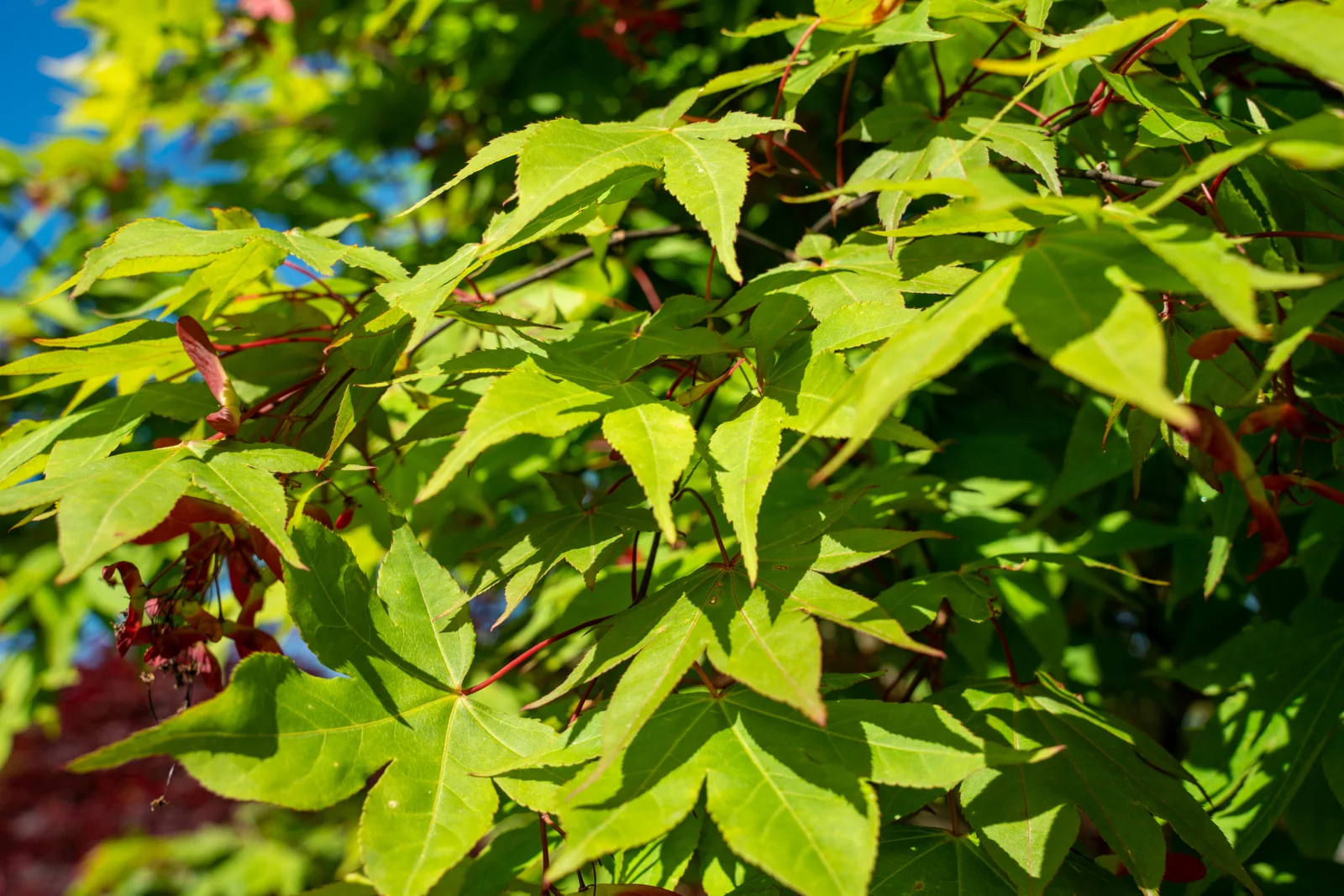
- Bright green palmate leaves through spring and summer
- Small scale, 4 to 5 m at maturity, vase to rounded
Key Facts
About this Cultivar
The cultivar distinguishes itself operationally from dissectum and purple-leaved forms on three points: a robust seven-lobed palmate leaf without filamentous cutting; an upright vase habit when young that broadens with age to 4 to 6 m in height by 4 to 5 m across; and better sun tolerance than the laceleaf forms, which reduces the careful exposure planning…
Read more
Show less
The cultivar distinguishes itself operationally from dissectum and purple-leaved forms on three points: a robust seven-lobed palmate leaf without filamentous cutting; an upright vase habit when young that broadens with age to 4 to 6 m in height by 4 to 5 m across; and better sun tolerance than the laceleaf forms, which reduces the careful exposure planning that other Japanese maples demand. In a Portuguese plant schedule (caderno de encargos), it occupies the role that a paisagista reserves for typical Acer palmatum in a Japanese-inspired garden or in an intimate park clearing, with the added value of the autumn signature.
Site performance favours the cooler northern half of the country and Atlantic-influenced microclimates: Minho, the Douro Litoral, the Sintra and Cascais coast, the northern reaches of the Costa de Prata, and well-sheltered courtyards within Greater Lisbon. The cultivar requires soil rich in organic matter, slightly acidic, with reliable drainage; tolerates clay where structure prevents prolonged waterlogging. In the inland Algarve and the dry Alentejo it functions only with half shade (a wall, a pinheiro-manso canopy), generous mulch, and irrigation through the dry months. Field-grown in Amarante (approximately 950 mm annual rainfall, mild winters, dry summers), the stock translates well into the comparable climates of the Norte and Centro.
Foliage emerges and holds a clear bright green through spring and summer, with fine texture and a quiet sheen. Autumn colour develops between mid-October and mid-November under Atlantic conditions, turns to a luminous scarlet to crimson rated among the most intense in the species, and holds for two to three weeks before fall. Intensity responds to exposure: late-afternoon direct light on well-hydrated foliage delivers the strongest colour. Growth is slow; the genus has moderate disease and pest resistance, with no active phytosanitary pressure documented in Portugal.
Project role: feature specimen at a lawn edge, chromatic counterpoint against a dark evergreen hedge, focal point at the entry of an interior courtyard (pátio) or in a Japanese-inspired planting scheme. The cultivar's scale, larger than the dissectum forms, gives it the presence to structure a space where weeping cultivars stay in the understorey, without reaching the canopy dimension that would unbalance a small composition.
Advice on this species
Want to know more about Acer palmatum 'Osakazuki'?
Tell us about your project and we'll advise you on this species — where it thrives, which size makes sense, and what to expect once planted.
- Produção própria
- Exemplares adultos
- Resposta em 1–2 dias
Sem compromisso · orçamento personalizado