

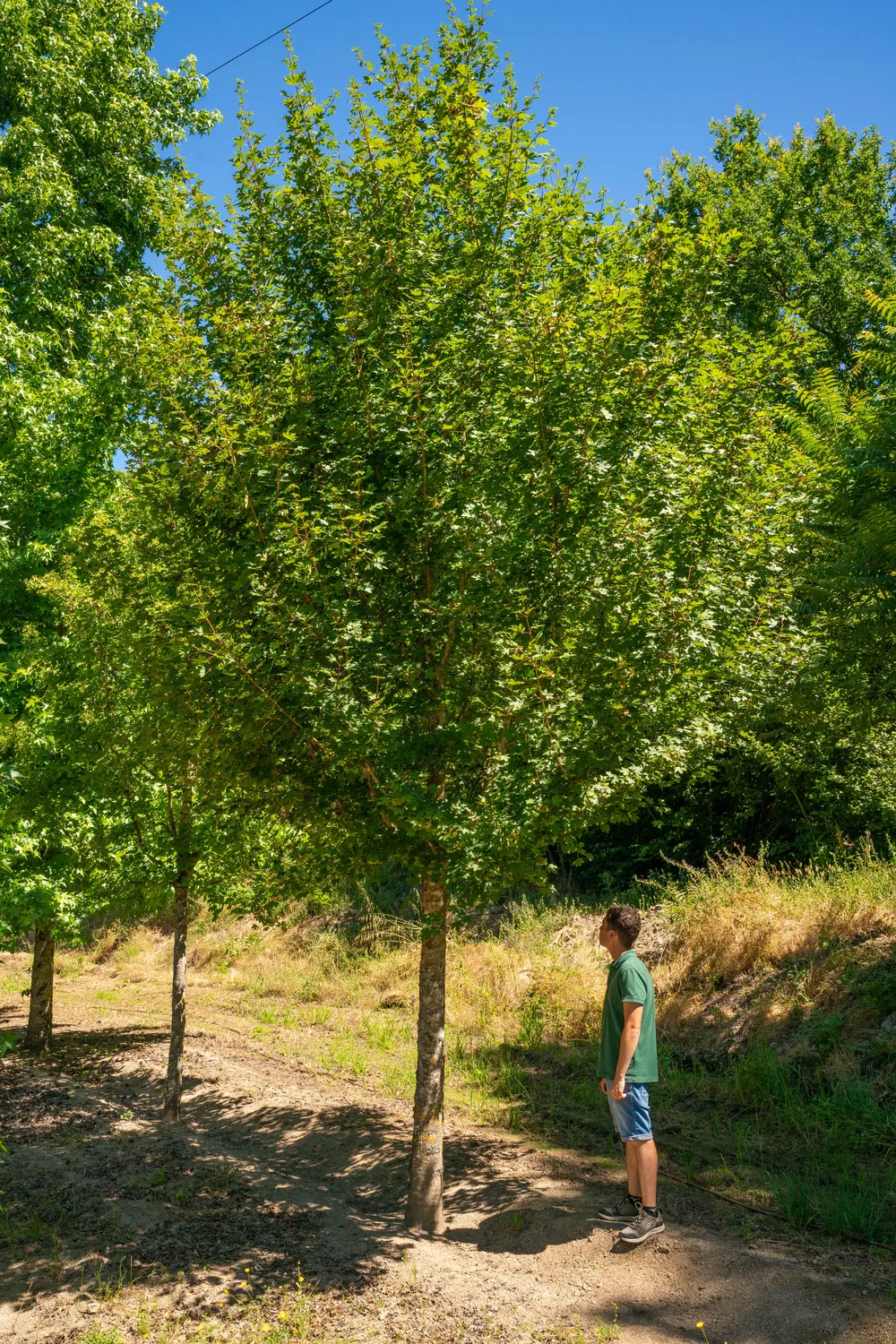
A compact deciduous maple for inland Portuguese gardens
Field Maple · Acer campestre
A compact deciduous maple suited to clipped alignments, dense screens, and structural infill on Portuguese projects that require a tolerant urban tree (bordo-do-campo) of restrained mature scale.
- Compact rounded crown of eight to twelve metres at maturity
- Reliable clear yellow autumn colour in cooler inland regions
- Tolerant of heavy clay, alkaline limestone, and urban air
About this Species
The field maple is a rounded, low-branched deciduous tree typically reaching 8 to 12 metres in cultivation, with a spread of 6 to 10 metres. It carries five-lobed leaves with milky sap in the petiole, inconspicuous yellow-green flowers in spring, paired samaras with horizontal wings in autumn, and a yellow autumn turn that is reliable in cooler northern…
Read more
Show less
The field maple is a rounded, low-branched deciduous tree typically reaching 8 to 12 metres in cultivation, with a spread of 6 to 10 metres. It carries five-lobed leaves with milky sap in the petiole, inconspicuous yellow-green flowers in spring, paired samaras with horizontal wings in autumn, and a yellow autumn turn that is reliable in cooler northern conditions and variable further south.
Mature bark develops shallow ridges and corky fissures that give specimens a recognisable textural quality once past the first decade.
For Portuguese projects, the tree functions primarily as a framework species and a clipped structural element. It responds well to hard pruning and is the historical material of the Schönbrunn hedges in Vienna, which is the reference point for its use in tall formal screens.
Specifiers can rely on it for arruamento alignments where mature scale must stay below twelve metres, for praca and parking schemes where dense shade is required under a modest crown, and for hedgerow or screening planting where annual shearing is part of the maintenance plan.
Performance is strongest in the humid Minho and Douro and on cooler Atlantic-influenced sites where the species mirrors its native temperate range. It tolerates urban Lisbon conditions and limestone-derived soils, accepts heavy clay, and withstands compaction and air pollution.
In the interior Alentejo and coastal Algarve, plantings benefit from deep establishment irrigation through the first two summers, after which moderate drought tolerance can be expected. The species is shade-tolerant when young, more light-demanding once seed-bearing, and prefers neutral to alkaline soils.
Maintenance is straightforward: formative pruning during the first decade sets the structure, after which an established specimen requires only routine inspection. Recognised pressures are verticillium wilt, powdery mildew, leaf spots, and tar spot; none is consistently severe under Portuguese conditions when the tree is correctly sited.



Advice on this species
Want to know more about Acer campestre?
Tell us about your project and we'll advise you on this species — where it thrives, which size makes sense, and what to expect once planted.
- Produção própria
- Exemplares adultos
- Resposta em 1–2 dias
Sem compromisso · orçamento personalizado