

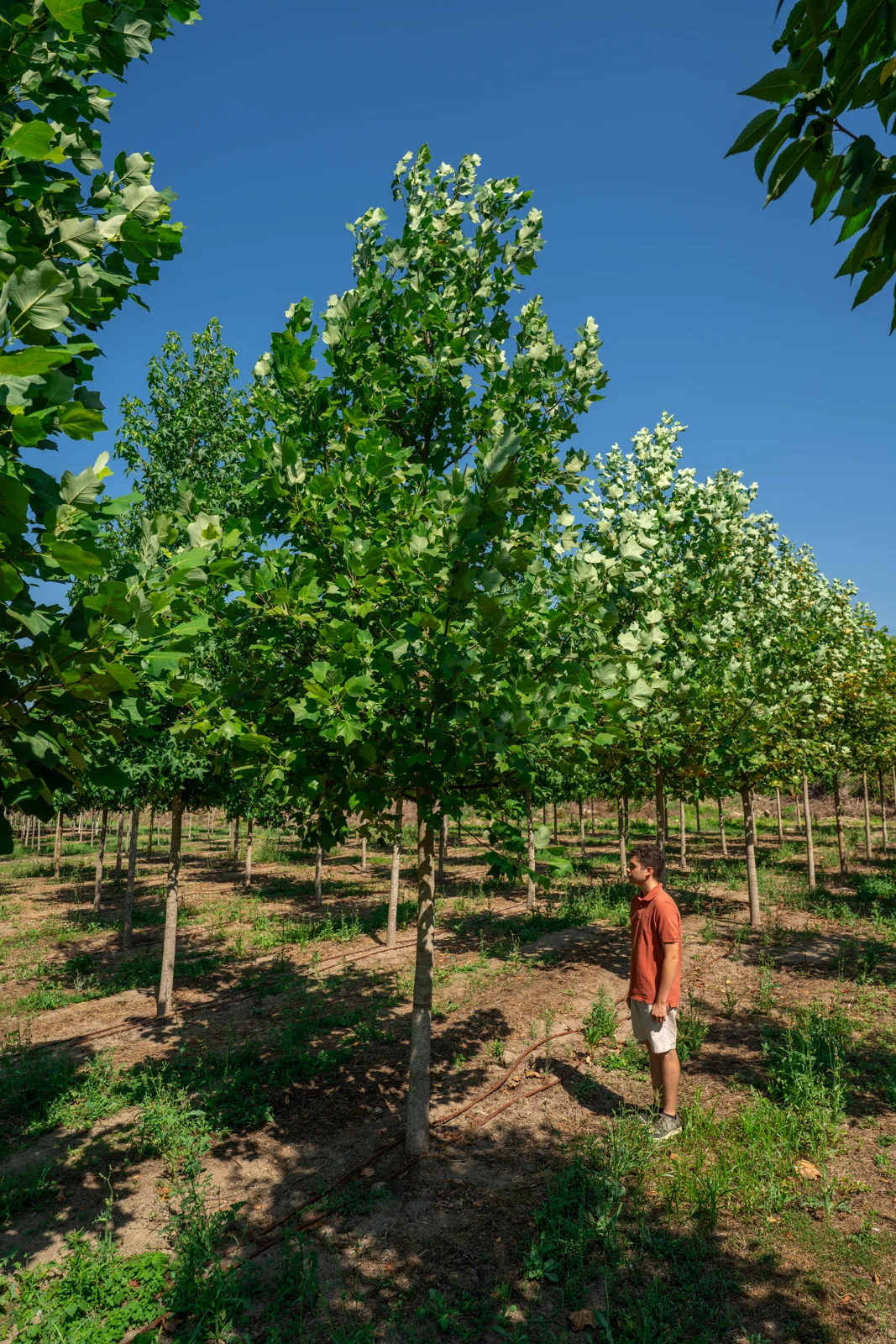
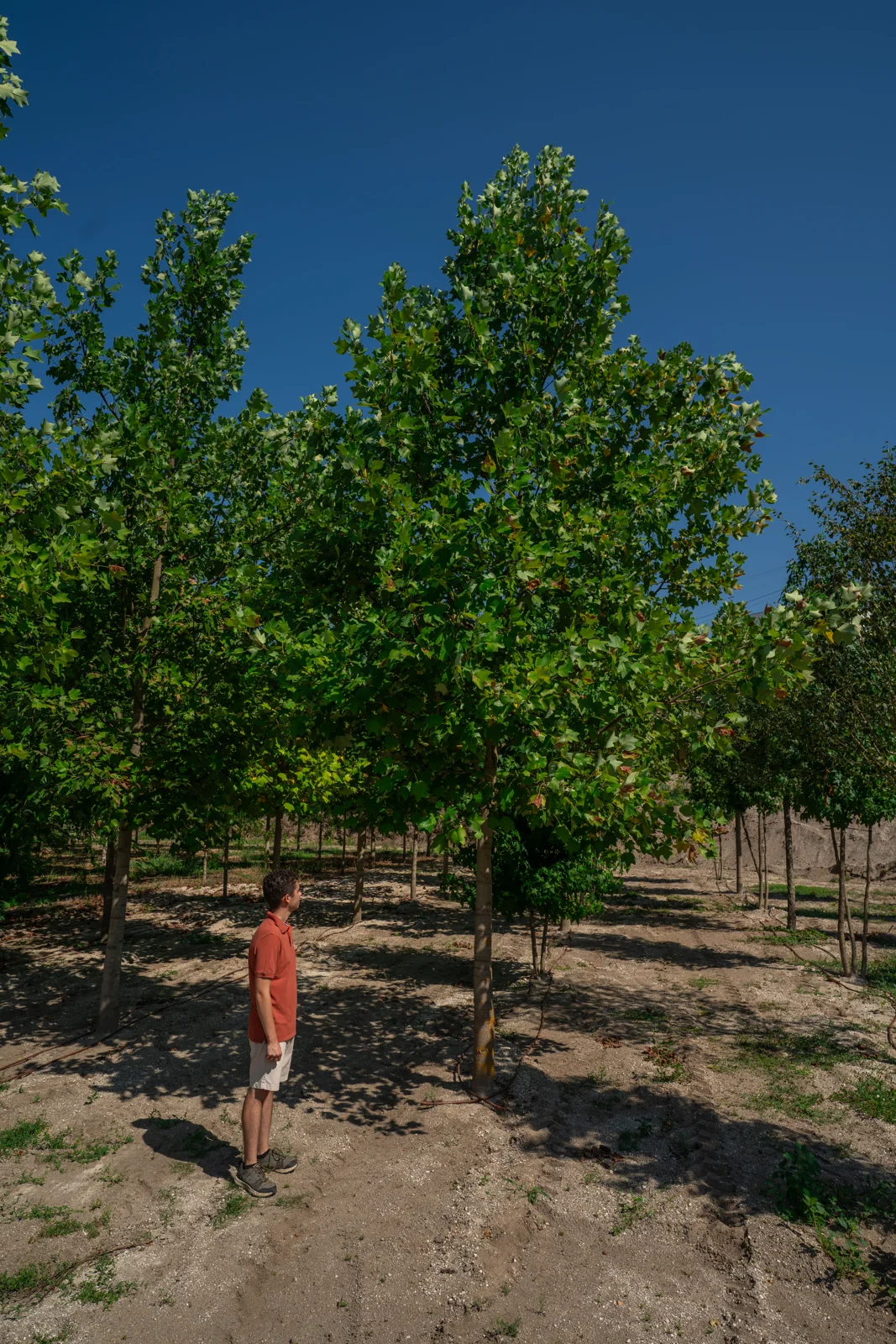
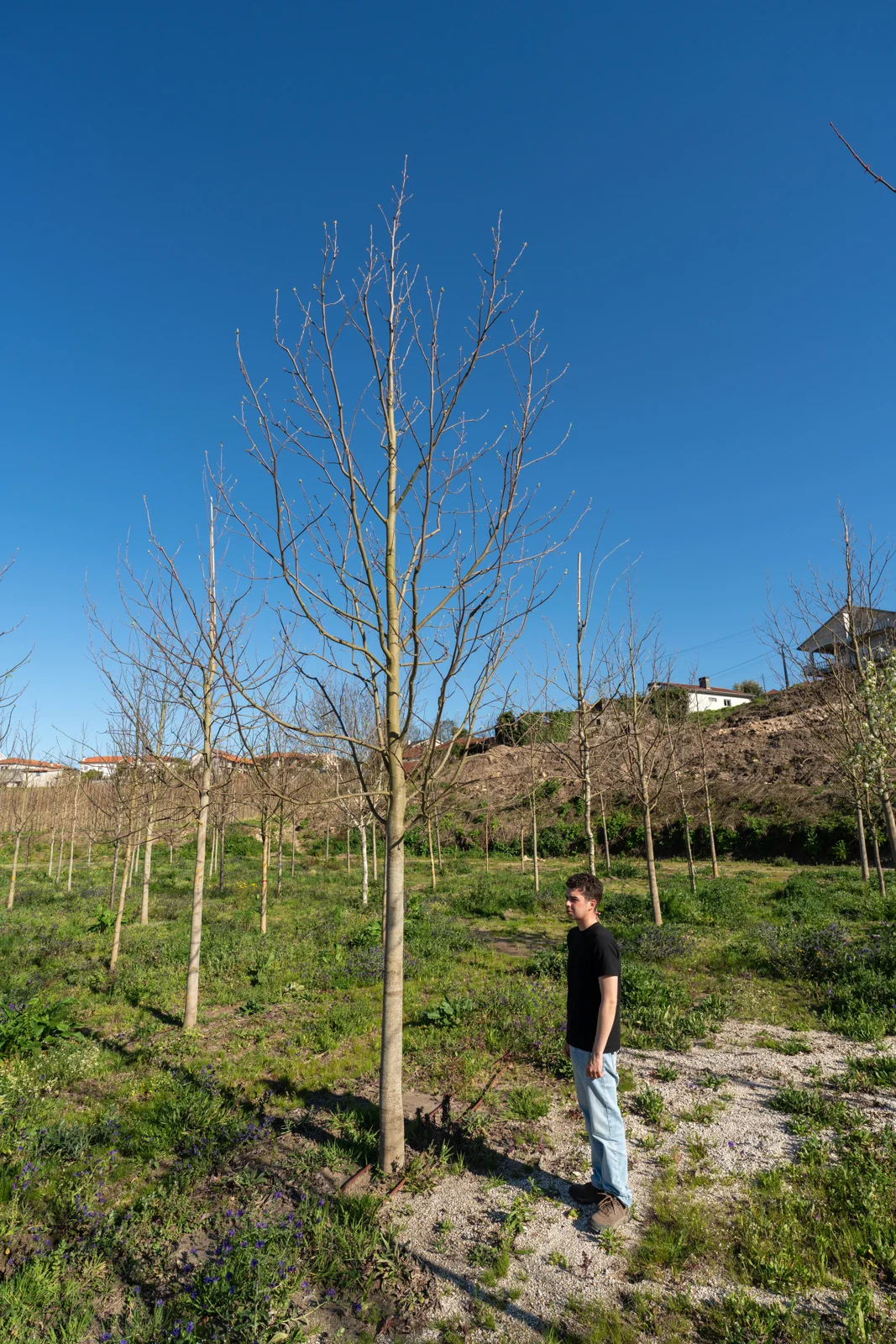
Fast-growing canopy tree with distinctive foliage and tulip flowers
Tulip Tree · Liriodendron tulipifera
A large deciduous canopy tree suited to parkland, estate, and urban shade plantings across much of temperate Europe. Winter-hardy to approximately minus 34 °C (USDA zone 4a), it tolerates a wider climatic range than most North American broadleaves.
About this Species
One of the few fast-growing broadleaves that combines rapid height gain with structurally sound wood, Liriodendron tulipifera develops a strongly conical crown to 20 to 35 metres, broadening with age to an oval silhouette roughly 10 to 15 metres wide. Growth rates of 60 to 90 centimetres per year in the establishment phase are realistic on suitable sites.…
Read more
Show less
One of the few fast-growing broadleaves that combines rapid height gain with structurally sound wood, Liriodendron tulipifera develops a strongly conical crown to 20 to 35 metres, broadening with age to an oval silhouette roughly 10 to 15 metres wide. Growth rates of 60 to 90 centimetres per year in the establishment phase are realistic on suitable sites. The foliage is immediately recognisable: four-lobed leaves with a broad, truncate apex give a distinctive outline unlike any other European-planted broadleaf, and the bright green canopy turns a clear golden yellow in autumn.
Cup-shaped flowers appear in May and June, greenish yellow with an orange band at the base of each petal, borne upright at branch tips. On young trees they are conspicuous; on larger specimens they tend to sit high in the crown and are often noticed only when petals fall. The flowers are nectar-rich, supporting pollinators where urban biodiversity is a design consideration.
Hardiness is among the broadest in the catalogue. The species is reliable throughout USDA zones 4a to 9a, tolerating winter minima down to approximately minus 34 °C. In Europe this places it comfortably within range from southern Scandinavia and the Baltic coast through to the Po valley, the Pannonian basin, and the Atlantic and Mediterranean seaboards. Specimens of nearly 50 metres have been recorded near Milan and Pau in southwest France; the tallest broadleaf at the National Botanic Garden in Meise, Belgium, is a Liriodendron at over 46 metres. In Finland, it has been grown as far north as Arboretum Mustila, though at those latitudes it may not develop a full-sized trunk.
The principal site limitation is soil moisture and structure. Liriodendron requires deep, moist, well-drained, preferably loamy and slightly acidic ground. It does not tolerate waterlogged clay, compacted substrates, or prolonged ponding. On dry, chalky, or shallow soils it will survive but perform poorly, and extended summer drought above 35 °C can trigger premature leaf yellowing and drop. Salt tolerance is low, ruling out exposed coastal positions with salt-laden wind. Transplanting should be carried out in early spring before leaf-out, as the fleshy Magnoliaceae root system is susceptible to damage if handled roughly or moved late in the season.



Advice on this species
Want to know more about Liriodendron tulipifera?
Tell us about your project and we'll advise you on this species — where it thrives, which size makes sense, and what to expect once planted.
- Produção própria
- Exemplares adultos
- Resposta em 1–2 dias
Sem compromisso · orçamento personalizado