

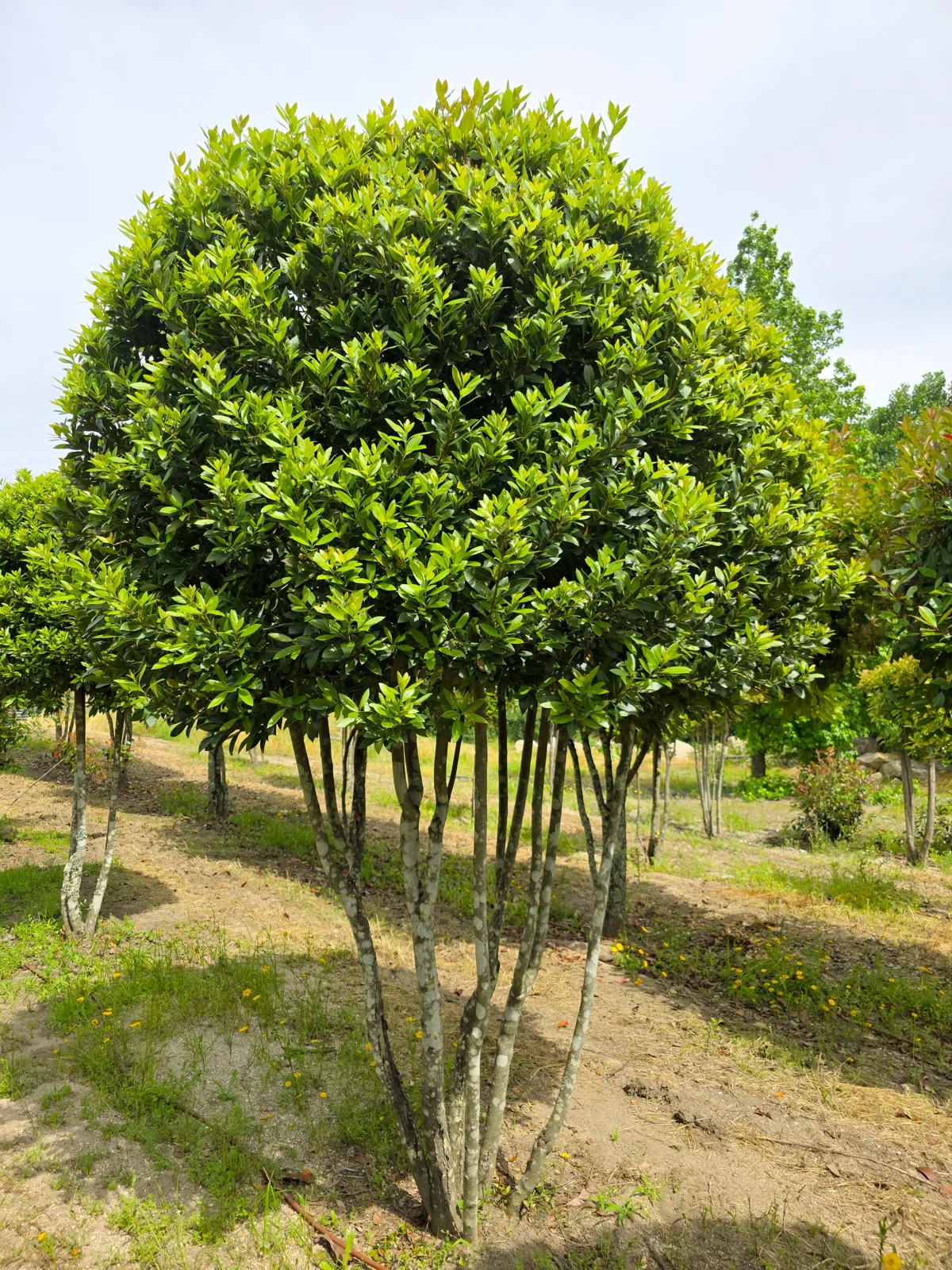
Evergreen Mediterranean canopy tree for warm-temperate and Atlantic schemes
Bay Laurel · Laurus nobilis
A clippable evergreen presence with culinary and architectural pedigree, defensible across the Atlantic seaboard, the Mediterranean basin, and warm pockets of central Europe where winter minima reliably hold above minus twelve degrees Celsius.
About this Species
A relict of the Mediterranean laurel forests that retreated during the Pliocene, Laurus nobilis is an aromatic broadleaf evergreen with leathery, ovate leaves in blue green to silvery green and dark grey, fissured bark. Habit is naturally conical and inclined to multiple stems; in open European cultivation, working sizes of 5 to 12 metres in height with a 3…
Read more
Show less
A relict of the Mediterranean laurel forests that retreated during the Pliocene, Laurus nobilis is an aromatic broadleaf evergreen with leathery, ovate leaves in blue green to silvery green and dark grey, fissured bark. Habit is naturally conical and inclined to multiple stems; in open European cultivation, working sizes of 5 to 12 metres in height with a 3 to 6 metre spread are realistic, with specimens to 20 metres recorded in optimal conditions.
The climate envelope is warm-temperate to Mediterranean. Reliably winter hardy in USDA zone 8b and warmer, with mature specimens accepting brief minima around minus 12 degrees Celsius; foliage scorch and stem dieback appear below approximately minus 15 degrees Celsius. The reliable band covers coastal Iberia and the Mediterranean basin, the Atlantic seaboard from Brittany to coastal Ireland, sheltered sites in the coastal Netherlands and Belgium, the Po valley, the Adriatic coast, and the warmer Aegean and Pannonian margins. North of a line through Edinburgh or east of a line through Berlin, performance becomes contingent on sheltered urban microclimates; in continental zone 7 and colder, specify as a movable container subject for orangery overwintering rather than as a ground planted specimen.
Heat tolerance is high; the species sustains prolonged maxima above 35 degrees Celsius without leaf damage where root volume is adequate. Drought tolerance is moderate once established, supported by reduced cuticular loss from the aromatic foliage, but the tree is not a steppe species and shows stress under prolonged sub 400 millimetre summers without supplementary water. It accepts loamy and clay soils with assured drainage, tolerates moderate coastal salt and exposure, and performs in full sun to partial shade. Avoid waterlogged ground; phytophthora and root rot are the principal soil pathologies, with the psyllid Trioza alacris and soft scale the recurring foliar pests.
Specification roles span specimen, multi stem feature, evergreen screen, clipped standard, pyramid, and high hedge. The species bears clipping and pollarding, holds its line for formal axes, and reads as a low maintenance evergreen anchor where Quercus ilex is the closer functional reference than any deciduous broadleaf in the pan European urban canon.



Advice on this species
Want to know more about Laurus nobilis?
Tell us about your project and we'll advise you on this species — where it thrives, which size makes sense, and what to expect once planted.
- Produção própria
- Exemplares adultos
- Resposta em 1–2 dias
Sem compromisso · orçamento personalizado