

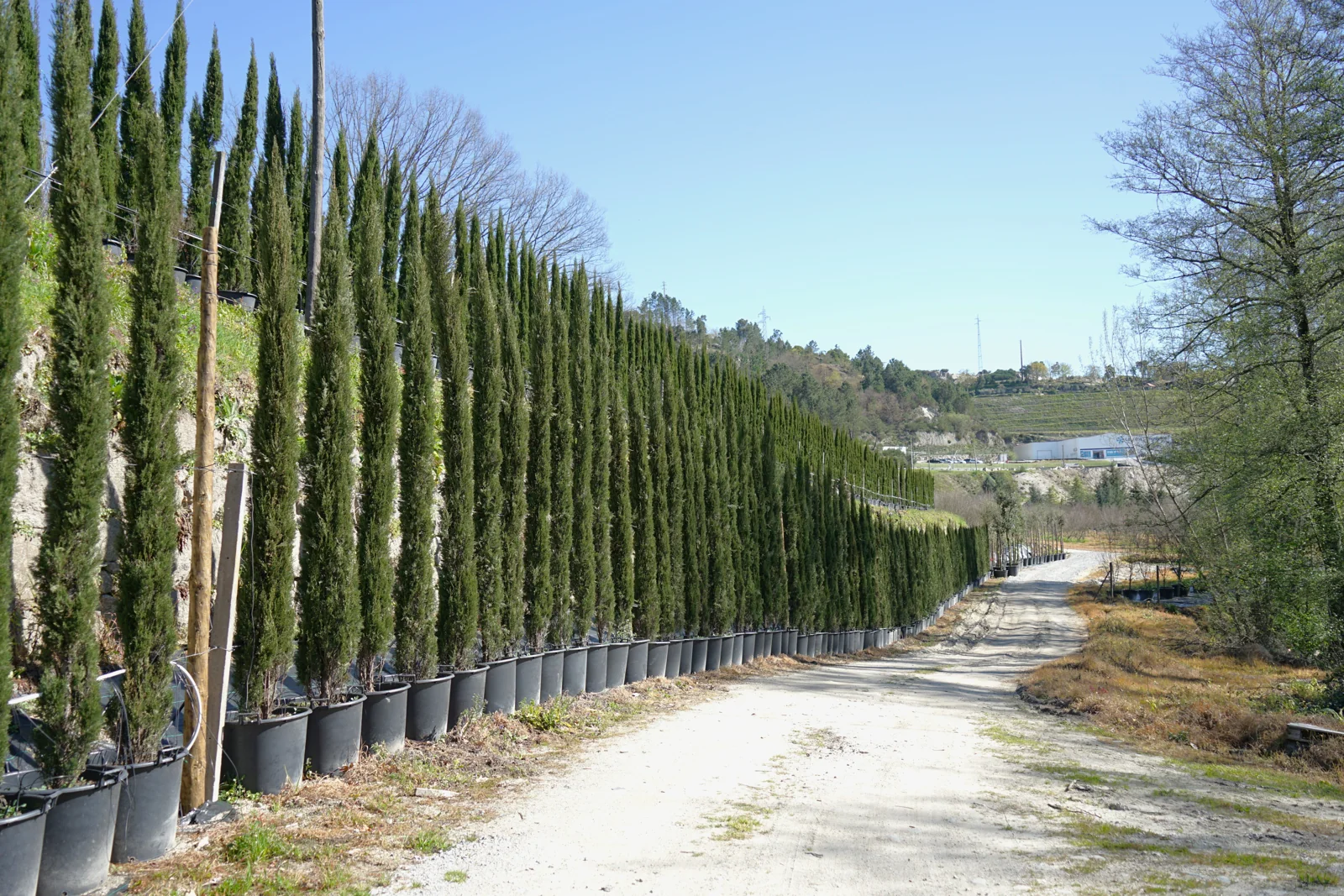
Columnar Mediterranean evergreen for warm-temperate accents
Italian Cypress ‘Stricta’ · Cupressus sempervirens ‘Stricta’
A strictly fastigiate silhouette, specified across warm-temperate Europe as a vertical evergreen accent wherever a narrow architectural line and proven tolerance of summer drought together define the brief.
Key Facts
About this Cultivar
'Stricta' carries the classic columnar habit of the Italian cypress in its tightest form. Mature height in cultivation reaches 15 to 20 metres with a crown width of only 2 to 3 metres, giving a height-to-spread ratio that no broadleaf alternative in the European urban canon, from Platanus to Tilia to Quercus robur, can substitute for. Foliage is dense, dark…
Read more
Show less
'Stricta' carries the classic columnar habit of the Italian cypress in its tightest form. Mature height in cultivation reaches 15 to 20 metres with a crown width of only 2 to 3 metres, giving a height-to-spread ratio that no broadleaf alternative in the European urban canon, from Platanus to Tilia to Quercus robur, can substitute for. Foliage is dense, dark green, and persistent year-round, holding the silhouette through winter.
The climate envelope is Mediterranean and Atlantic warm-temperate. Reliably hardy to roughly minus 12 to minus 15 °C (USDA zone 7b at the cold edge, 8a with confidence), tolerant of prolonged summer maxima above 35 °C, and unbothered by annual rainfall below 500 mm once established. Performance is reliable along the Mediterranean and Aegean coasts, the Atlantic seaboard from Brittany southward, the Po valley, and sheltered coastal sites in southern England, Ireland, and the Low Countries.
North and east of that envelope, expectations should be calibrated. In continental zone 7a interiors, the Pannonian basin, inland Poland and Czechia, and anywhere north of a line through Berlin or Edinburgh, foliage scorch and trunk splitting from radiative night frosts become real risks; the tree is not a defensible specification for boreal or strongly continental sites. Heavy wet snow loads can also splay the upright leaders, so exposed sites benefit from discreet structural support during establishment.
Siting calls for full sun, free-draining soil, and shelter from cold continental winds. Tolerance of alkaline and chalky substrates, sandy coastal soils, and moderate salt-laden wind extends use into resort and infrastructure plantings on the southern and Atlantic margins. The crown's narrow footprint suits tight tree pits, formal alignments framing entrances and axes, and rhythmic vertical punctuation in parkland or estate schemes where a broader-crowned conifer would close down sightlines.
Advice on this species
Want to know more about Cupressus sempervirens 'Stricta'?
Tell us about your project and we'll advise you on this species — where it thrives, which size makes sense, and what to expect once planted.
- Produção própria
- Exemplares adultos
- Resposta em 1–2 dias
Sem compromisso · orçamento personalizado