

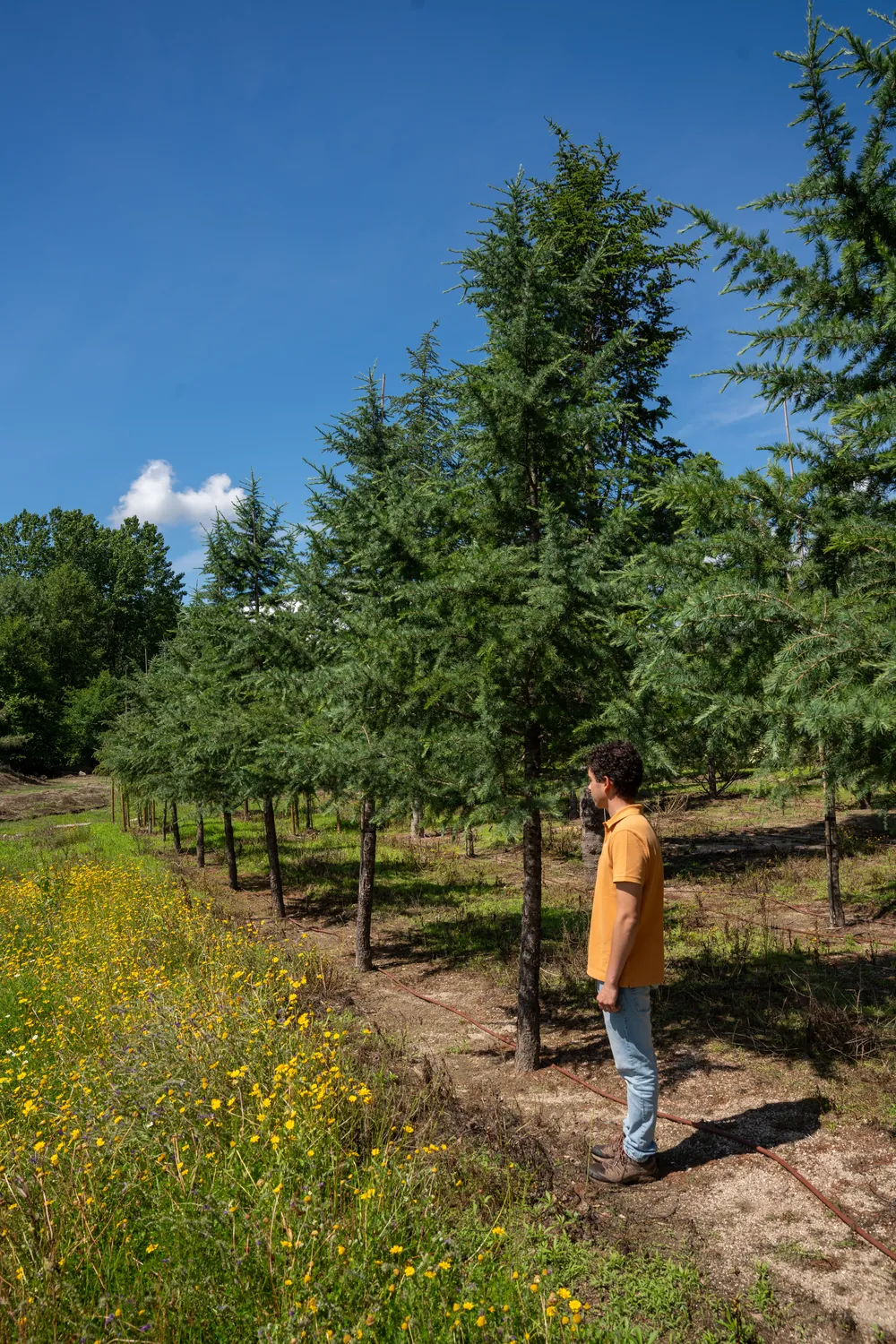
Drought-adapted Himalayan conifer for warm-temperate parkland
Deodar Cedar · Cedrus deodara
{# A tabela de LOTES (§C, «zoom no lote») foi movida para baixo das características (botânica em cima, lotes em baixo — reunião 24/07). Ver #crm-lotes mais abaixo. #}A specimen conifer for warm-temperate European projects where a large evergreen silhouette is required, Cedrus deodara performs reliably across Atlantic and Mediterranean climates and tolerates summer drought once established.
About this Species
Native to the western Himalayas between roughly 1,200 and 3,200 metres, Cedrus deodara reaches 20 to 40 metres in cultivation. The crown is conical when young, broadening with age to a flat-topped form with horizontal branching and pendulous branchlets, the most weeping silhouette among the true cedars. Foliage holds a glaucous grey-green to blue-green tone year-round, giving the tree a defined winter presence in mixed evergreen schemes.
The climate envelope for the species in its standard form is USDA zone 7 and warmer, reliable to around minus 20 °C with damage reported below minus 25 °C. This places it confidently across the Atlantic seaboard, the western and central Mediterranean basin, the Po valley, the Pannonian basin, and as far north as coastal Belgium, the Netherlands, and southern England in sheltered positions. East of a line through Berlin and across continental zone 6, expect winter damage on standard provenances. Cold-selected German clones from the Paktia and Kashmir…
Native to the western Himalayas between roughly 1,200 and 3,200 metres, Cedrus deodara reaches 20 to 40 metres in cultivation. The crown is conical when young, broadening with age to a flat-topped form with horizontal branching and pendulous branchlets, the most weeping silhouette among the true cedars. Foliage holds a glaucous grey-green to blue-green tone year-round, giving the tree a defined winter presence in mixed evergreen schemes.
The climate envelope for the species in its standard form is USDA zone 7 and warmer, reliable to around minus 20 °C with damage reported below minus 25 °C. This places it confidently across the Atlantic seaboard, the western and central Mediterranean basin, the Po valley, the Pannonian basin, and as far north as coastal Belgium, the Netherlands, and southern England in sheltered positions. East of a line through Berlin and across continental zone 6, expect winter damage on standard provenances. Cold-selected German clones from the Paktia and Kashmir provenances extend reliability towards zone 6, useful where a continental project still requires a true cedar.
Summer performance is the species' strongest argument outside the Mediterranean: it withstands prolonged maxima above 35 °C with adequate root depth, tolerates dry continental summers once established, and accepts humid maritime summers better than C. atlantica or C. libani. Rainfall between 600 and 1,200 mm distributed through the year suits it; it does not accept waterlogged ground and declines on heavy, poorly drained substrates.
Specify in full sun on deep, freely drained, slightly acidic loams. Wind exposure is tolerated inland but coastal salt-laden wind shortens the crown and browns the lower needles. Use as a single specimen on lawns or in parkland, as a structural focal point in resort and estate schemes, or as a tall evergreen screen where the mature spread of 8 to 12 metres can be accommodated. Avoid narrow tree pits and avenues that require uniform monopodial form, as the central leader can fail with age.
Disponibilidade & preço
Interested in Cedrus deodara?
Our team can help you select the perfect specimen for your project. Get in touch for availability and pricing.
- Produção própria
- Exemplares adultos
- Resposta em 1–2 dias
Sem compromisso · orçamento personalizado