

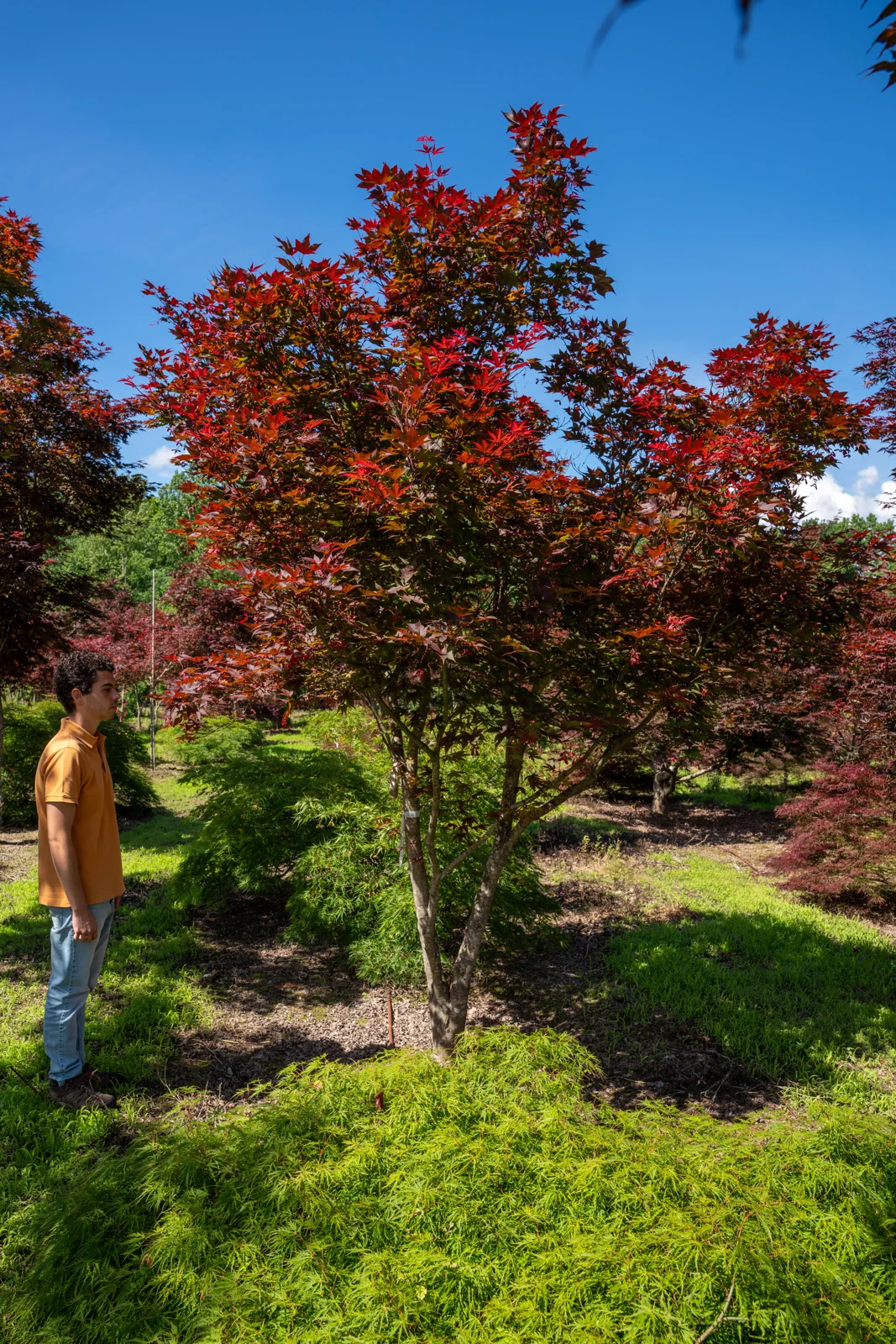
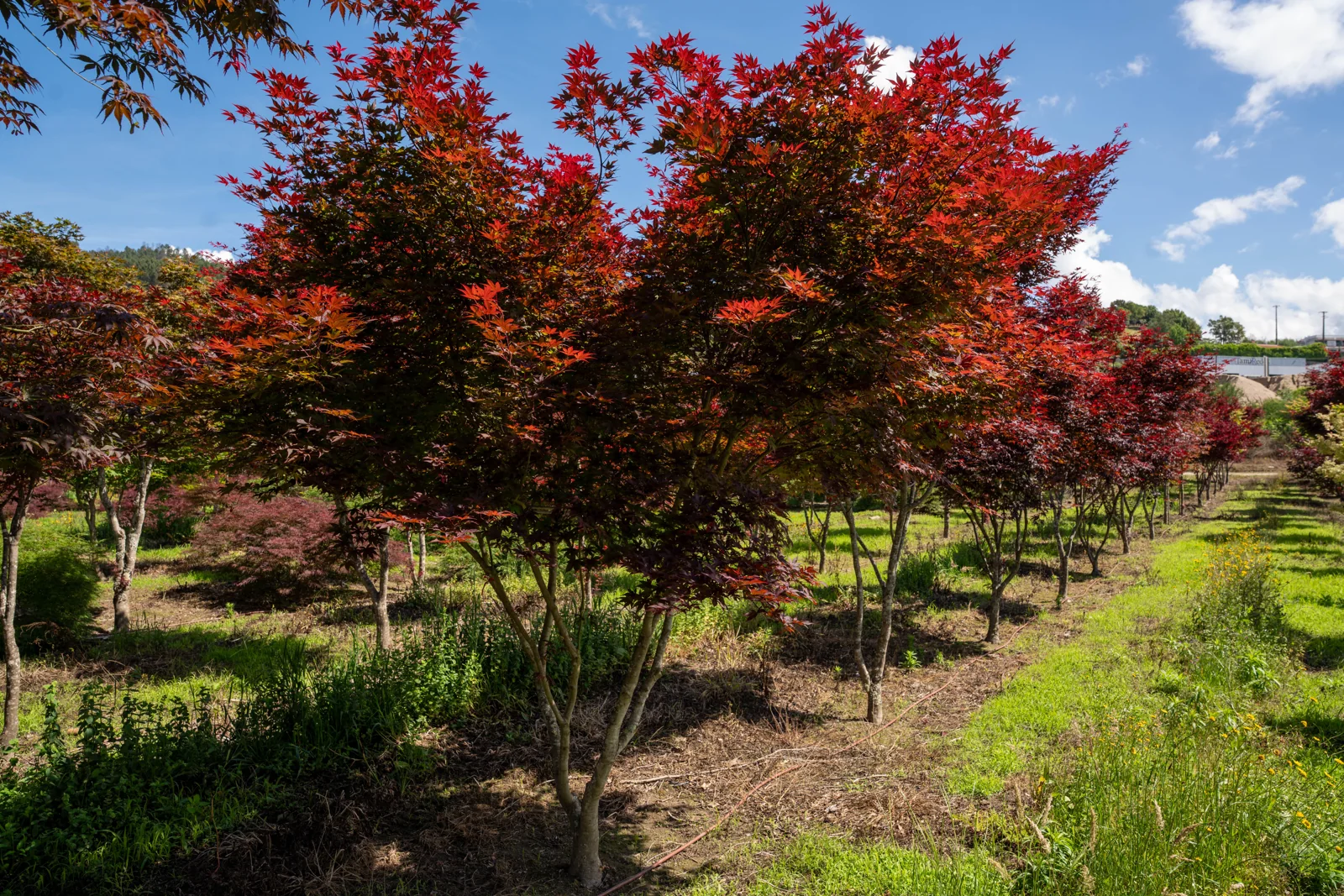
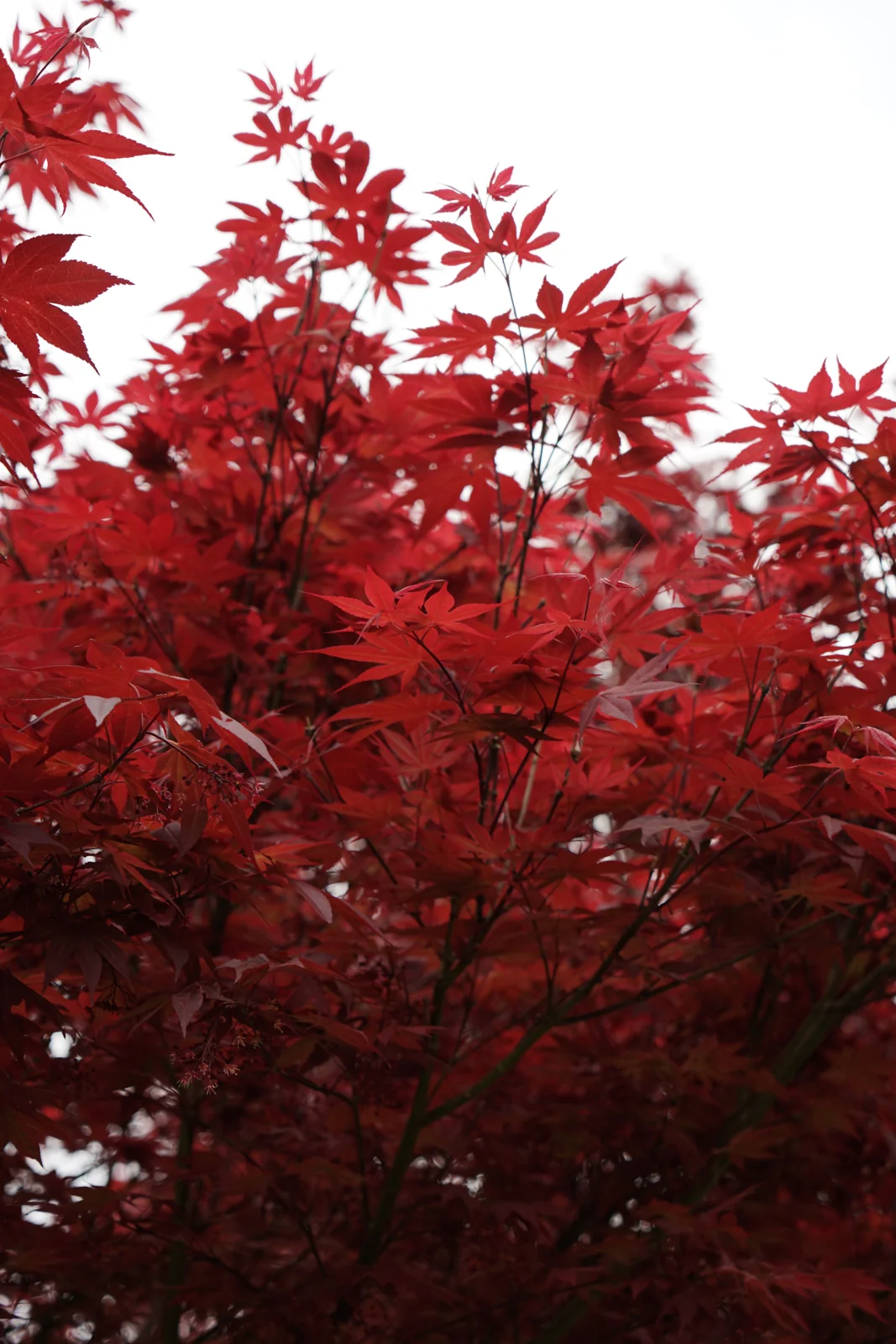
Compact Acer palmatum cultivar with sustained fire red summer foliage
Japanese Maple ‘Fireglow’ · Acer palmatum ‘Fireglow’
An Acer palmatum cultivar selected for fire red colour from spring through autumn, hardy to about minus 15 degrees C (USDA zone 7a). A focal specimen for sheltered partial shade settings across warm temperate and Atlantic Europe.
Key Facts
About this Cultivar
Within the established purple-leaved Acer palmatum cultivar group (Atropurpureum, Bloodgood, Sherwood Flame), 'Fireglow' distinguishes itself by the brightness and seasonal persistence of its red colouring. The hue tends toward flame rather than deep burgundy, and it holds through the summer months without the dulling bronze that affects 'Bloodgood' under…
Read more
Show less
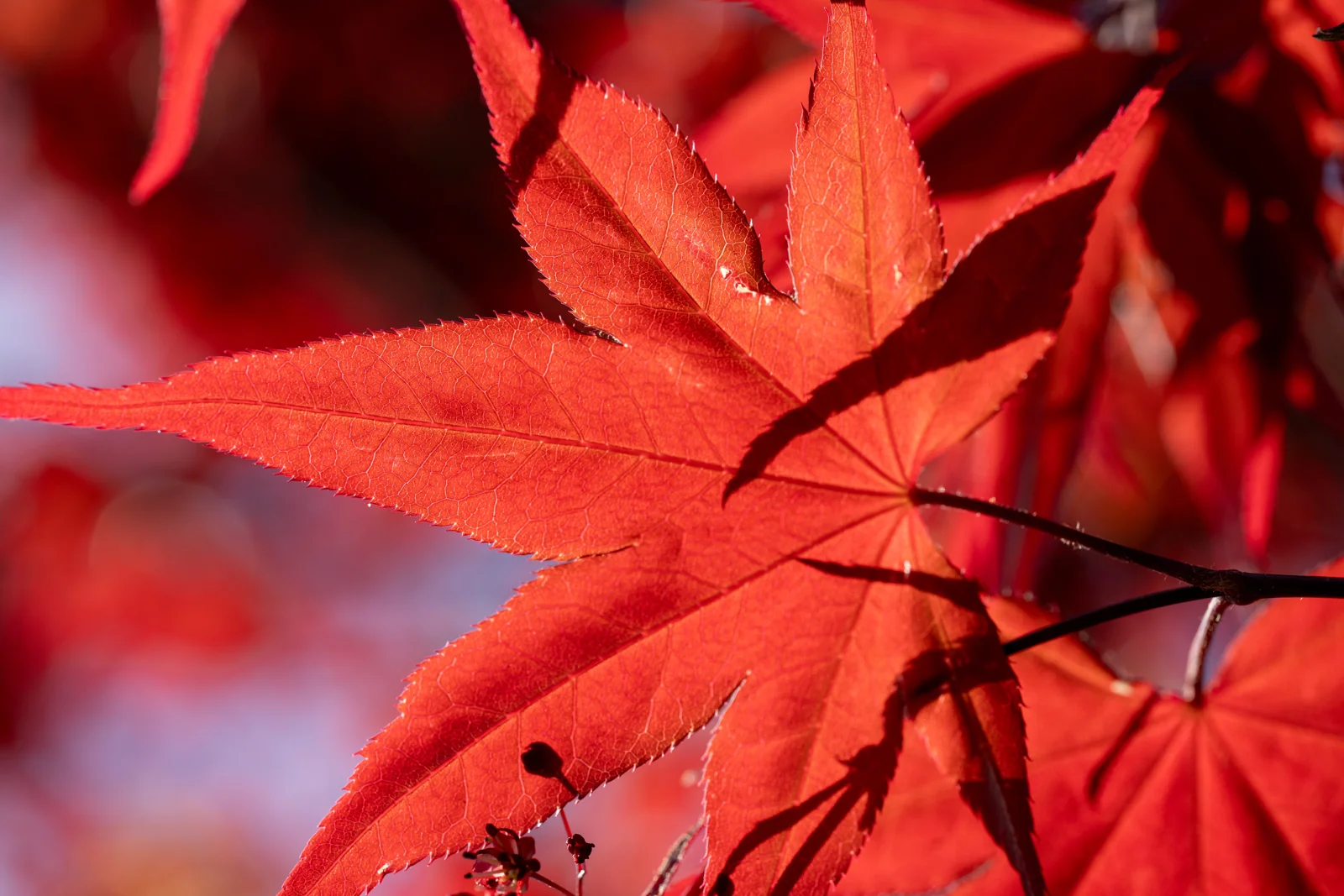
Within the established purple-leaved Acer palmatum cultivar group (Atropurpureum, Bloodgood, Sherwood Flame), 'Fireglow' distinguishes itself by the brightness and seasonal persistence of its red colouring. The hue tends toward flame rather than deep burgundy, and it holds through the summer months without the dulling bronze that affects 'Bloodgood' under hot dry conditions. The leaf is regular palmate, five to seven lobed, and the habit is upright and rounded; this is not the laceleaf Dissectum cultivar group and not a weeping form.
Mature dimensions sit at 3 to 4 m in height and spread, placing the cultivar in the focal specimen role rather than any alignment or structural canopy specification. Growth rate is slightly above the average for purple cultivars at around 20 to 25 cm per year in favourable conditions, which shortens the timeline to project calibre. The crown architecture remains erect and clean at maturity, suitable for a contained courtyard, a private garden focal point, or a large deep-section planter where root volume is managed.
Climate envelope. Winter hardiness reaches reliably to approximately minus 15 degrees C (USDA zone 7a) on mature wood in free draining substrate; damage to young wood is observed below approximately minus 18 degrees C in open exposure. This places the cultivar within reliable performance across coastal southern England, the Atlantic seaboard from the Loire estuary northward, coastal Belgium and the Netherlands, the Po valley, the Adriatic coast, the Pannonian basin in its milder western reaches, and the warmer Mediterranean coastal zones. Continental sites east of a line through Berlin and northern sites above approximately the Edinburgh latitude require windbreak shelter, free drainage, and an avoidance of open exposure on young plants; in Boreal climates and at altitudes above 600 m, the cultivar is generally outside its working envelope.
Site requirements remain narrow. The cultivar requires an acidic to mildly acidic, free draining, organic substrate; calcareous active soils trigger iron chlorosis and stunted development. Light exposure should be partial shade, the filtered cover of a taller canopy or a wall orientation that excludes direct afternoon sun, particularly in warm continental and Mediterranean climates where prolonged summer maxima above 35 degrees C produce marginal scorch and a dulled colour. Annual rainfall in the 700 to 1200 mm range distributed through the season suits the cultivar best; under sustained drought below 500 mm, supplementary irrigation is required to maintain leaf integrity. Disease resistance is moderate, with watchfulness required against Verticillium on poorly drained sites and against scale insects under sustained drought stress. Autumn colour carries the summer red into orange and scarlet, holding for approximately two to three weeks in cool-temperate continental and Atlantic settings.
Advice on this species
Want to know more about Acer palmatum 'Fireglow'?
Tell us about your project and we'll advise you on this species — where it thrives, which size makes sense, and what to expect once planted.
- Produção própria
- Exemplares adultos
- Resposta em 1–2 dias
Sem compromisso · orçamento personalizado