

Slow upright evergreen for formal structure and screening
English Yew ‘Fastigiata Robusta’ · Taxus baccata ‘Fastigiata Robusta’
Where a scheme needs a slow, dense vertical accent that holds line and clipped form for decades, this fastigiate yew delivers a tight columnar silhouette, dark glossy foliage, and an evergreen presence on calcareous and clay soils.
- Narrow upright form gives vertical structure without taking width
- Thrives across the Costa del Sol, Costa Blanca, and the Balearics once established
- Tolerates alkaline and chalky soils with free drainage
Key Facts
About this Cultivar
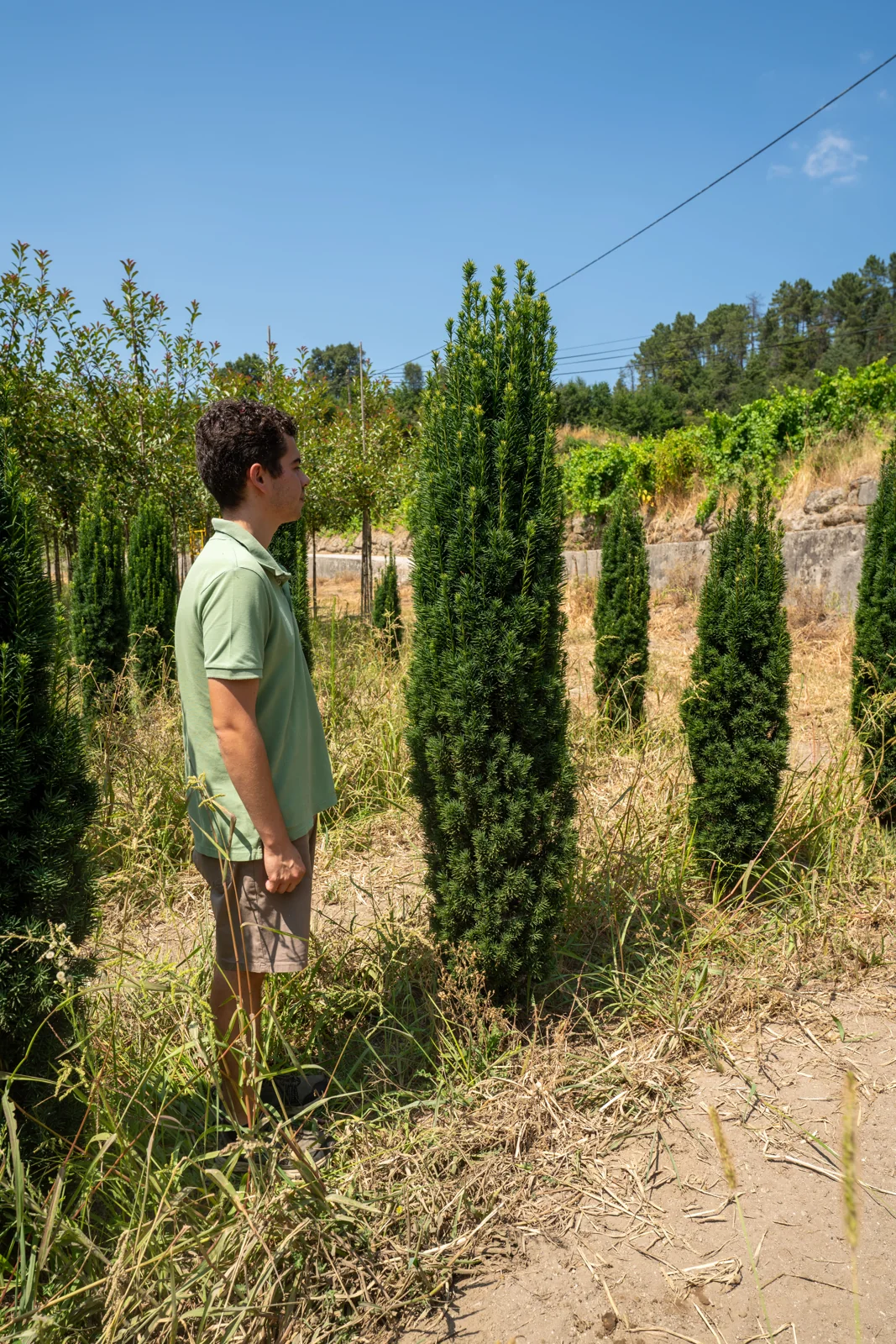
Tighter and more upright than the familiar 'Fastigiata', this selection forms a narrow columnar crown of closely held branches, giving a cleaner vertical line for avenues, formal parterres, and repeated structural accents. The needles are dark green, glossy, and longer than the type, reading as a dense near-black column at maturity. For an international…
Read more
Show less
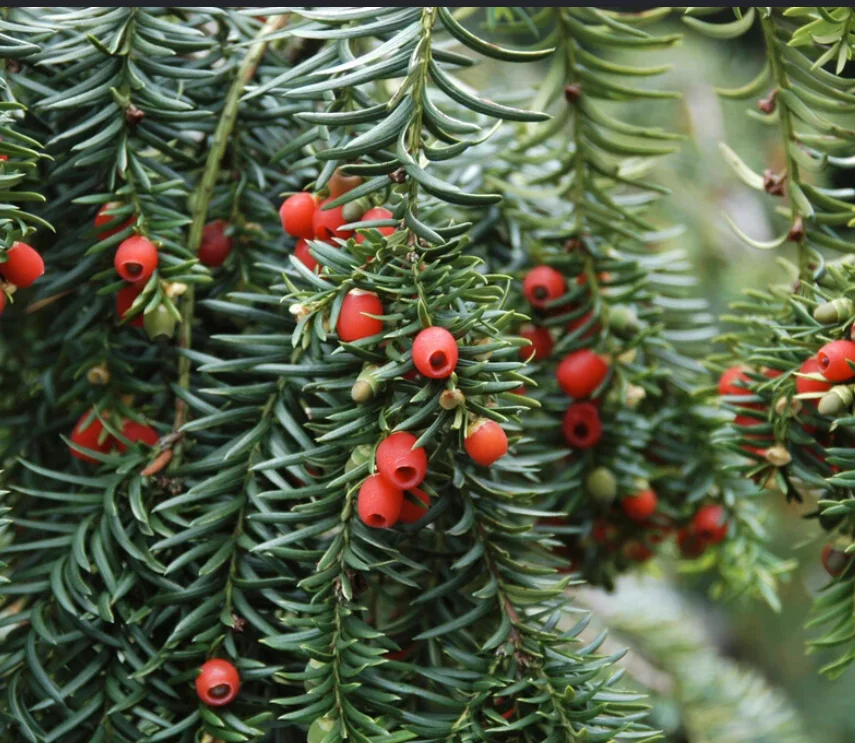
Tighter and more upright than the familiar 'Fastigiata', this selection forms a narrow columnar crown of closely held branches, giving a cleaner vertical line for avenues, formal parterres, and repeated structural accents. The needles are dark green, glossy, and longer than the type, reading as a dense near-black column at maturity. For an international specifier, it sits where Cupressus sempervirens or clipped Quercus ilex might otherwise carry the vertical, but with finer texture and far greater tolerance of shade and cold.
Growth is slow, which is the point: the form stays disciplined for many years with minimal correction, and the dense habit takes clipping well for hedging or topiary where a project calls for it. Expect a mature height in the region of 8 to 15 m over a long horizon, with a spread of 5 to 10 m, though the columnar habit keeps the working footprint narrow for confined urban pits and tight planting lines.
Climatically it is suited to the cooler and wetter parts of Spain, including the humid Atlantic northwest (the cornisa cantabrica) and the wider plateau interior (the meseta), where it is hardy to roughly minus 18 to minus 20 degrees C. It tolerates the deep shade of courtyards and north walls, an advantage in dense urban fabric. In hot, dry Mediterranean and semi-arid southeastern sites it asks for afternoon shade, free-draining soil, and supplementary irrigation through its first summers, after which an established root system carries moderate drought.
It accepts a wide range of soils, performing notably well on the alkaline and calcareous ground common across much of Spain, and stays clean of major pest and disease pressure. The genus falls outside the Xylella fastidiosa host range, which makes it a defensible evergreen structural choice where Olea or other hosts are constrained. All parts except the red aril are toxic, a relevant note for planting near livestock or children.
Advice on this species
Want to know more about Taxus baccata 'Fastigiata Robusta'?
Tell us about your project and we'll advise you on this species — where it thrives, which size makes sense, and what to expect once planted.
- Produção própria
- Exemplares adultos
- Resposta em 1–2 dias
Sem compromisso · orçamento personalizado