

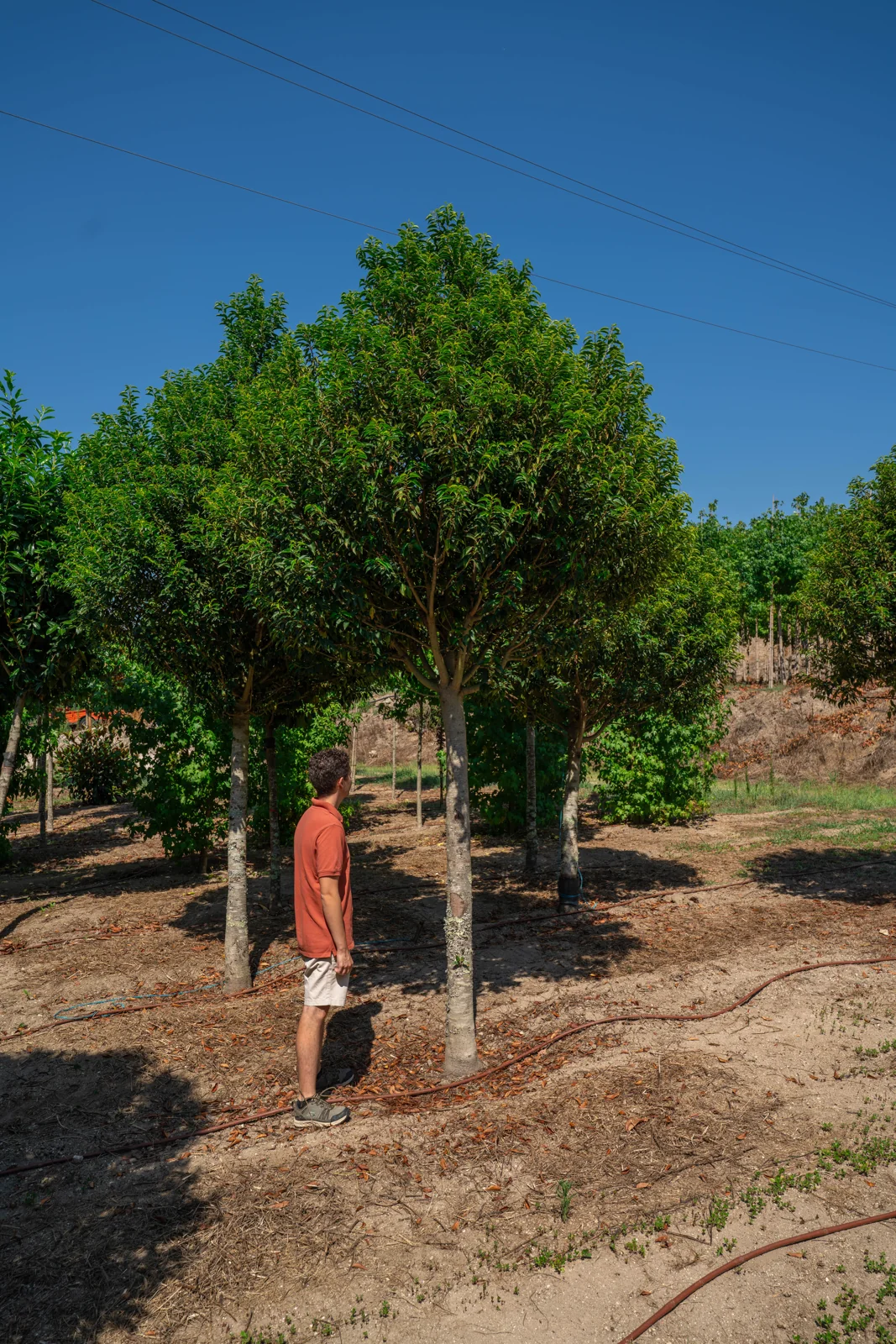
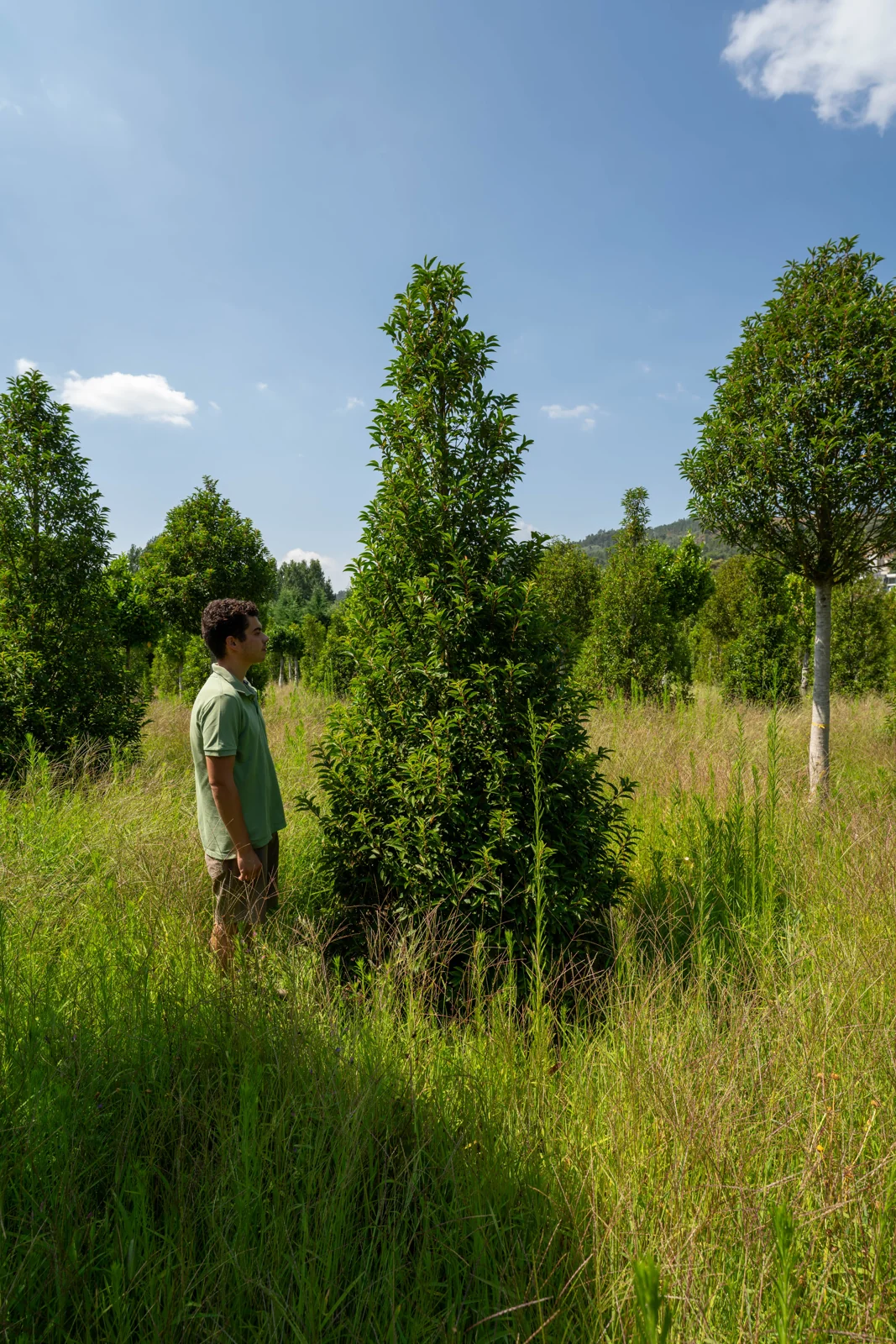
A refined evergreen screen for the walled garden
Portuguese Laurel ‘Angustifolia’ · Prunus lusitanica ‘Angustifolia’
Evergreen structure that holds its line year-round, carried on a dense upright crown of narrow glossy leaves. Specifiers building formal screens across much of Spain reach for it as a refined, Iberian-native alternative to cherry laurel.
- Finer, narrower foliage than the common cherry laurel
- Dense evergreen screen that takes clipping into formal shapes
- Thrives on the Costa del Sol, Costa Blanca, and Balearics
About this Cultivar
The narrow, elongated dark glossy leaves set this selection apart from the type, giving a finer, denser texture on a tight upright crown that reaches 4 to 6 m tall and 2 to 3 m wide. That restrained spread, held without heavy pruning, makes it a cleaner choice than the straight species for formal screens (setos formales) and clipped structure where a…
Read more
Show less
The narrow, elongated dark glossy leaves set this selection apart from the type, giving a finer, denser texture on a tight upright crown that reaches 4 to 6 m tall and 2 to 3 m wide. That restrained spread, held without heavy pruning, makes it a cleaner choice than the straight species for formal screens (setos formales) and clipped structure where a controlled outline matters. As a refined, Iberian-native alternative to cherry laurel (Prunus laurocerasus), it carries the same evergreen weight on a more disciplined frame.
Hardy to roughly -15 °C, it performs reliably across Mediterranean coastal Spain and the milder Atlantic northwest (cornisa cantábrica), and tolerates the cold winters of the central plateau (meseta) where a sheltered position protects new growth from late spring frost. Drought tolerance is moderate rather than absolute: a deepening root system carries established plants through the dry Mediterranean summer, but in the semi-arid southeast and on the hottest interior sites it holds condition better with supplementary irrigation. Through the first two to three summers it needs regular water to establish, after which demand falls sharply.
It accepts a wide range of soils provided drainage is good, from acidic Atlantic ground to alkaline coastal substrates, and its tolerance of urban pollution and confined pits suits street and courtyard work. As a Prunus, it sits within the recognised host range of Xylella fastidiosa, so coordinate with local teams on demarcated-zone status before specifying for projects in the Levante or the south. It responds well to pruning, recovering cleanly from clipping, which is what allows the compact hedge forms it is most often specified for.
In spring and early summer it carries erect racemes of small, fragrant white flowers that draw bees, followed by oval drupes ripening from red to black that feed birds. The glossy foliage holds colour and density year-round, giving the screening and backdrop value that is the tree's principal professional use.
Advice on this species
Want to know more about Prunus lusitanica 'Angustifolia'?
Tell us about your project and we'll advise you on this species — where it thrives, which size makes sense, and what to expect once planted.
- Produção própria
- Exemplares adultos
- Resposta em 1–2 dias
Sem compromisso · orçamento personalizado