

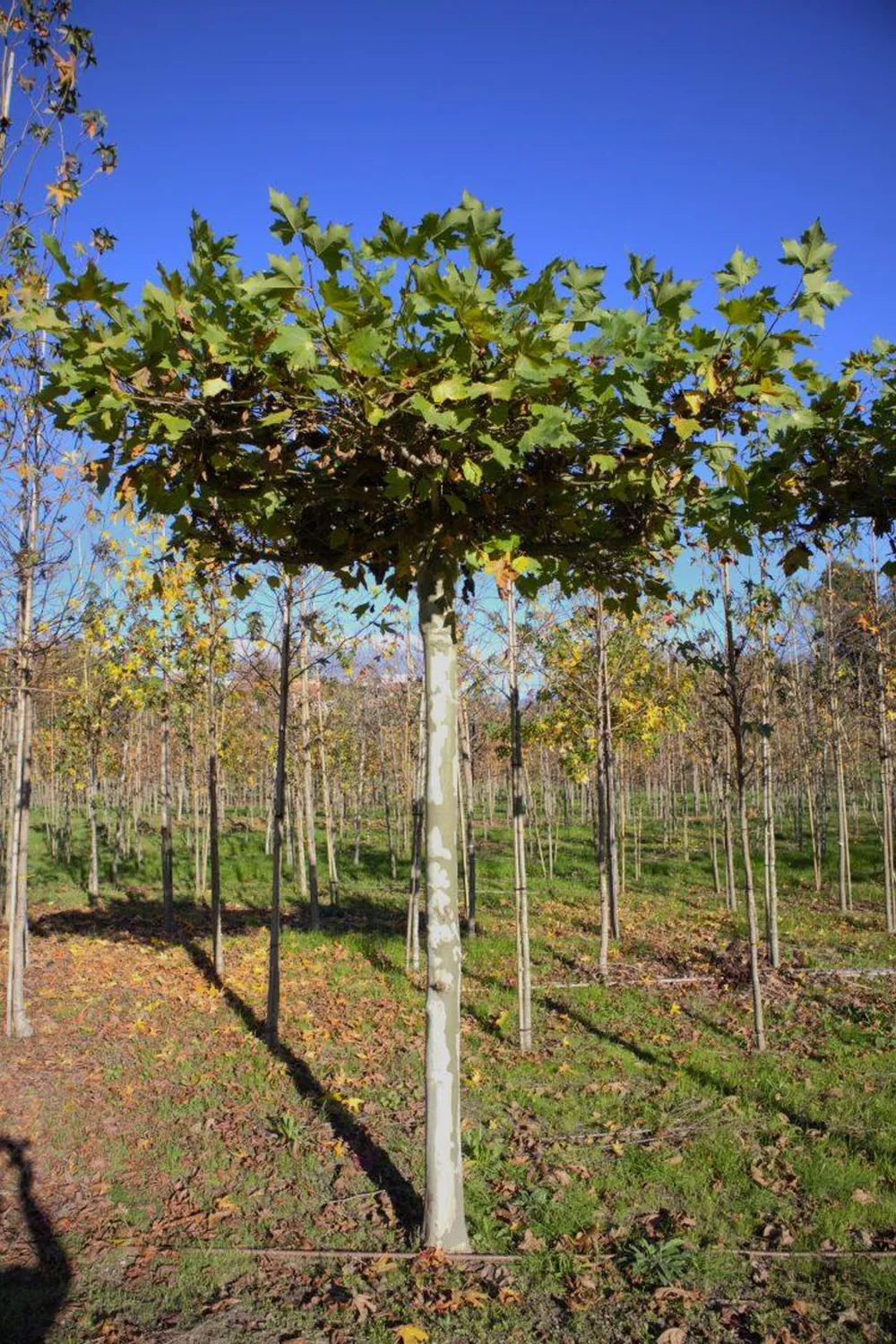
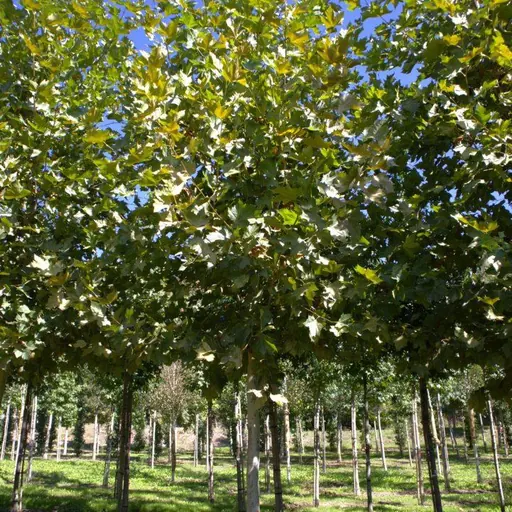
Generous summer shade for terrace and courtyard
London Plane · Platanus × hispanica
Few trees match its record in compacted city ground, casting dense summer shade over avenues and plazas while tolerating pollution, paving, and reflected heat. Specifiers reach for it where a fast canopy must close over a hard urban setting.
- Casts broad, cooling summer shade over terraces and courtyards
- Flaking cream-and-olive bark gives real winter interest
- Fast-growing, so a young tree reads as mature quickly
About this Species
Fast-growing and broad-crowned, it reaches 20 to 35 m in height with a spread of 15 to 25 m, building a dense, rounded canopy that closes over a street or plaza within a relatively short span of years. The flaking bark sheds in irregular plates to expose a creamy olive underbark, giving the trunk a mottled patina that reads as winter interest once the…
Read more
Show less
Fast-growing and broad-crowned, it reaches 20 to 35 m in height with a spread of 15 to 25 m, building a dense, rounded canopy that closes over a street or plaza within a relatively short span of years. The flaking bark sheds in irregular plates to expose a creamy olive underbark, giving the trunk a mottled patina that reads as winter interest once the maple-shaped foliage drops to a muted yellow-brown. As the standard plátano de sombra of Spanish urbanism, its behaviour is already familiar to municipal teams (servicio de parques y jardines); the case for specifying it rests on form, siting, and clean disease provenance rather than introduction.
The tree carries the full range of Spanish climates with ease. It is hardy well below minus 12 degrees Celsius, so continental meseta winters and late frosts in Castilla and Aragón pose no concern, and its high heat tolerance suits the hot dry summers of the Mediterranean coast and the southern interior. Reliable salt tolerance extends its use to exposed coastal projects along both the Mediterranean and Atlantic littorals.
Water demand is moderate rather than low. Through the first two or three summers it needs supplementary irrigation to establish its deep, vigorous root system; once mature, it draws on that root reach to hold form through seasonal drought and short irrigation cut-offs, though in the semi-arid southeast it performs best with retained access to ground moisture rather than on rainfall alone. It accepts heavy clay, compacted urban substrates, and a wide pH range, and adapts to the alkaline soils common across much of the peninsula.
The genus sits outside the Xylella fastidiosa host range, but its defining phytosanitary issue in Spain is Ceratocystis platani (canker stain, chancro coloreado), a lethal vascular pathogen spread largely through wounding and contaminated tools. Specifying stock of verified clean provenance, and the more resistant selections developed against it, is the relevant precaution. Note that the vigorous roots can lift paving and the persistent fruit balls and leaf litter add to maintenance.



Advice on this species
Want to know more about Platanus × hispanica?
Tell us about your project and we'll advise you on this species — where it thrives, which size makes sense, and what to expect once planted.
- Produção própria
- Exemplares adultos
- Resposta em 1–2 dias
Sem compromisso · orçamento personalizado