

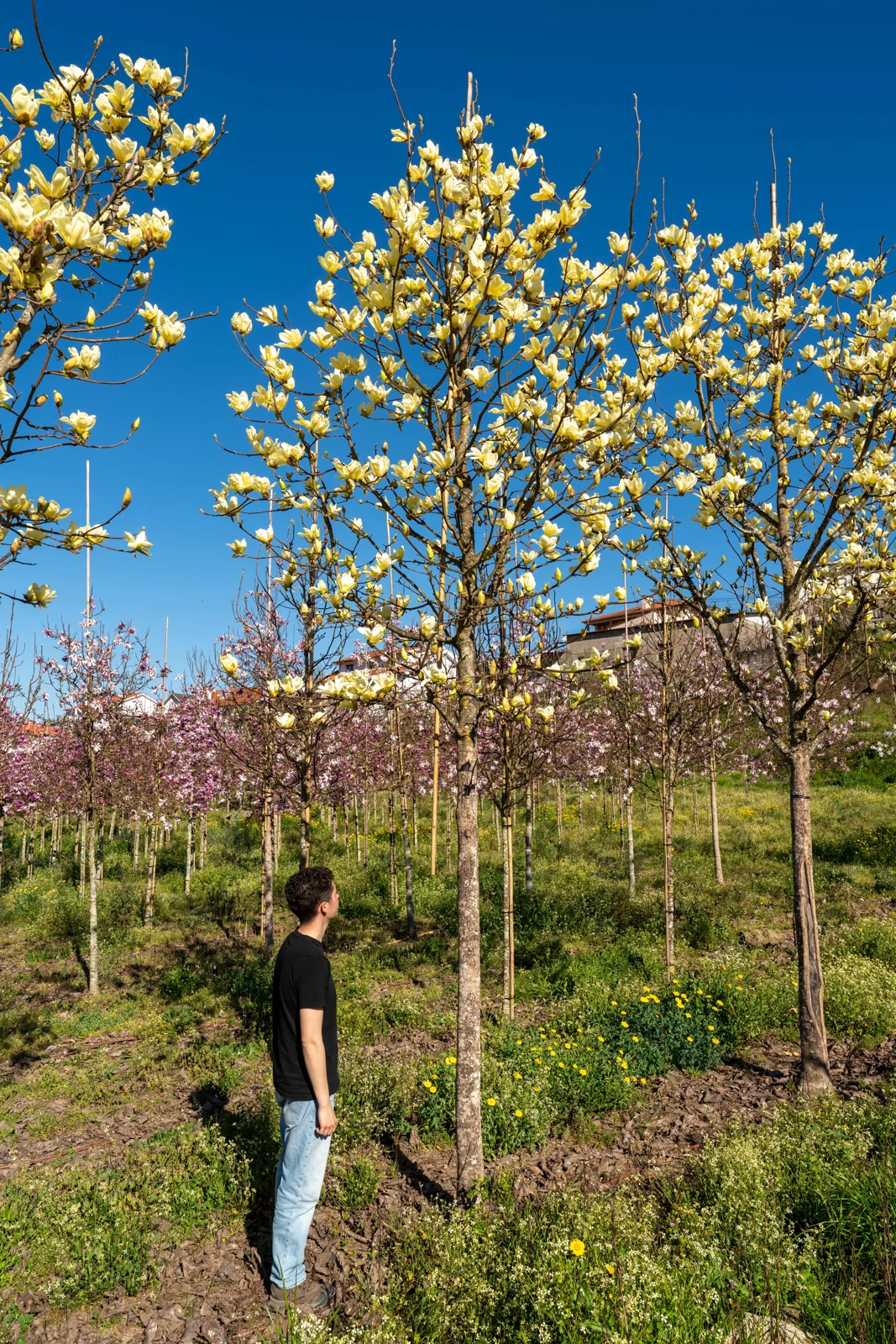
Early yellow flowers on bare winter branches
Yulan Magnolia ‘Yellow River’ · Magnolia denudata ‘Yellow River’
A deciduous cultivar selected for its pale yellow spring flowers, a colour rare among magnolias. Asking for acidic, moisture-retentive soil and shelter from summer drought, it specifies reliably across the humid Atlantic northwest and similarly favourable Spanish microclimates.
- Hardy to at least minus 20 degrees Celsius; winter cold is no constraint in Spain
- Rewards consistent irrigation through the dry months with steady, healthy growth
- Performs best on deep, slightly acidic soil that stays moist yet free-draining
Key Facts
About this Cultivar
Where the straight species M. denudata produces white to ivory tepals, 'Yellow River' opens cup-shaped flowers in a clear pale yellow to yellow-cream, appearing before leaf emergence in early spring. Individual flowers reach 12 to 15 cm across, carry a pronounced lemon fragrance, and last roughly two to three weeks if late frosts do not brown the tepals.…
Read more
Show less
Where the straight species M. denudata produces white to ivory tepals, 'Yellow River' opens cup-shaped flowers in a clear pale yellow to yellow-cream, appearing before leaf emergence in early spring. Individual flowers reach 12 to 15 cm across, carry a pronounced lemon fragrance, and last roughly two to three weeks if late frosts do not brown the tepals. The cultivar forms a rounded, moderately dense crown reaching 6 to 8 m in height and 3 to 5 m in spread at maturity, slower-growing than the species and more compact in habit.
Cold tolerance is not the limiting factor in Spain. Winter minimums down to approximately -20 °C are within the cultivar's range, which covers every Spanish climate zone for frost hardiness. The constraint is water and soil chemistry. 'Yellow River' requires consistently moist, well-drained, acidic to neutral soil (pH below 7) and does not tolerate prolonged summer drought or waterlogged conditions. In the humid Atlantic northwest (cornisa cantábrica), from Galicia through Asturias and Cantabria to the Basque Country, naturally acidic soils and annual rainfall above 1 000 mm meet these requirements without supplementary irrigation once established. In sheltered gardens of Greater Bilbao or Donostia, the tree performs reliably as a specimen focal point.
Across Mediterranean coastal Spain and the continental interior (meseta), the combination of alkaline or calcareous soils and summer drought makes 'Yellow River' a poor specification choice without permanent irrigation infrastructure and soil amendment. Even with irrigation, summer heat above 35 °C stresses the foliage and reduces flowering vigour the following spring. The semi-arid southeast is unsuitable. Where a professional working in these zones needs a flowering specimen tree of similar scale, Lagerstroemia indica or Punica granatum (granado) offer better adaptation to calcareous, low-water conditions.
The genus Magnolia sits outside the known host range of Xylella fastidiosa, which removes one specification obstacle in demarcated zones. The cultivar shows no serious susceptibility to pests or diseases in European cultivation. Bark is thin and mechanically vulnerable, so specification near high-traffic pedestrian areas or maintenance corridors should account for trunk protection during the establishment phase. Root behaviour is compatible with paved surfaces, and the tree tolerates urban pit conditions provided drainage and soil acidity are managed. Growth is slow, with trees typically reaching their mature canopy spread over 15 to 20 years under favourable Atlantic conditions.
Advice on this species
Want to know more about Magnolia denudata 'Yellow River'?
Tell us about your project and we'll advise you on this species — where it thrives, which size makes sense, and what to expect once planted.
- Produção própria
- Exemplares adultos
- Resposta em 1–2 dias
Sem compromisso · orçamento personalizado