

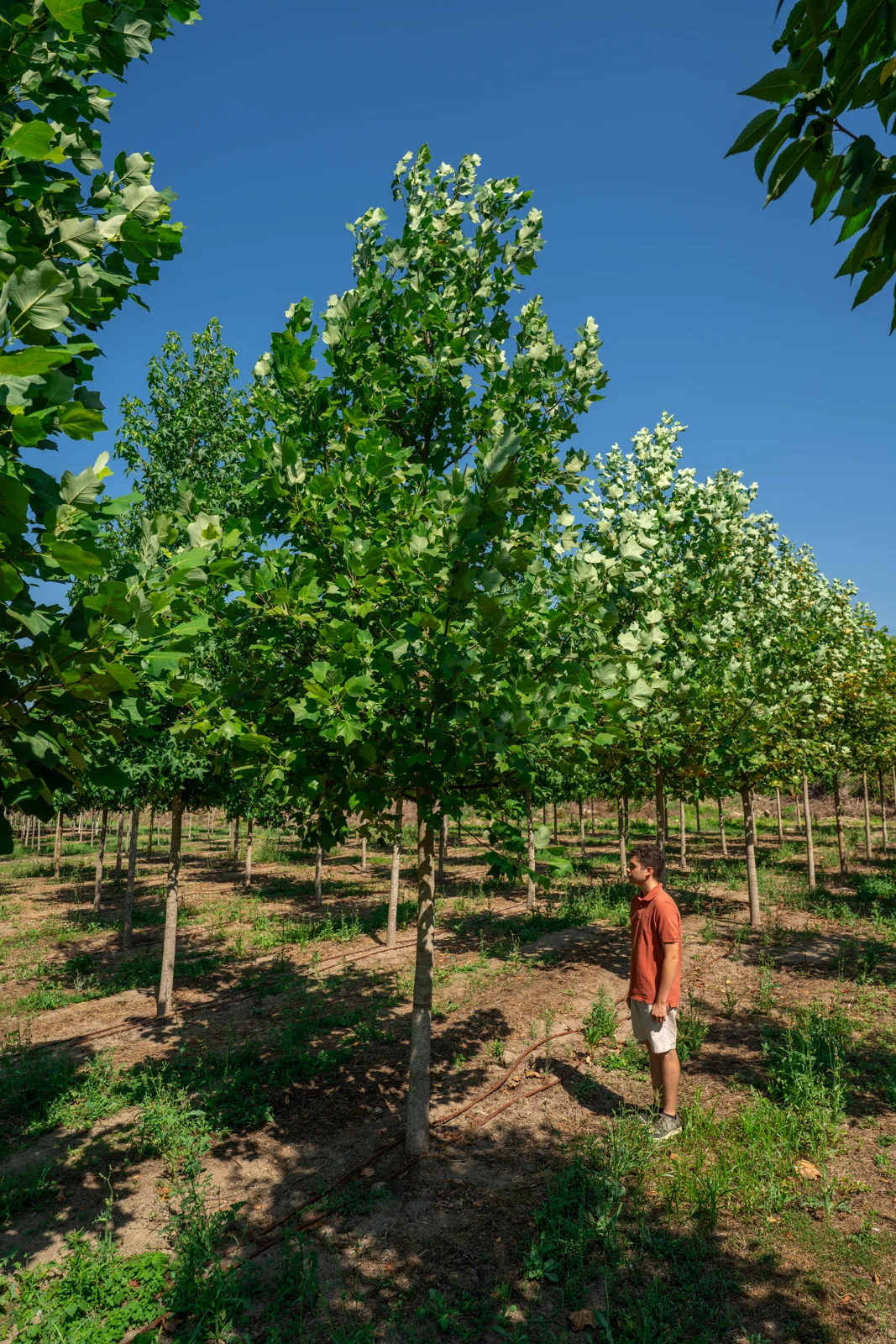
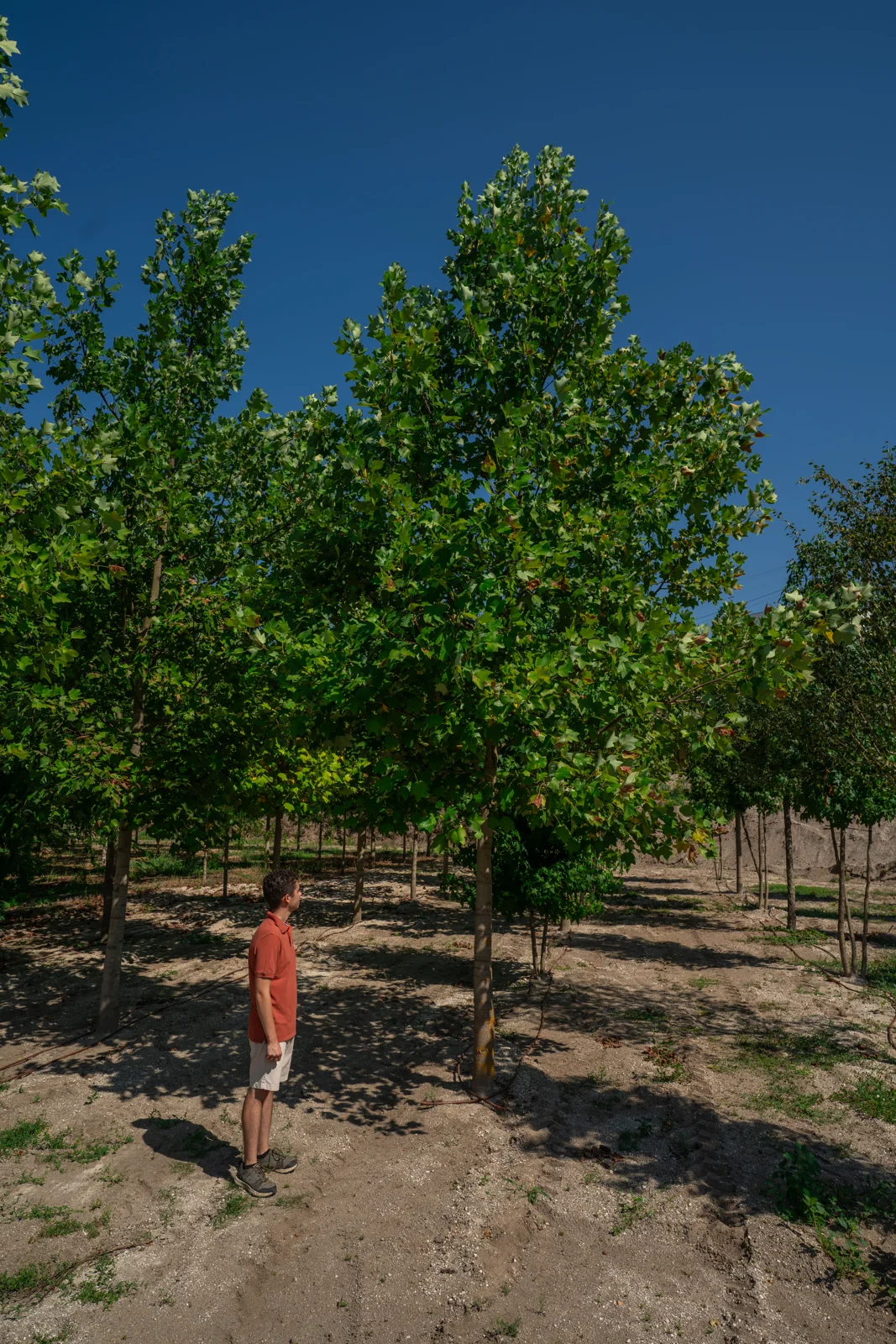
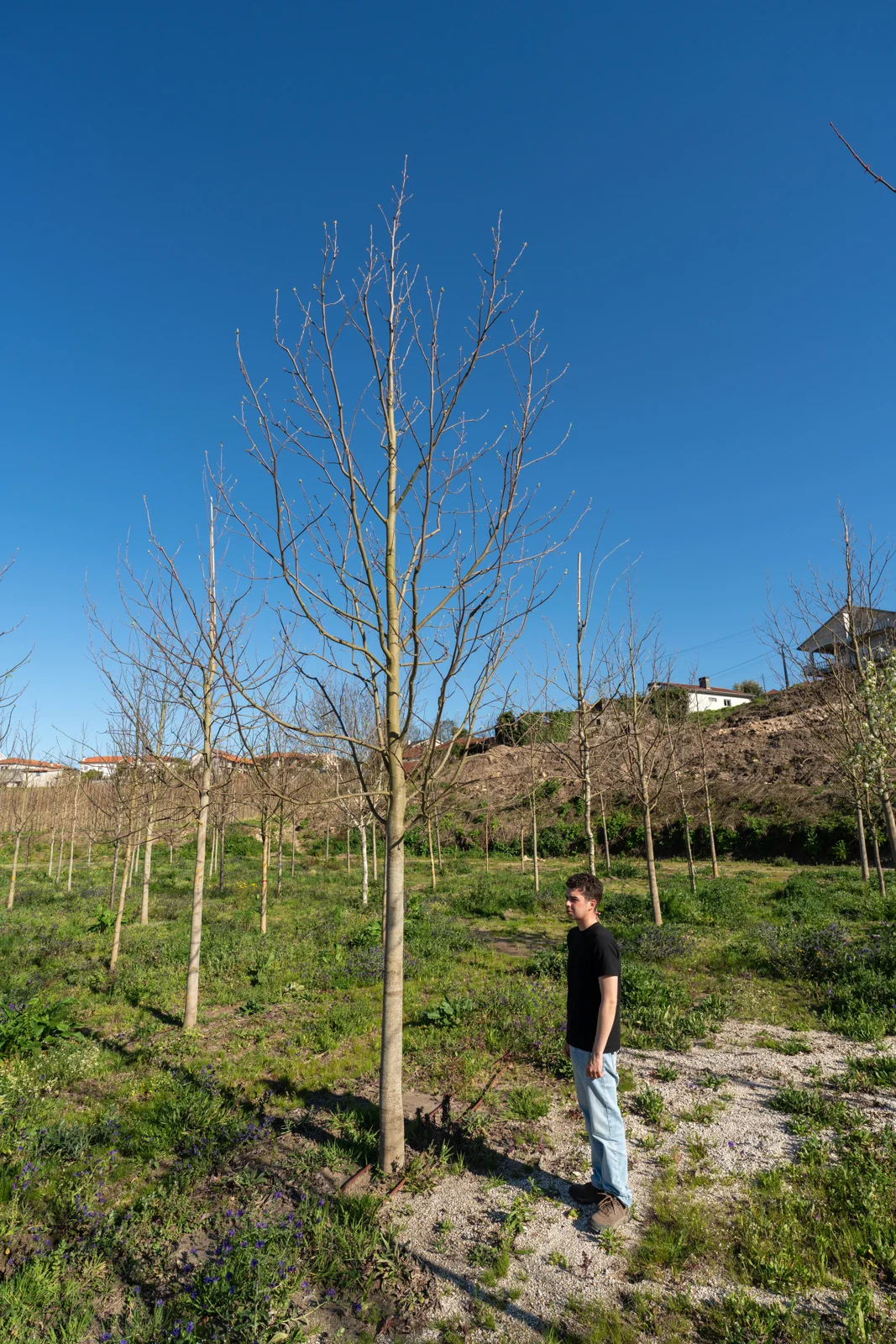
A tall deciduous canopy for the well-watered garden
Tulip Tree · Liriodendron tulipifera
A fast-establishing deciduous canopy of 20 to 35 metres for projects on deep, acidic, moisture-retentive soils, well matched to the humid Atlantic northwest and well-irrigated northern parkland schemes where soil pH and summer water supply can be assured.
- Suits Atlantic Spain, Cantabrian coast, and irrigated gardens around Madrid and Barcelona
- Needs consistent moisture; pair with drip irrigation for the summer months
- Fast-growing, reaching roughly 12 m in fifteen years on good soil
About this Species
Within Spain, Liriodendron tulipifera performs reliably across the humid Atlantic strip (cornisa cantábrica), from Galicia through Asturias and Cantabria to the Basque Country, where cool summers, mild winters, annual rainfall above 1 000 mm, and naturally acidic soils replicate the conditions of its native Appalachian cove forests. Trees in these regions…
Read more
Show less
Within Spain, Liriodendron tulipifera performs reliably across the humid Atlantic strip (cornisa cantábrica), from Galicia through Asturias and Cantabria to the Basque Country, where cool summers, mild winters, annual rainfall above 1 000 mm, and naturally acidic soils replicate the conditions of its native Appalachian cove forests. Trees in these regions develop the characteristic straight central leader and dense conical crown that distinguish field-grown specimens, reaching 15 to 18 metres within fifteen years under favourable conditions. Winter hardiness is not a limiting factor: the species tolerates temperatures to roughly -30 °C, well beyond the coldest continental interior (meseta) episodes.
The limiting variables in most Spanish contexts are soil chemistry and summer moisture. Liriodendron requires acidic to neutral substrates, ideally deep loam with reliable moisture at root depth. On the calcareous, alkaline, or gypsiferous soils widespread across the Ebro valley, the meseta, and the Mediterranean littoral, chlorosis sets in and vigour declines sharply. Where alkaline conditions prevail, the tree is not a viable specification. On the meseta interior, cold hardiness is adequate but summer drought and heavy clay soils prone to compaction and ponding present a second constraint. Specification outside the Atlantic zone is realistic only where irrigation infrastructure is permanent and soil amendment to lower pH has been carried out, as in purpose-built urban parks or private estate landscapes in Greater Madrid or Greater Bilbao.
Water demand is substantial during establishment and remains moderate to high at maturity. Through the first three summers, deep irrigation at intervals of seven to ten days is essential. Once established on suitable soil, the tree draws on deep moisture reserves, but extended dry spells above three to four weeks without rain or supplementary water cause premature leaf yellowing and drop. In municipalities subject to drought decrees (sequía), this behaviour makes Liriodendron a poor fit for publicly maintained streetscapes where irrigation may be curtailed. For private parkland and institutional grounds with independent water supply, it remains a strong candidate.
The species sits outside the known host range of Xylella fastidiosa, which removes one layer of phytosanitary complexity from the specification process. General disease resistance is good, though aphid colonies can produce honeydew and secondary sooty mould on lower canopy, a maintenance consideration for specimen trees near pedestrian areas. Fire flammability is rated low, relevant for projects at the wildland-urban interface (interfaz urbano-forestal) in northern coastal zones.
The crown is strongly upright and conical in youth, broadening to an oval dome at maturity with a spread of 10 to 15 metres. Four-lobed leaves, each 12 to 15 cm across, create dense summer shade and turn a clear golden yellow in autumn, a genuine seasonal event in the Atlantic and northern project palette where deciduous colour is valued. Cup-shaped flowers of pale green-yellow marked with orange at the base appear in May to June but sit high in the crown on mature trees and are more a botanical distinction than a landscape feature at ground level. Bark matures from smooth grey-green to a furrowed grey-brown diamond pattern that reads well on clean, branch-free trunks.



Advice on this species
Want to know more about Liriodendron tulipifera?
Tell us about your project and we'll advise you on this species — where it thrives, which size makes sense, and what to expect once planted.
- Produção própria
- Exemplares adultos
- Resposta em 1–2 dias
Sem compromisso · orçamento personalizado