

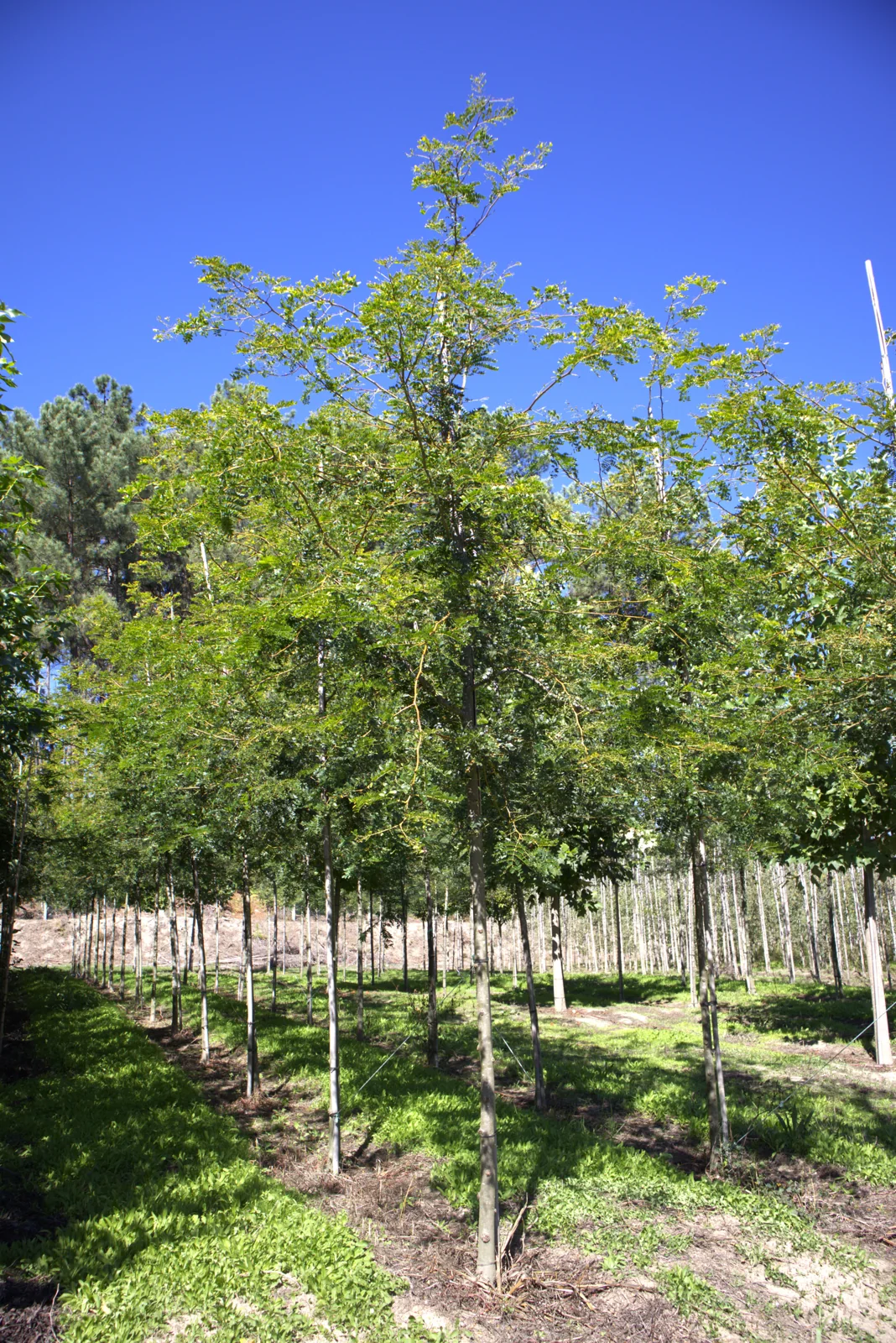
An airy, thornless shade tree for the Spanish garden
Honey Locust ‘Inermis’ · Gleditsia triacanthos ‘Inermis’
A thornless selection of Gleditsia triacanthos for Spanish urban work where a Platanus shade canopy is too dense or too prone to anthracnose. Filters light, tolerates drought, accepts compacted alkaline substrates.
- Thornless form of the honey locust, safe for family gardens and walkways
- Light, dappled shade that allows underplanting and lawn to survive beneath
- Suits the Costa del Sol, Costa Blanca, Balearics, and inland Andalucía
Key Facts
About this Cultivar
Gleditsia triacanthos 'Inermis' is a fast-growing deciduous legume reaching 12 to 18 m in height and 8 to 12 m across, with a broad, lightly irregular crown. The defining trait of the cultivar is the absence of the stout three-branched spines that disqualify the straight species from public-realm specification; everything else (bipinnate fine-textured…
Read more
Show less
Gleditsia triacanthos 'Inermis' is a fast-growing deciduous legume reaching 12 to 18 m in height and 8 to 12 m across, with a broad, lightly irregular crown. The defining trait of the cultivar is the absence of the stout three-branched spines that disqualify the straight species from public-realm specification; everything else (bipinnate fine-textured foliage, open crown architecture, golden autumn turn, nitrogen-fixing root association) is inherited from the parent.
Within Spain, the cultivar reads as a working alternative to plátano de sombra (Platanus x acerifolia) on sites where Ceratocystis platani surveillance, root-bed conflict, or the heavy summer shade of Platanus argue against it. The pinnate canopy filters light rather than blocking it, which allows turf and tolerant underplanting to continue beneath, a useful property in plazas and avenues where a closed Platanus tunnel would be too sombre. Compared with Celtis australis, another standard Mediterranean street tree, Gleditsia carries the same urban temperament with a lighter, more transparent canopy and faster early calibre gain.
Climate envelope is wide. The species is hardy to roughly minus 30 °C at the cold end of its native range, which means meseta continental winters in Castilla, Aragón, and the northern interior present no hardiness limit. Mediterranean coastal heat and the alkaline calcareous soils of the Levante and Ebro valley are tolerated without distress, and once established the tree accepts the prolonged summer drought characteristic of much of the peninsula. In the semi-arid southeast (Almería, Murcia, inland Alicante), supplementary irrigation through the first two to three summers remains advisable; mature specimens then hold under restriction.
Gleditsia sits outside the current Xylella fastidiosa host list, which makes it a defensible substitution in comunidades autónomas operating active demarcation zones. The genus is not host to Ceratocystis platani either. Practical maintenance points to flag in a pliego de condiciones: the species can produce twisted legume pods that fall and require collection in formal settings (the 'Inermis' selection retains pod production unless paired with a podless clone such as 'Skyline'), and locust leafminer and webworm appear occasionally without typically threatening structure.
Advice on this species
Want to know more about Gleditsia triacanthos 'Inermis'?
Tell us about your project and we'll advise you on this species — where it thrives, which size makes sense, and what to expect once planted.
- Produção própria
- Exemplares adultos
- Resposta em 1–2 dias
Sem compromisso · orçamento personalizado