

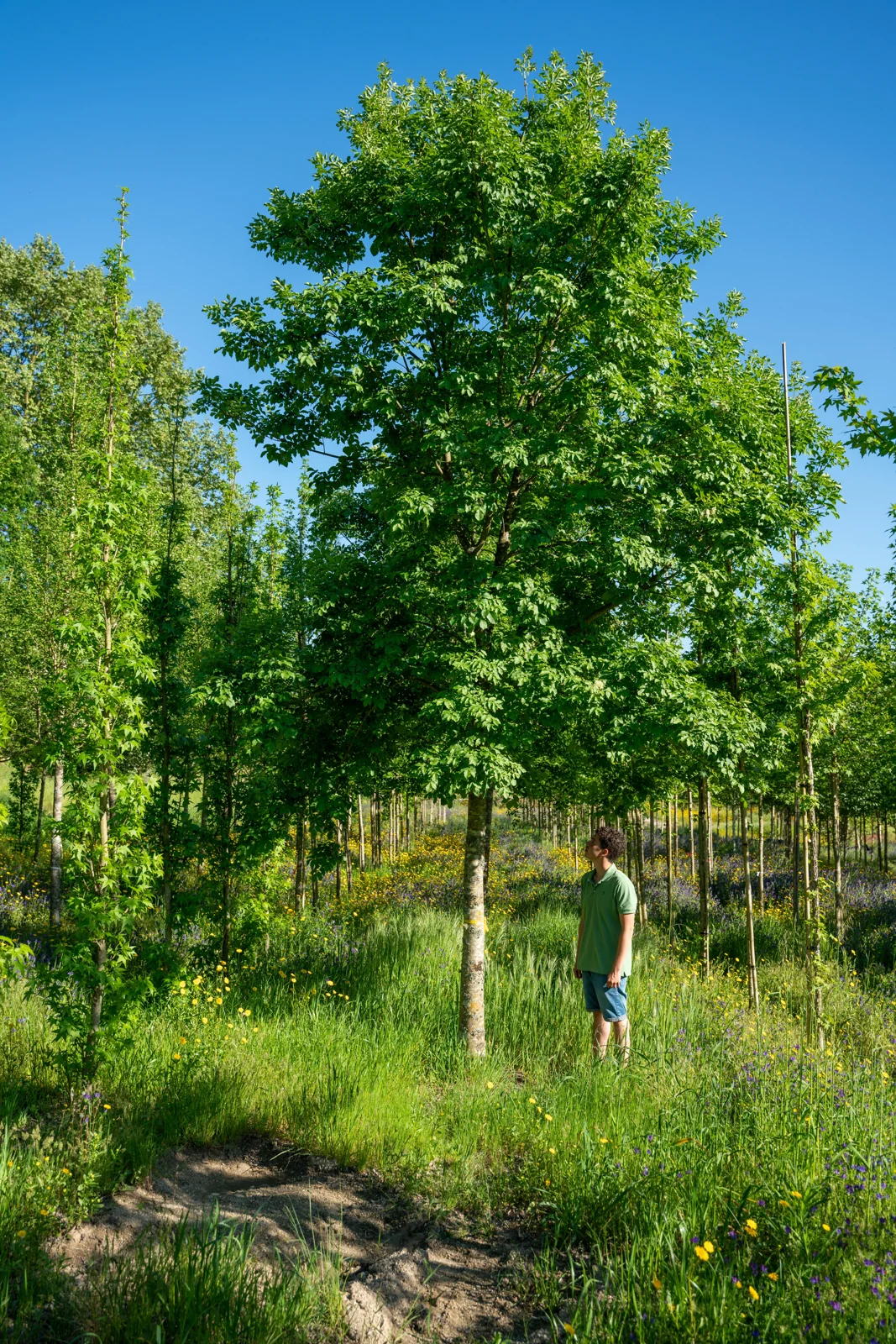
A flowering ash for the dry Mediterranean garden
Manna Ash · Fraxinus ornus
A medium deciduous tree (fresno de flor) for inland and Mediterranean Spanish projects, thriving on summer heat and limited water where a reliable, drought-tolerant avenue tree with spring flower is wanted.
- Suits the Costa Blanca, Costa del Sol, Balearics, and Catalan coast
- Hardy to roughly minus 15 °C in the Madrid and Guadarrama gardens
- Modest summer water in its first three seasons; self-sufficient thereafter
About this Species
Reaching 8 to 15 m with a rounded crown to 10 m wide, manna ash sits between Celtis australis and the larger Platanus in scale, suited to mid-width avenues, plaza edges, and specimen positions where a platano de sombra would outgrow the site or demand more irrigation. Native distribution runs from the Iberian east through the Balkans to Anatolia, so…
Read more
Show less
Reaching 8 to 15 m with a rounded crown to 10 m wide, manna ash sits between Celtis australis and the larger Platanus in scale, suited to mid-width avenues, plaza edges, and specimen positions where a platano de sombra would outgrow the site or demand more irrigation. Native distribution runs from the Iberian east through the Balkans to Anatolia, so adaptation to peninsular conditions is intrinsic rather than tested. The 1 m trunk diameter recorded on mature wild specimens is rarely reached in urban use.
Creamy-white panicles open in May and June with the new foliage, scented and visually prominent against grey, smooth bark that stays unfissured into maturity. This is a specification asset on civic projects where flowering interest must coincide with the late-spring use peak. Autumn colour is variable, yellow to purplish, useful in cornisa cantabrica and northern meseta schemes but secondary in evergreen-dominant Mediterranean palettes.
Winter hardiness reaches roughly minus 23 °C, covering continental Madrid and Castilla-Leon winters and late frosts in Aragon. Summer performance is the principal argument: high heat tolerance and high drought tolerance once established, on well-drained chalky or loamy substrates including the calcareous soils of the Ebro valley and inland Andalucia. Salt tolerance is low, which rules out direct coastal exposure on the Levante and Balearic littorals.
Water envelope is moderate during the first two to three summers, then low under mature irrigation regimes; the species holds form through restriction periods declared by a comunidad autonoma without canopy collapse. The genus sits outside the principal Xylella fastidiosa host pressure affecting Olea, Nerium and Polygala myrtifolia in Spanish demarcated zones, and the species shows good general disease and pest resistance, simplifying pliego de condiciones arguments where Olea substitution is being evaluated.



Advice on this species
Want to know more about Fraxinus ornus?
Tell us about your project and we'll advise you on this species — where it thrives, which size makes sense, and what to expect once planted.
- Produção própria
- Exemplares adultos
- Resposta em 1–2 dias
Sem compromisso · orçamento personalizado