

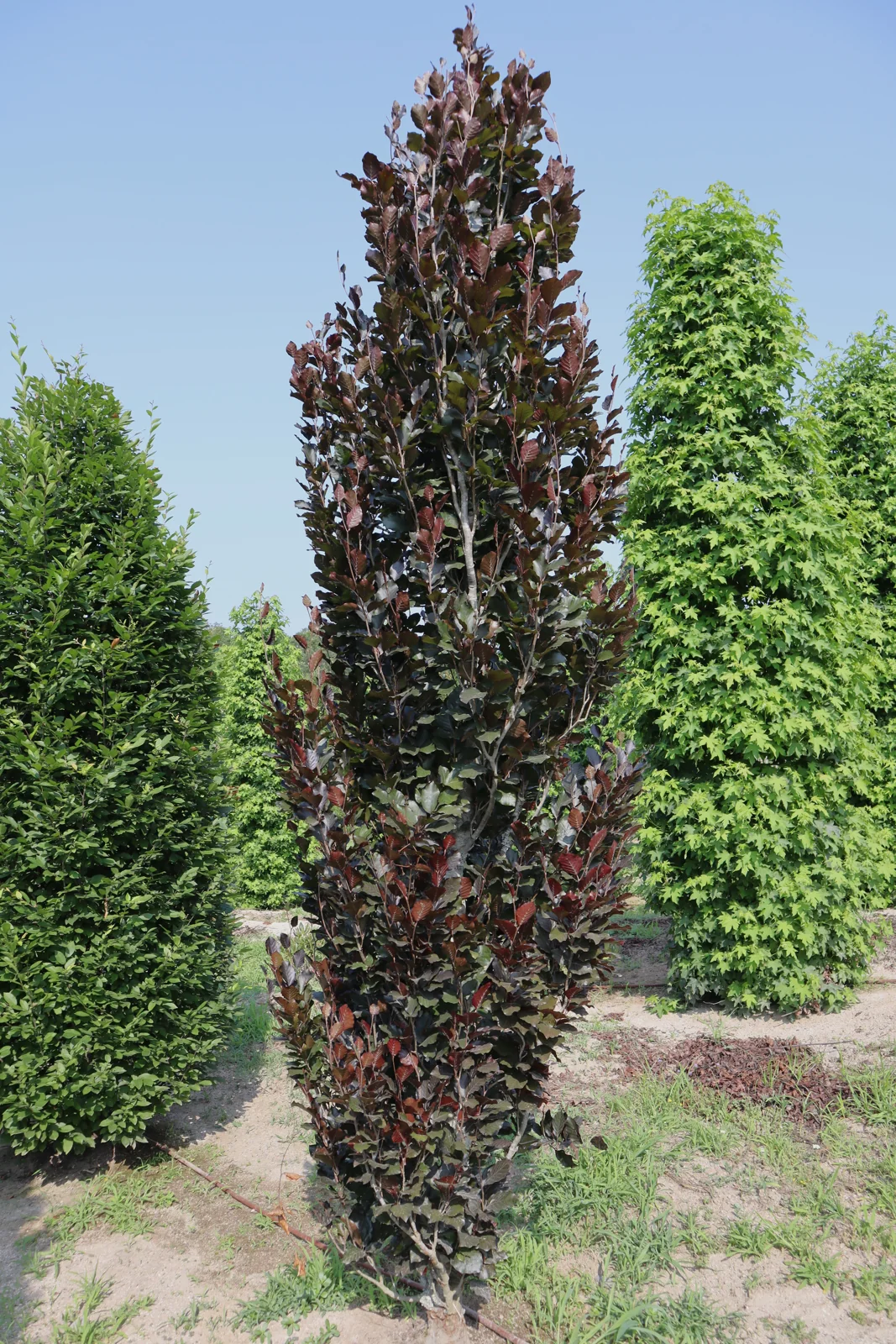
A narrow purple-leaved beech for cooler, well-watered gardens
European Beech ‘Dawyck Purple’ · Fagus sylvatica ‘Dawyck Purple’
A narrow, fastigiate selection of European beech with deep purple foliage, specified where a vertical accent or a tight alignment is required on cool, moist sites across the Atlantic northwest and northern interior of Spain.
- Strictly columnar habit reaching twelve to eighteen metres at maturity
- Deep purple-claret foliage spring through summer, copper in autumn
- Best in cool, moist sites: Pyrenean foothills, Sierra de Guadarrama, Tramuntana
Key Facts
About this Cultivar
'Dawyck Purple' holds an erect, near-columnar habit, typically reaching 12 to 18 metres in height with a crown only 3 to 5 metres wide at maturity. The form is naturally tidy: branches stay close to the trunk without intervention, so the silhouette can be relied on for formal alignments, narrow planting belts, and gateway or entrance accents where a…
Read more
Show less
'Dawyck Purple' holds an erect, near-columnar habit, typically reaching 12 to 18 metres in height with a crown only 3 to 5 metres wide at maturity. The form is naturally tidy: branches stay close to the trunk without intervention, so the silhouette can be relied on for formal alignments, narrow planting belts, and gateway or entrance accents where a broad-crowned tree will not fit. Growth is slow to moderate, which keeps the specimen in proportion to its setting for decades rather than outgrowing it.
Foliage is the principal ornamental argument. Leaves emerge a saturated dark purple in spring, hold the colour through summer, and shift to copper and reddish-bronze tones in autumn before falling. Spring flowers are inconspicuous and the tree produces few beech nuts in cultivation at this calibre, which keeps litter and allergen load low compared with the green species.
Climatic envelope is the decisive specification variable. The taxon is reliably hardy to roughly minus 25 degrees Celsius and performs best where summers stay cool and soils remain moist. In Spanish terms this means the cornisa cantábrica (Galicia, Asturias, Cantabria, the Basque Country) and the higher, wetter parts of the meseta and the Pyrenean foothills. It does not tolerate prolonged Mediterranean summer drought, the saline alkaline soils of the Levante, or the aridity of the southeast; in the huerta valenciana or on the Costa del Sol it should not be specified.
Site requirements track the parent species. Soils should be deep, fertile, well drained, and on the acid side of neutral; the cultivar accepts mildly calcareous ground but declines on shallow chalk and on heavy compacted urban substrates. It does not perform reliably in confined tree pits, so its place is in parks, private estates, courtyards with generous root volumes, and project specifications (pliegos de condiciones) where the rooting envelope can be guaranteed. Beech is not within the known host range of Xylella fastidiosa, which removes one phytosanitary variable from the assessment for projects inside demarcated zones.
Maintenance is light: the columnar habit holds without formative pruning, the species is resistant to deer browsing, and no major pest or disease pressure is currently active on beech in the Iberian Peninsula. Where the brief calls for vertical structure with year-round colour, this is one of a small group of trees that delivers it without losing scale or requiring containment.
Advice on this species
Want to know more about Fagus sylvatica 'Dawyck Purple'?
Tell us about your project and we'll advise you on this species — where it thrives, which size makes sense, and what to expect once planted.
- Produção própria
- Exemplares adultos
- Resposta em 1–2 dias
Sem compromisso · orçamento personalizado