

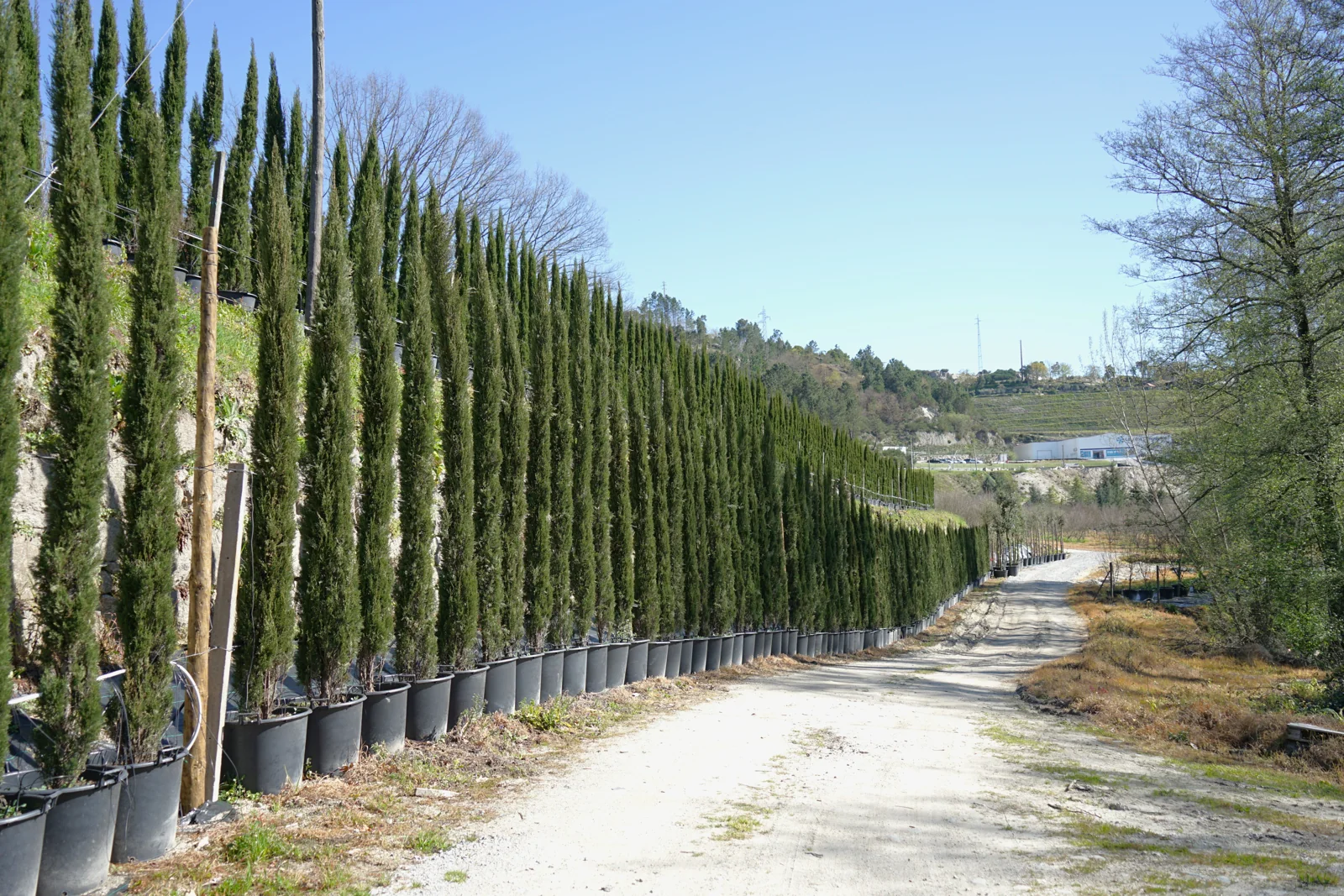
A narrow evergreen exclamation mark for the Mediterranean garden
Italian Cypress ‘Stricta’ · Cupressus sempervirens ‘Stricta’
A narrow fastigiate cypress used as a vertical marker in Spanish landscape projects, from Levantine coastal schemes to drier interior sites where a tightly columnar evergreen is needed in the specification.
- Thrives across the Costa del Sol, Costa Blanca, Balearics, and Catalan coast
- Hardy to roughly minus 10 degrees Celsius in the Madrid foothills
- Modest deep watering for three summers; self-sufficient thereafter
Key Facts
About this Cultivar
Cupressus sempervirens 'Stricta' is the tight-columnar selection of the Mediterranean cypress (ciprés mediterráneo), holding a 15 metre by roughly 2 to 3 metre profile at maturity. Compared with seed-raised material, which is variable in habit, the cultivar gives the specifier a predictable vertical line, useful for axial planting, entrance markers, and…
Read more
Show less
Cupressus sempervirens 'Stricta' is the tight-columnar selection of the Mediterranean cypress (ciprés mediterráneo), holding a 15 metre by roughly 2 to 3 metre profile at maturity. Compared with seed-raised material, which is variable in habit, the cultivar gives the specifier a predictable vertical line, useful for axial planting, entrance markers, and the rhythmic punctuation associated with the jardín andaluz and masía catalana traditions.
Climatic envelope across Spain is broad. The cultivar performs reliably across Mediterranean coastal sites (the Levante, Costa del Sol, Balearics) and across most of the meseta interior, with winter hardiness to around minus 15 degrees Celsius covering all but the coldest northern continental positions. Heat tolerance is high; salt tolerance is moderate, sufficient for second-line coastal planting rather than direct frontal exposure.
Water demand is modest. Establishment requires regular irrigation through the first two to three summers; once rooted, mature specimens hold form under restricted irrigation regimes, a relevant consideration where the proyecto de ajardinamiento must address summer sequía protocols. Performance is weakest on the humid Atlantic cornisa cantábrica, where prolonged wet winters and acidic soils favour fungal pressure and the species reads as foreign within the regional palette.
The principal phytosanitary concern is cypress canker, caused by Seiridium cardinale, present across the western Mediterranean and capable of causing branch dieback on stressed specimens. Specifying mature, field-grown stock and avoiding pruning into stressed tissue limits exposure. The species sits outside the known host range of Xylella fastidiosa, which simplifies coordination in demarcated zones where Olea, Polygala, and Nerium are constrained.
Foliage is persistent, dense, and dark green, producing a sharp scenographic silhouette without underplanting shade penalty thanks to the narrow crown. Field trials in Valencia following the 2012 Andilla fire reported low flammability relative to other conifers, which is a functional argument in interfaz urbano-forestal schemes where conifer use is otherwise restricted.
Advice on this species
Want to know more about Cupressus sempervirens 'Stricta'?
Tell us about your project and we'll advise you on this species — where it thrives, which size makes sense, and what to expect once planted.
- Produção própria
- Exemplares adultos
- Resposta em 1–2 dias
Sem compromisso · orçamento personalizado