

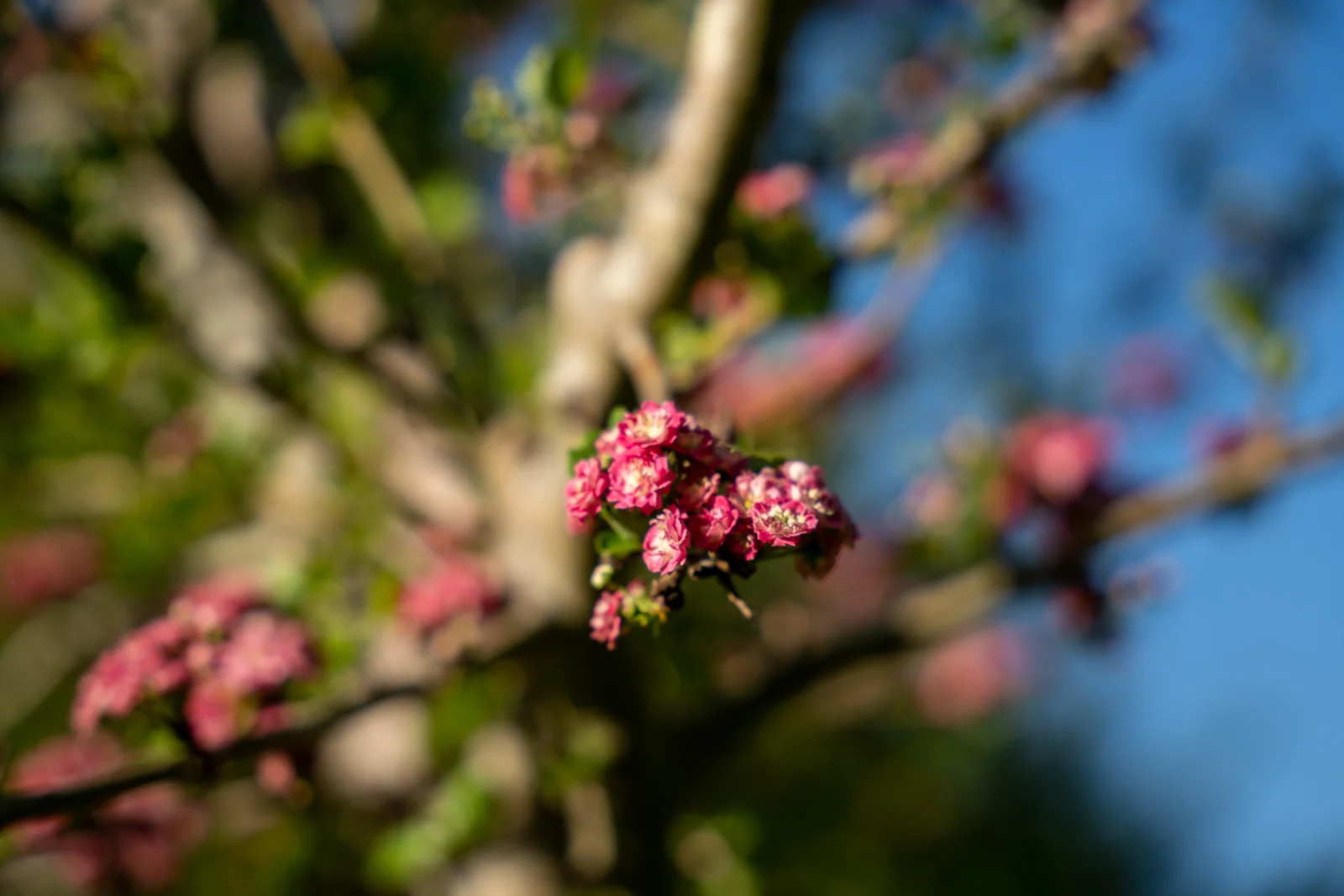
A spring-flowering hawthorn for a small Spanish garden
Midland Hawthorn ‘Paul‘s Scarlet’ · Crataegus laevigata ‘Paul‘s Scarlet’
A small, slow-growing form of Midland hawthorn (espino navarro) carrying dense double scarlet flowers, useful where designers need a compact deciduous accent across continental and Atlantic Spain without reaching for larger Prunus or Malus.
- Dense double scarlet flowers for two to three weeks each spring
- Compact rounded crown of five to seven metres at maturity
- Best in cooler interior and Atlantic regions with a real winter
Key Facts
About this Cultivar
Crataegus laevigata 'Paul's Scarlet' reaches 5 to 7 metres in height with a 4 to 6 metre rounded crown, noticeably more contained than the straight species and slower in growth. The double scarlet corymbs set it apart from white-flowered espino navarro and from the pink Crataegus × lavalleei often specified for Spanish avenues, giving a denser and…
Read more
Show less
Crataegus laevigata 'Paul's Scarlet' reaches 5 to 7 metres in height with a 4 to 6 metre rounded crown, noticeably more contained than the straight species and slower in growth. The double scarlet corymbs set it apart from white-flowered espino navarro and from the pink Crataegus × lavalleei often specified for Spanish avenues, giving a denser and longer-lasting spring display against dark green foliage.
Winter hardiness reaches roughly minus 25 °C, so the cultivar handles late frosts on the meseta interior of Castilla and Aragón as readily as the milder cornisa cantábrica. Heat and drought tolerance are moderate: it performs reliably across the central and northern half of the country, but in the semi-arid southeast around Murcia and Almería it will need supplementary irrigation through the establishment phase and into mature life.
The tree accepts a wide range of substrates including clay, sand, and mildly acidic Atlantic soils, provided drainage is adequate. Pavement tolerance is full, which is the practical reason it appears in Spanish urban schemes as a flowering alternative to Prunus cerasifera 'Pissardii' in tighter pits and courtyards where root volume is constrained. It withstands urban pollution and the persistent wind exposure typical of plateau sites.
Flowering runs from March into May depending on altitude and latitude, opening earlier on the Andalusian and Levantine coasts and later in the north. The cultivar carries little fruit compared with the species, which removes the seasonal litter that complicates specification of fruiting hawthorns in pedestrian zones. Pollinator value is retained through the open phase of bloom, supporting the biodiversity criteria now common in proyecto de ajardinamiento submissions.
Maintenance demand is low once established: the rounded habit needs no formative pruning beyond the nursery shape, and disease and pest pressure remain moderate under Spanish conditions, with fire blight (Erwinia amylovora) the principal genus-level concern in years of conducive weather.
Advice on this species
Want to know more about Crataegus laevigata 'Paul's Scarlet'?
Tell us about your project and we'll advise you on this species — where it thrives, which size makes sense, and what to expect once planted.
- Produção própria
- Exemplares adultos
- Resposta em 1–2 dias
Sem compromisso · orçamento personalizado