

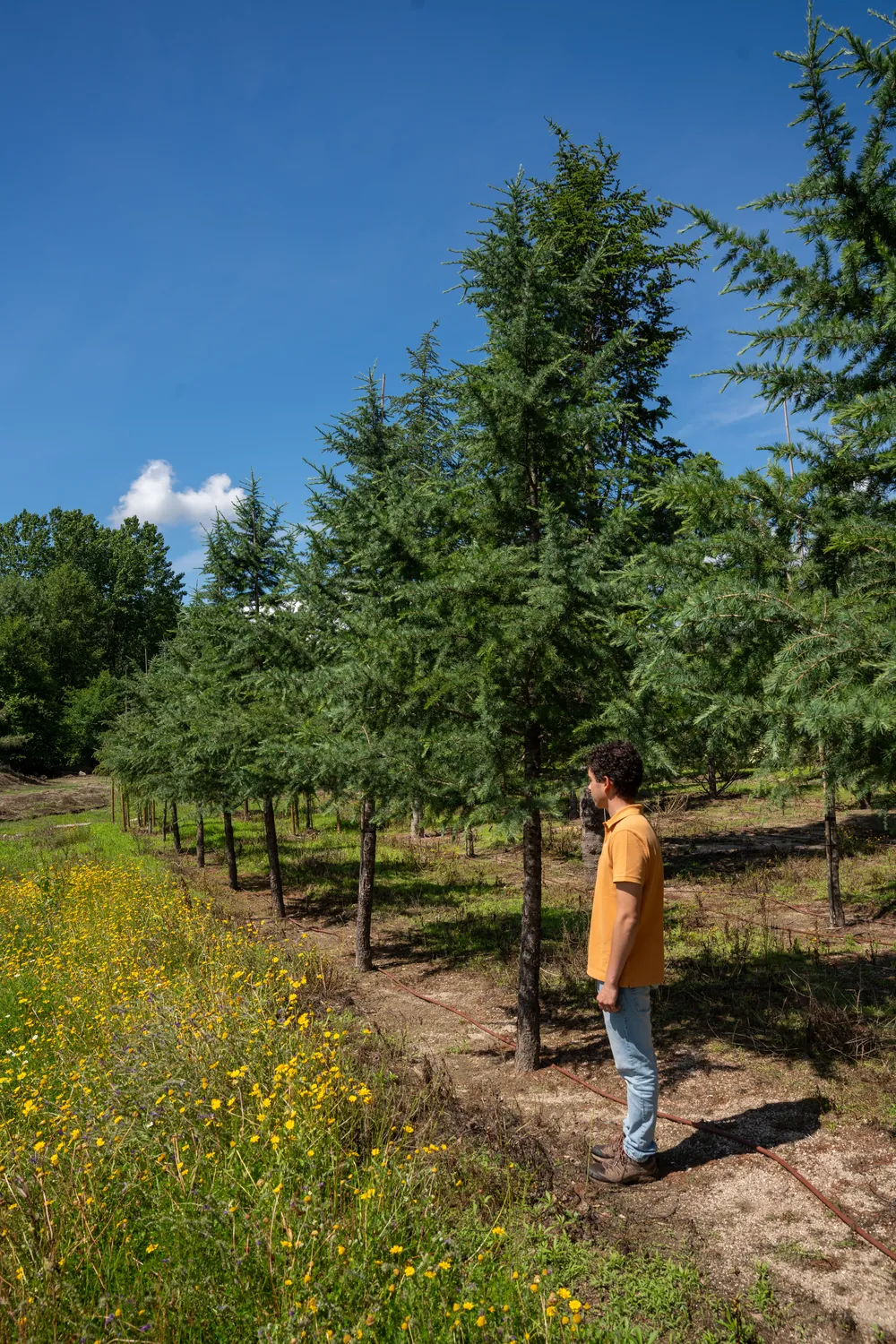
A weeping Himalayan conifer for a generous Spanish garden
Deodar Cedar · Cedrus deodara
{# A tabela de LOTES (§C, «zoom no lote») foi movida para baixo das características (botânica em cima, lotes em baixo — reunião 24/07). Ver #crm-lotes mais abaixo. #}An evergreen cedar of broad pyramidal habit and pendulous branchlets, specified as a long-lived focal tree on Spanish estates, institutional grounds, and avenue plantings where scale and year-round structure carry the scheme.
- Suits Costa del Sol, Costa Blanca, Costa Brava, the Balearics and Sierra de Guadarrama foothills
- Hardy through coastal winters down to around minus 15 degrees Celsius
- Modest summer water for the first three years; largely self-sufficient thereafter
About this Species
Cedrus deodara reaches 20 to 40 metres at maturity, with a 8 to 12 metre spread, and holds a conical silhouette for several decades before broadening to a flat-topped crown with horizontal branching. Among the true cedars, it carries the most pronounced weeping tip habit; lower limbs persist on undisturbed specimens and sweep close to the ground, which determines its underplanting envelope and its suitable distance from paths and pavement. Grey-green to glaucous needles in dense whorls give the tree a fine year-round texture that reads cleanly against masonry, against deciduous neighbours, and against the open sky of larger compositions.
The deodar is reliable across much of Spain on deep, well drained, acidic to neutral loams. It grows well in the cornisa cantábrica and the cooler northern Atlantic interior, performs across the central meseta where soils are sufficiently deep and winter minimums stay above roughly minus 15 degrees Celsius, and tolerates Mediterranean coastal…
Cedrus deodara reaches 20 to 40 metres at maturity, with a 8 to 12 metre spread, and holds a conical silhouette for several decades before broadening to a flat-topped crown with horizontal branching. Among the true cedars, it carries the most pronounced weeping tip habit; lower limbs persist on undisturbed specimens and sweep close to the ground, which determines its underplanting envelope and its suitable distance from paths and pavement. Grey-green to glaucous needles in dense whorls give the tree a fine year-round texture that reads cleanly against masonry, against deciduous neighbours, and against the open sky of larger compositions.
The deodar is reliable across much of Spain on deep, well drained, acidic to neutral loams. It grows well in the cornisa cantábrica and the cooler northern Atlantic interior, performs across the central meseta where soils are sufficiently deep and winter minimums stay above roughly minus 15 degrees Celsius, and tolerates Mediterranean coastal heat once established. It struggles on the gypsiferous and strongly alkaline soils of the Ebro depression and on the saline substrates of the sureste; salt tolerance is moderate at best, so coastal specification belongs in protected inland positions rather than front-line exposure.
Water demand is moderate during the first two to three summers after planting and drops sharply once the root system has reached subsoil moisture. Mature trees in continental and northern Atlantic conditions need no supplementary irrigation in an average year; under Mediterranean summer drought, occasional deep watering through the establishment phase produces a denser crown and earlier canopy fill. The species is intolerant of waterlogging and of compacted, poorly drained urban pits.
As a conifer outside the principal Spanish phytosanitary watch list, Cedrus deodara sits clear of Xylella fastidiosa host concerns and of the pressures shaping decisions on Olea, Platanus, Buxus, and Phoenix. It positions as a structural alternative where designers need an evergreen of comparable scale to Cupressus sempervirens or Pinus pinea with a softer, more pendulous silhouette. Specification should account for its high flammability rating in interfaz urbano-forestal zones and for the eventual canopy footprint when siting near buildings, walls, and adjacent species.
Disponibilidade & preço
Interested in Cedrus deodara?
Our team can help you select the perfect specimen for your project. Get in touch for availability and pricing.
- Produção própria
- Exemplares adultos
- Resposta em 1–2 dias
Sem compromisso · orçamento personalizado