

Living-fossil conifer for the cooler, damper Spanish garden
Monkey Puzzle Tree · Araucaria araucana
A sculptural evergreen for cool, maritime Spanish projects where structural singularity is the brief. Specified principally in the cornisa cantábrica and the cooler northern interior, where mild summers match its Andean cultivation envelope.
- Best on the Atlantic north coast, the Guadarrama foothills, and the cooler Catalan interior
- Prefers deep, well-drained, slightly acid loam; reliably hardy to around minus 12 degrees Celsius
- Regular summer water for the first three to five years; largely self-sufficient thereafter
About this Species
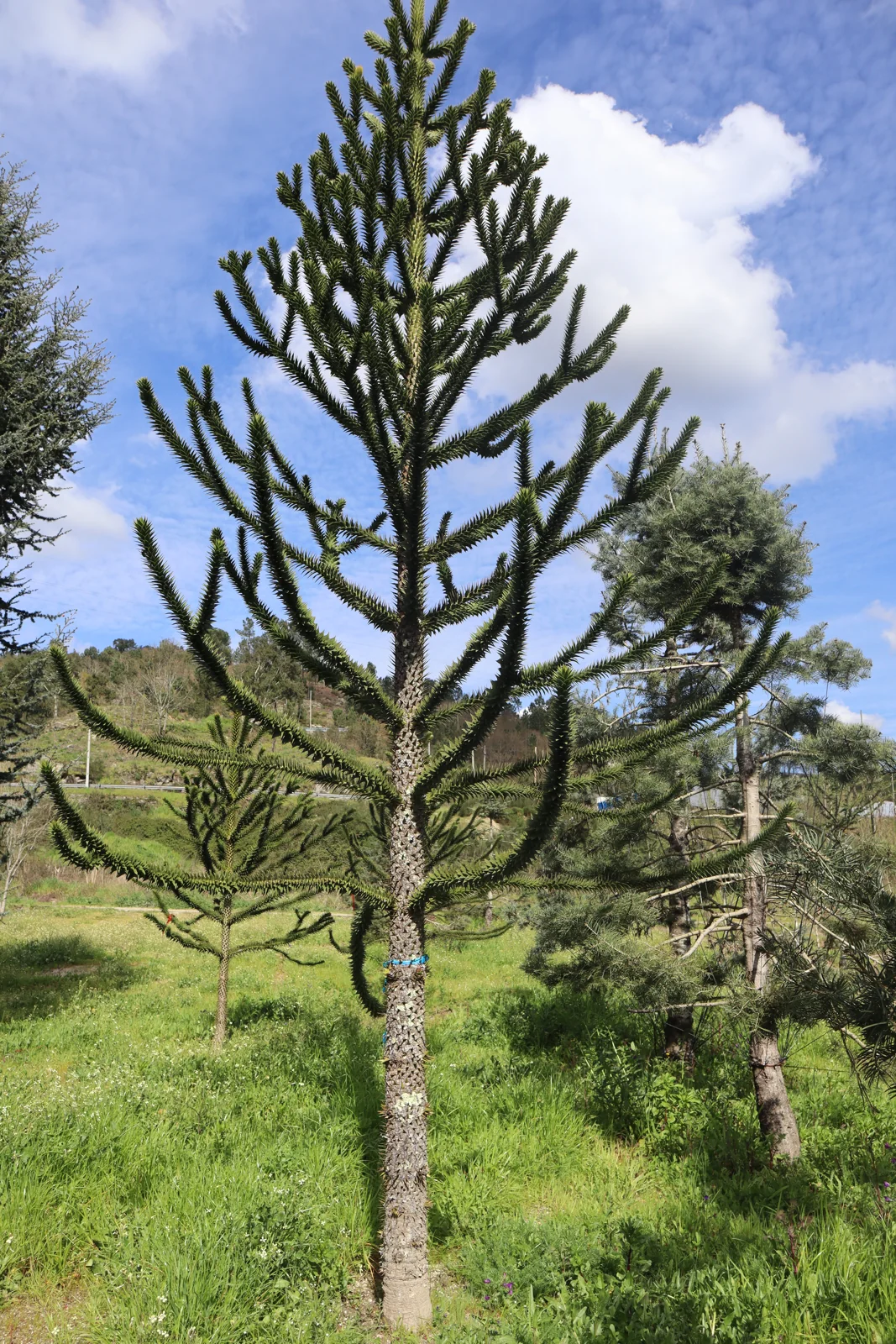
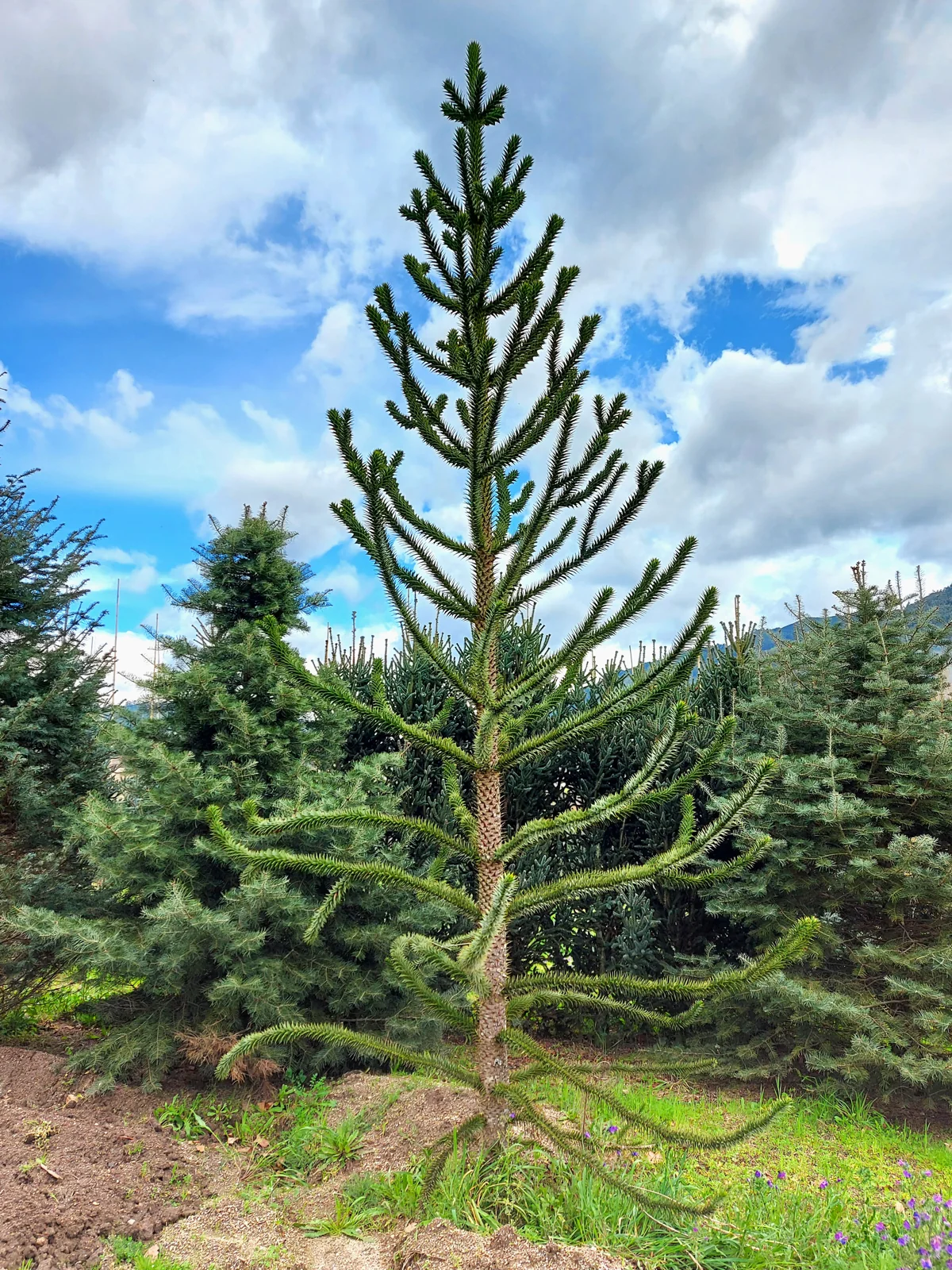
Araucaria araucana is one of the few specimen conifers whose silhouette functions as the design statement on its own. Juveniles are conical and open, with sparse rope-like branches arranged in symmetrical whorls; mature trees lose their lower branches and broaden into the characteristic umbrella crown atop a long clean trunk. Rigid triangular leaves are…
Read more
Show less
Araucaria araucana is one of the few specimen conifers whose silhouette functions as the design statement on its own. Juveniles are conical and open, with sparse rope-like branches arranged in symmetrical whorls; mature trees lose their lower branches and broaden into the characteristic umbrella crown atop a long clean trunk. Rigid triangular leaves are scale-like, sharply pointed, and persist on the branchlets for 10 to 15 years. Growth is slow.
Its native envelope is the cool, humid maritime climate of the southern Andes, and that envelope governs where the species belongs in Spain. The reliable range is the cornisa cantábrica (Galicia, Asturias, Cantabria, Basque Country) and cooler pockets of the northern interior, where mild summers match its cultivation requirement. It is not a tree for the central meseta in summer or for the semi-arid southeast, which exceed its heat tolerance. Hardy to roughly minus 15 °C once established.
Site requirements are exacting in detail rather than in quantity. Full sun, deep well-drained loam, mildly acidic preference, frequent watering through the first 2 to 3 summers; clay is tolerated where drainage is genuine. Salt tolerance is low, so coastal specification should sit back from the immediate littoral. The species does not tolerate urban pollution and is poorly suited to confined planting pits: surface roots will lift paving and hardscape, and adequate clearance is needed at the design stage.
Reach in cultivation is typically 15 to 21 m in height with a 5 to 10 m spread, slowly attained. Trees are dioecious, and female specimens produce heavy globose cones that fall at maturity, a consideration in pedestrian zones and adjacent to circulation routes. The species sits outside the Xylella fastidiosa host range and is generally free of serious pests, with only occasional scale, mealybug, or root rot in poorly drained ground. Source provenance matters: the species is listed on CITES Appendix I in its native distribution, and nursery-cultivated stock should be specified accordingly.



Advice on this species
Want to know more about Araucaria araucana?
Tell us about your project and we'll advise you on this species — where it thrives, which size makes sense, and what to expect once planted.
- Produção própria
- Exemplares adultos
- Resposta em 1–2 dias
Sem compromisso · orçamento personalizado