

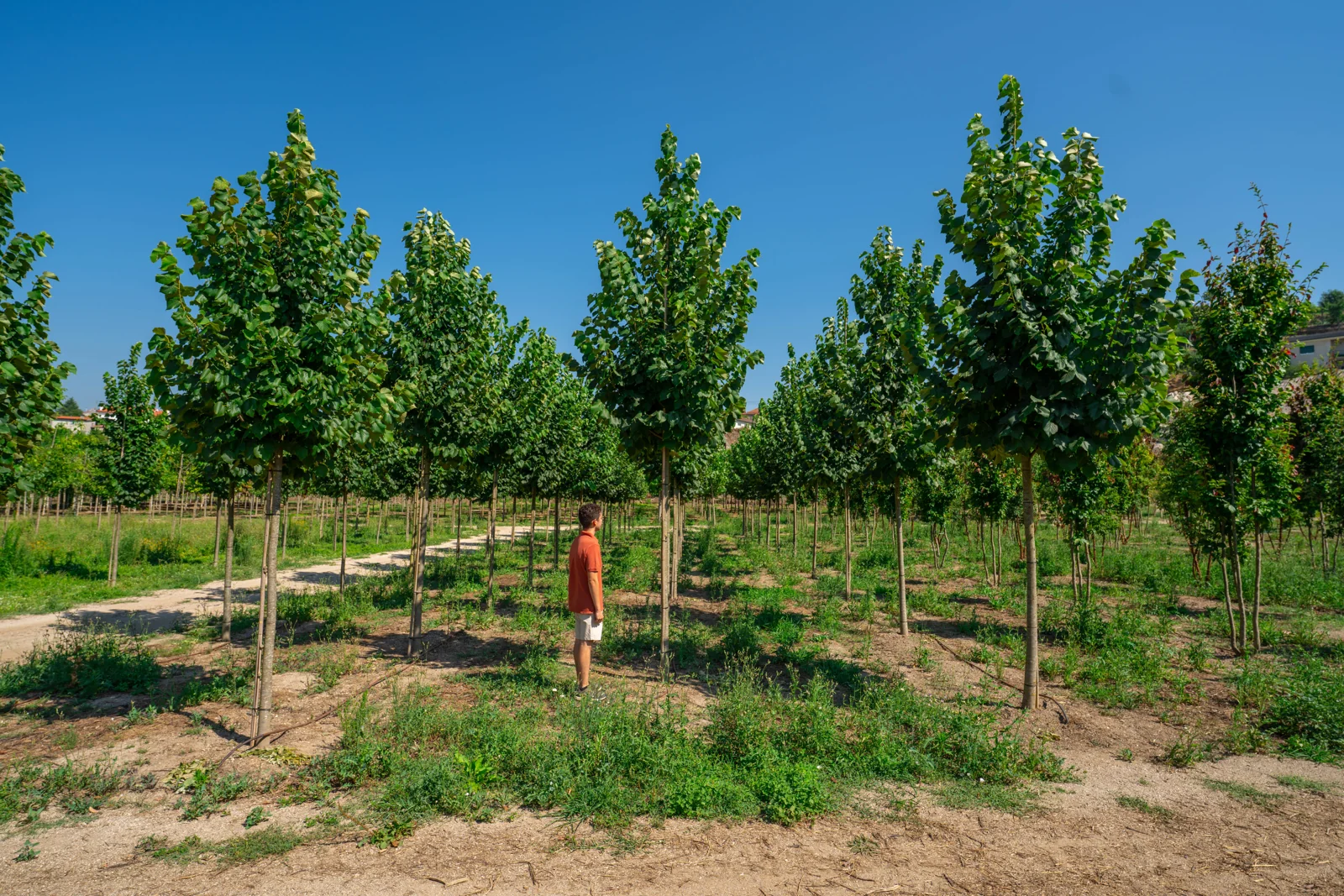
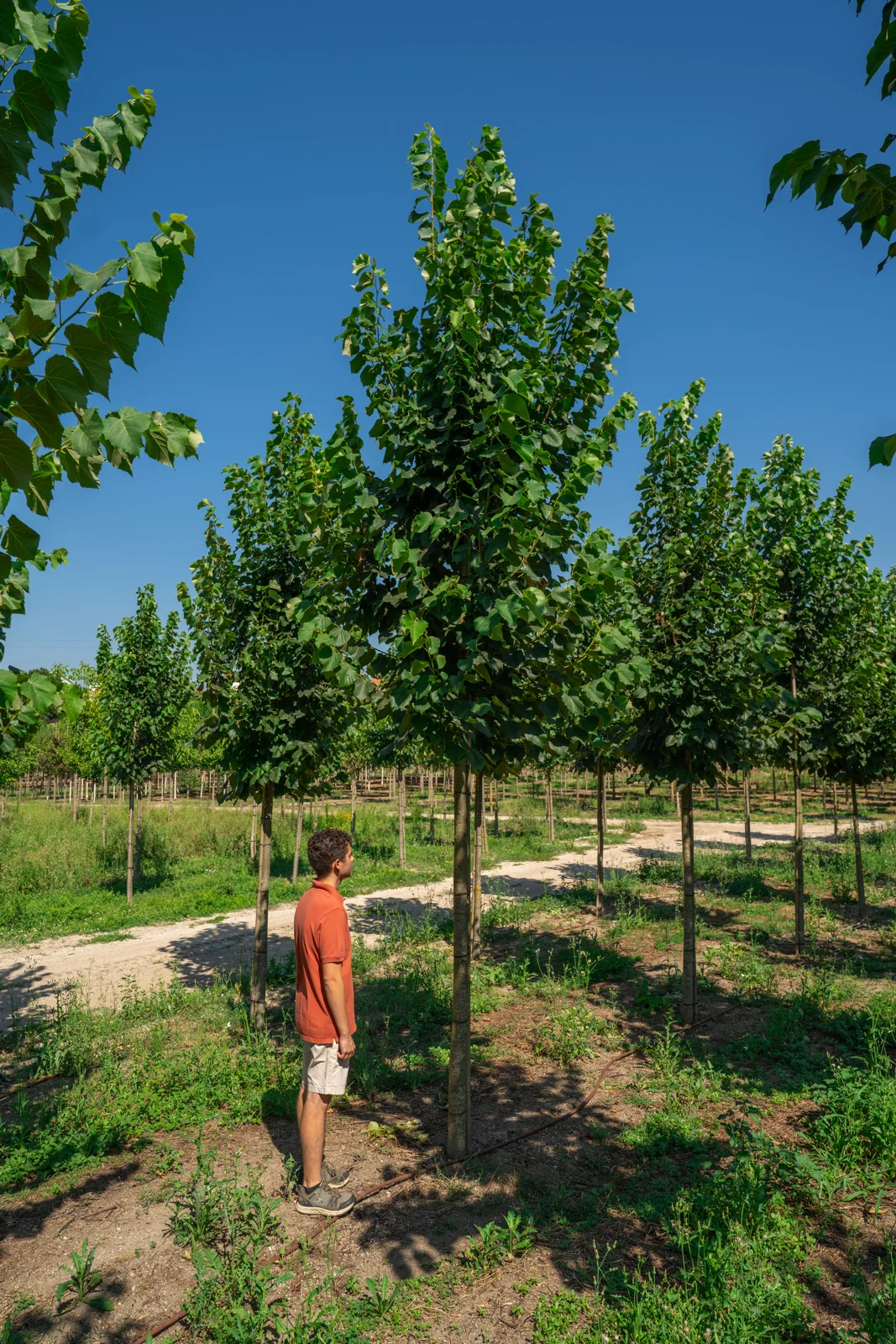
Heat-resilient Stadtbaum with silver-backed canopy for street alignments
Silver Lime · Tilia tomentosa
A dense, broadly conical street and avenue tree whose felted, silver-undersided foliage reflects summer heat, holding canopy through dry city summers where many Linden thin out. It tolerates compacted pits, pollution, and de-icing salt.
About this Species
Reliably hardy across the German planting range. The species withstands roughly minus 28 to minus 25 degrees Celsius, a margin set by its native distribution at moderate altitudes in the Balkans and western Anatolia, so winter hardiness (Winterhärte) is not the limiting factor it is for true Mediterranean stock: it performs from the Oberrheingraben (Upper…
Read more
Show less
Reliably hardy across the German planting range. The species withstands roughly minus 28 to minus 25 degrees Celsius, a margin set by its native distribution at moderate altitudes in the Balkans and western Anatolia, so winter hardiness (Winterhärte) is not the limiting factor it is for true Mediterranean stock: it performs from the Oberrheingraben (Upper Rhine valley) through the norddeutsche Tiefebene (northern German lowlands) and east of the Elbe, with no first-winter risk window to manage. This places hardiness well below any working threshold a specifier needs to defend.
Where it separates from the native Linden is heat-island and drought performance (Stadtbaumeignung). The leaf underside carries a dense white tomentum that reflects radiation and reduces water loss, so the crown holds colour and density through the hot, dry summers of the 2018 to 2022 sequence that thinned Tilia cordata and scorched Acer platanoides on exposed sites. It is established on the GALK-Straßenbaumliste (the definitive German municipal street tree list) and recurs on Klima-Artenmatrix climate-adapted lists, which gives the specification a documented basis rather than a supplier assertion.
Its site adaptability (Standortansprüche) is broad. It performs on free-draining loams with summer moisture, tolerates the calcareous Rhine and Bavarian limestone substrates to roughly pH 8, and accepts the compacted, confined root volumes (Wurzelverhalten) of street pits better than most large-crowned deciduous trees. De-icing salt tolerance is moderate, adequate for standard German winter salting on alignments away from the heaviest splash zones.
The form (Habitusform) is a dense, broadly conical to rounded crown that responds well to the regular crown build-up (Kronenaufbau) German Straßenbäume receive, casting deep shade for paved squares and Kurpark settings. Fragrant cream flowers in July and August feed bees, the silvered foliage gives a moving, two-toned canopy in wind, and autumn turns soft yellow. Free of the phytosanitary pressure that has compromised Fraxinus and Ulmus, it reads as a credible Zukunftsbaum where a heat-tolerant large Linden is wanted.



Advice on this species
Want to know more about Tilia tomentosa?
Tell us about your project and we'll advise you on this species — where it thrives, which size makes sense, and what to expect once planted.
- Produção própria
- Exemplares adultos
- Resposta em 1–2 dias
Sem compromisso · orçamento personalizado