

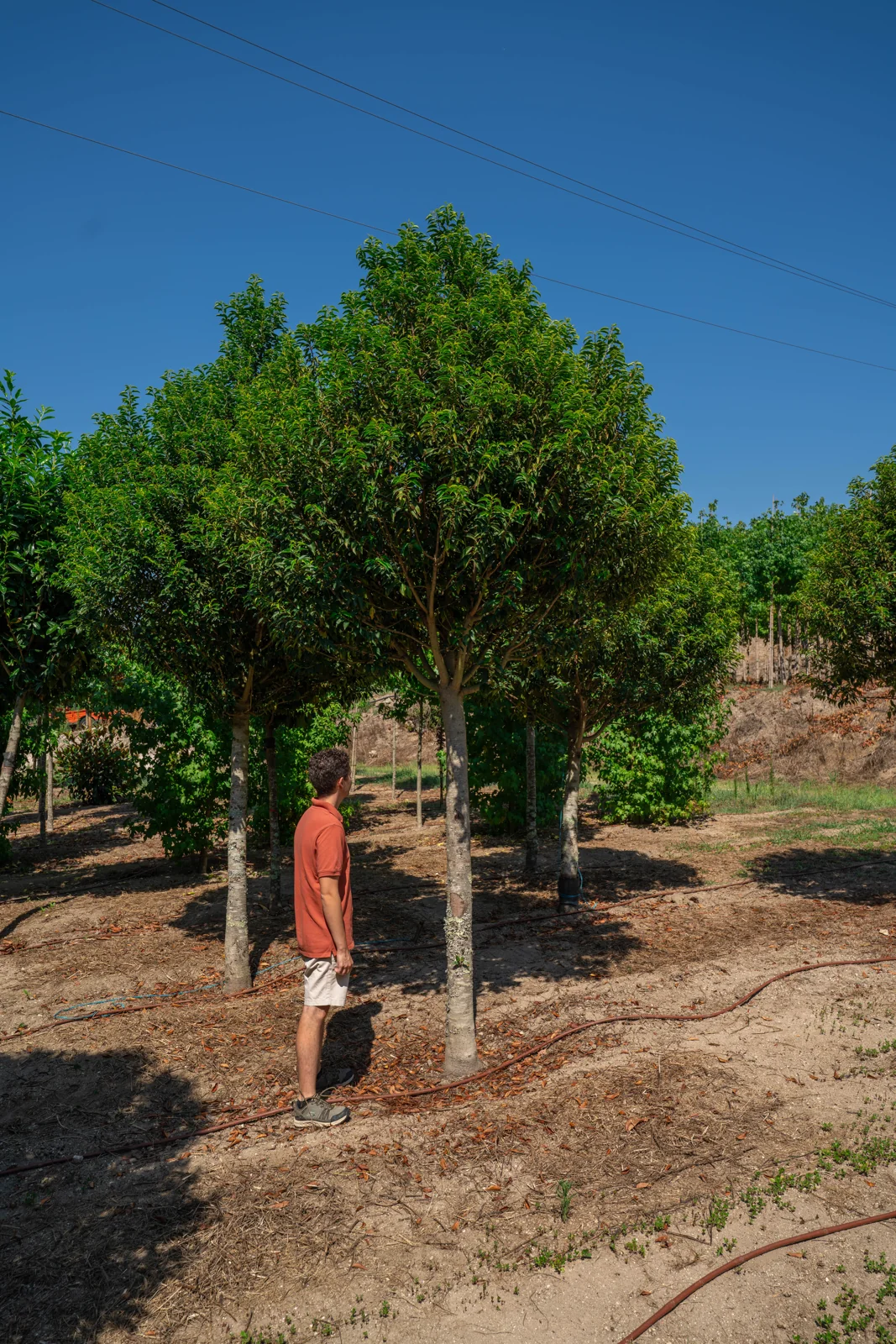
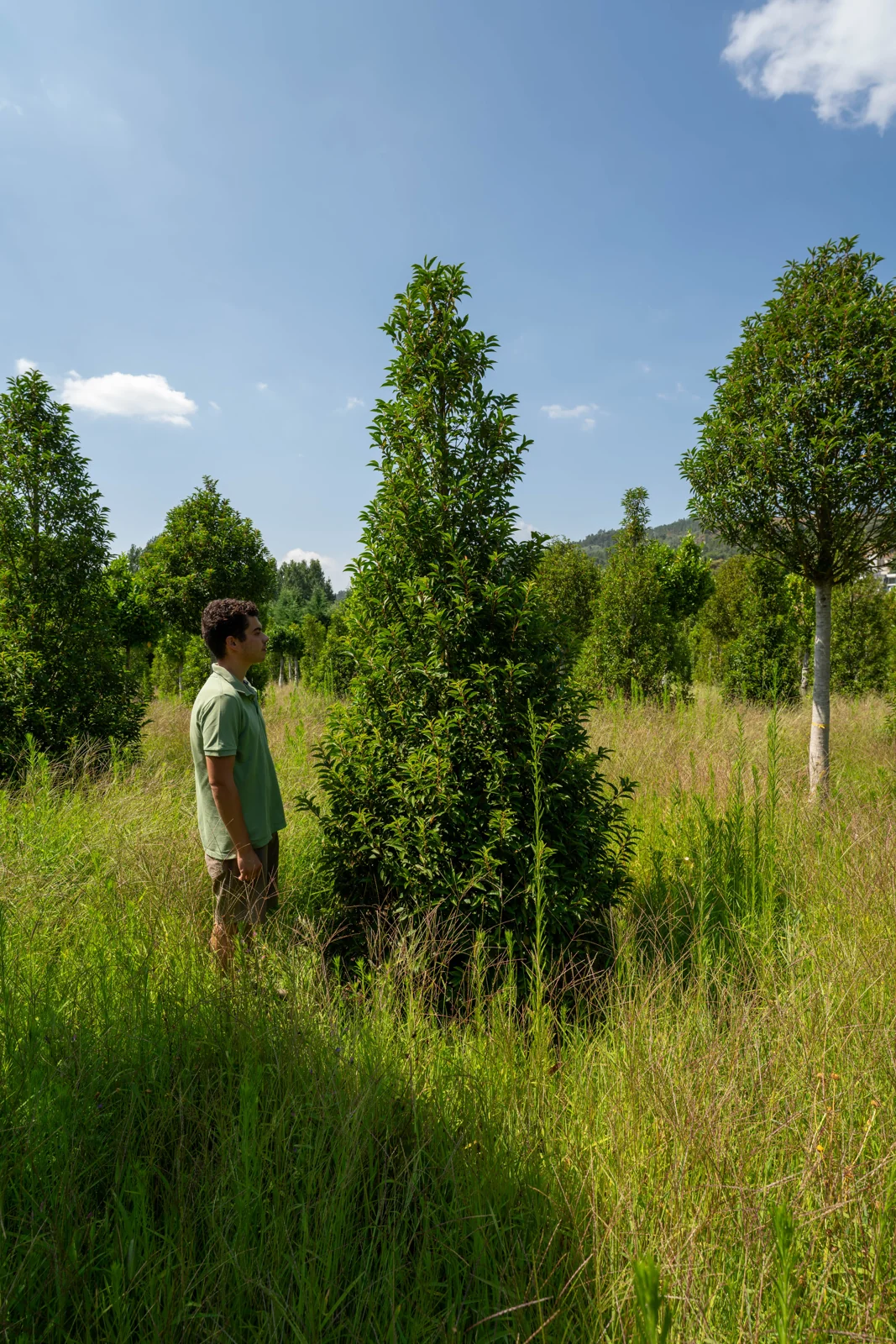
Frost-hardy evergreen screen for confined urban plantings
Portuguese Laurel ‘Angustifolia’ · Prunus lusitanica ‘Angustifolia’
Where a dense evergreen structure is wanted on a constrained German site, this narrow-leaved selection holds an upright, tightly furnished crown to 4 to 6 metres, tolerates hard pruning, and offers winter presence in a frost-tested screening role.
About this Cultivar
Winter hardiness (Winterhärte) is the first specification question for any Iberian evergreen on a German project, and this selection answers it better than most. The species withstands roughly minus 18 degrees Celsius on warm, free-draining soil where the wood ripens fully through the season; minus 15 degrees Celsius is a safer working limit in open…
Read more
Show less
Winter hardiness (Winterhärte) is the first specification question for any Iberian evergreen on a German project, and this selection answers it better than most. The species withstands roughly minus 18 degrees Celsius on warm, free-draining soil where the wood ripens fully through the season; minus 15 degrees Celsius is a safer working limit in open positions, because waterlogged or cold-wet roots, not air temperature alone, drive most winter loss. The first three winters are the risk window, after which established plants harden off and tolerate more.
This places reliable performance in the milder Klimaregionen: the Upper Rhine valley (Oberrheingraben), the Lower Rhine basin (Niederrheinische Bucht), and sheltered urban heat-island sites in cities such as Köln and Frankfurt am Main. East of the Elbe and above 400 metres in the pre-Alpine foothills (voralpenland) the species is marginal in open ground and wants a warm, wind-sheltered pocket against a south or west wall, where the retained warmth narrows the gap to its threshold.
The distinguishing trait of 'Angustifolia' is foliage: leaves are narrower and more elongated than the type, giving a finer, denser texture that takes clipping cleanly into formal screens and high boundaries. The crown is naturally upright and well structured, an evergreen alternative to Prunus laurocerasus with a more refined habit and, unlike the cherry laurel, greater frost tolerance and a lighter, less coarse line.
For street and site suitability (Stadtbaumeignung) the species tolerates compacted soils, urban air pollution, and short summer drought once the root system is established, drought tolerance and heat tolerance both being moderate rather than absolute. It performs on free-draining loams and on calcareous substrates, prefers slightly acidic ground, and fails only on standing wet. Fragrant white racemes open in spring to early summer for pollinators, followed by dark drupes taken by birds, with glossy evergreen cover the rest of the year. Note susceptibility to silver leaf disease (Stereum purpureum); prune in dry summer weather to limit infection.
Advice on this species
Want to know more about Prunus lusitanica 'Angustifolia'?
Tell us about your project and we'll advise you on this species — where it thrives, which size makes sense, and what to expect once planted.
- Produção própria
- Exemplares adultos
- Resposta em 1–2 dias
Sem compromisso · orçamento personalizado