

Pollution-tolerant alignment tree for compacted street pits
London Plane · Platanus × hispanica
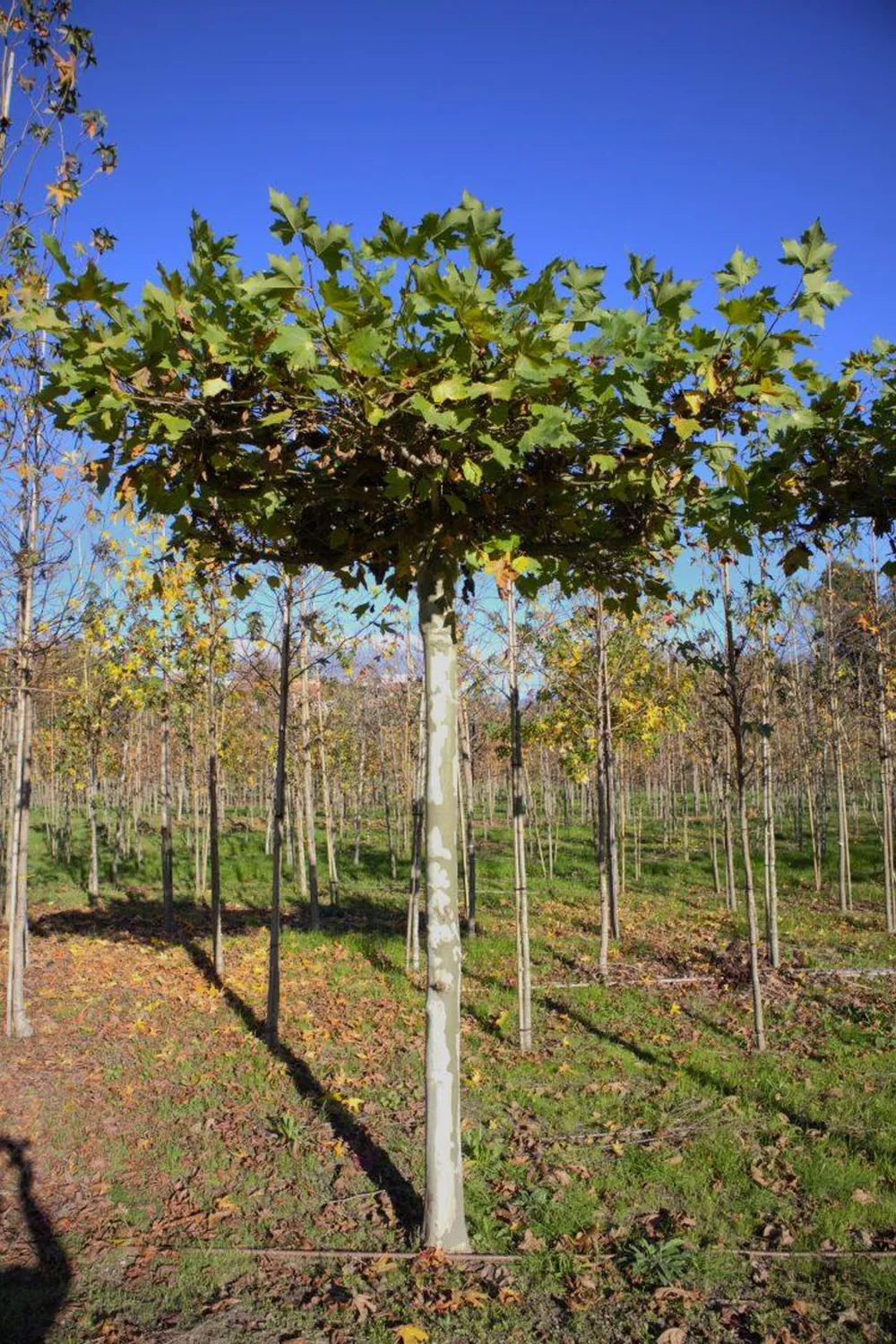
Few deciduous trees match its record on compacted, polluted German street sites: a fast, broad-crowned shade tree with exfoliating bark, deep root tolerance of confined pits, and proven winter hardiness across every Klimaregion, a defensible specification for avenues.
About this Species
Specifiers reaching for canopy on hard urban sites rely on this hybrid for one reason above all: street tree suitability (Stadtbaumeignung) under conditions that defeat most large deciduous trees. It tolerates compacted soils, confined root volumes, and atmospheric pollution because its vigorous, deep-questing root system exploits restricted pits rather…
Read more
Show less
Specifiers reaching for canopy on hard urban sites rely on this hybrid for one reason above all: street tree suitability (Stadtbaumeignung) under conditions that defeat most large deciduous trees. It tolerates compacted soils, confined root volumes, and atmospheric pollution because its vigorous, deep-questing root system exploits restricted pits rather than girdling within them, and it carries a long German municipal track record on the GALK street tree list maintained by the working group of municipal parks departments.
Winter hardiness (Winterhärte) is not the constraint here that it is for Mediterranean stock. The cross inherits the cold tolerance of its oriental parent improved by hybrid vigour, performing reliably below minus 20 degrees Celsius, so it overwinters without protection across the full range of German Klimaregionen from the Oberrheingraben to the norddeutsche Tiefebene and east of the Elbe. This is one of the few large-canopy trees a specifier can place anywhere in Germany on hardiness grounds alone.
The site argument is breadth of substrate tolerance. It establishes on free-draining loams with summer moisture, holds on heavy clay where many alignment trees stall, and tolerates calcareous substrates and de-icing salt loads typical of salted German carriageways, which makes it defensible on the difficult Standort a Pflanzliste must accommodate.
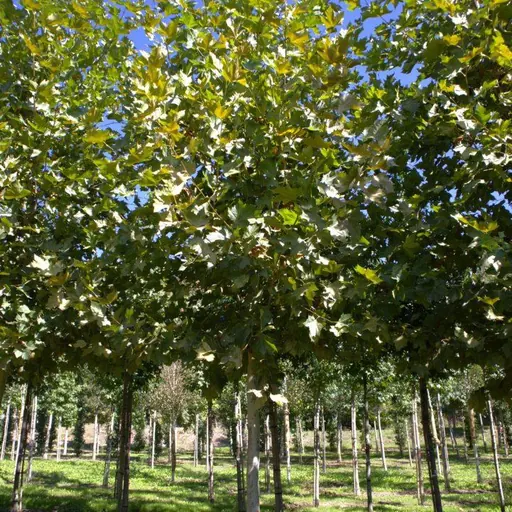
The honest limit is sanitary, not climatic. Under summer drought stress the species becomes susceptible to Massariakrankheit (Splanchnonema platani), a branch-dieback disease now under active monitoring in German cities, so specification should pair it with adequate root-zone water and a crown inspection regime. Anthracnose can disfigure foliage in cool wet springs without threatening the tree. Form supports the urban case: a broad, high crown casts dense summer shade, and the flaking grey-green to olive bark gives winter structure.



Advice on this species
Want to know more about Platanus × hispanica?
Tell us about your project and we'll advise you on this species — where it thrives, which size makes sense, and what to expect once planted.
- Produção própria
- Exemplares adultos
- Resposta em 1–2 dias
Sem compromisso · orçamento personalizado