

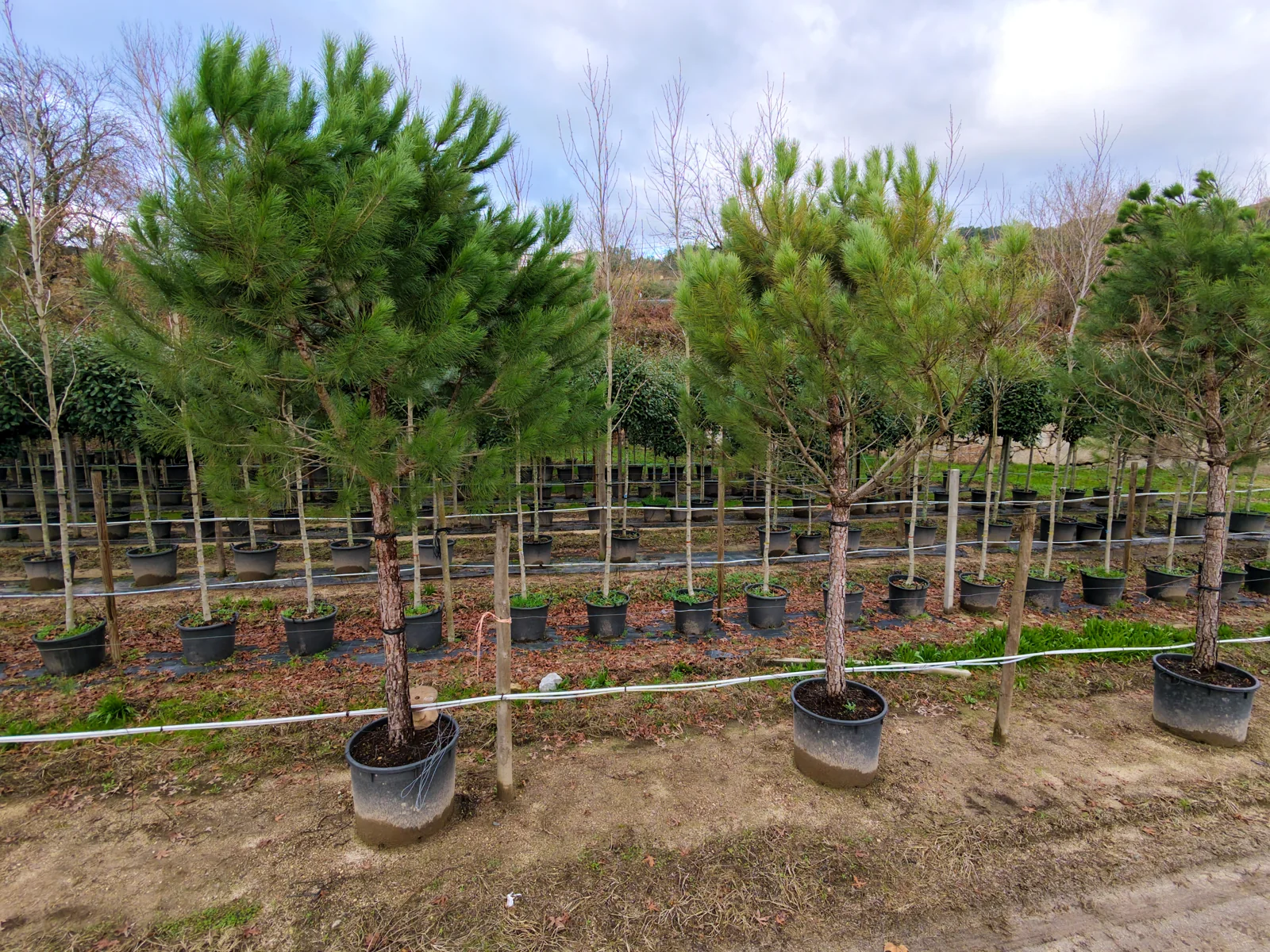
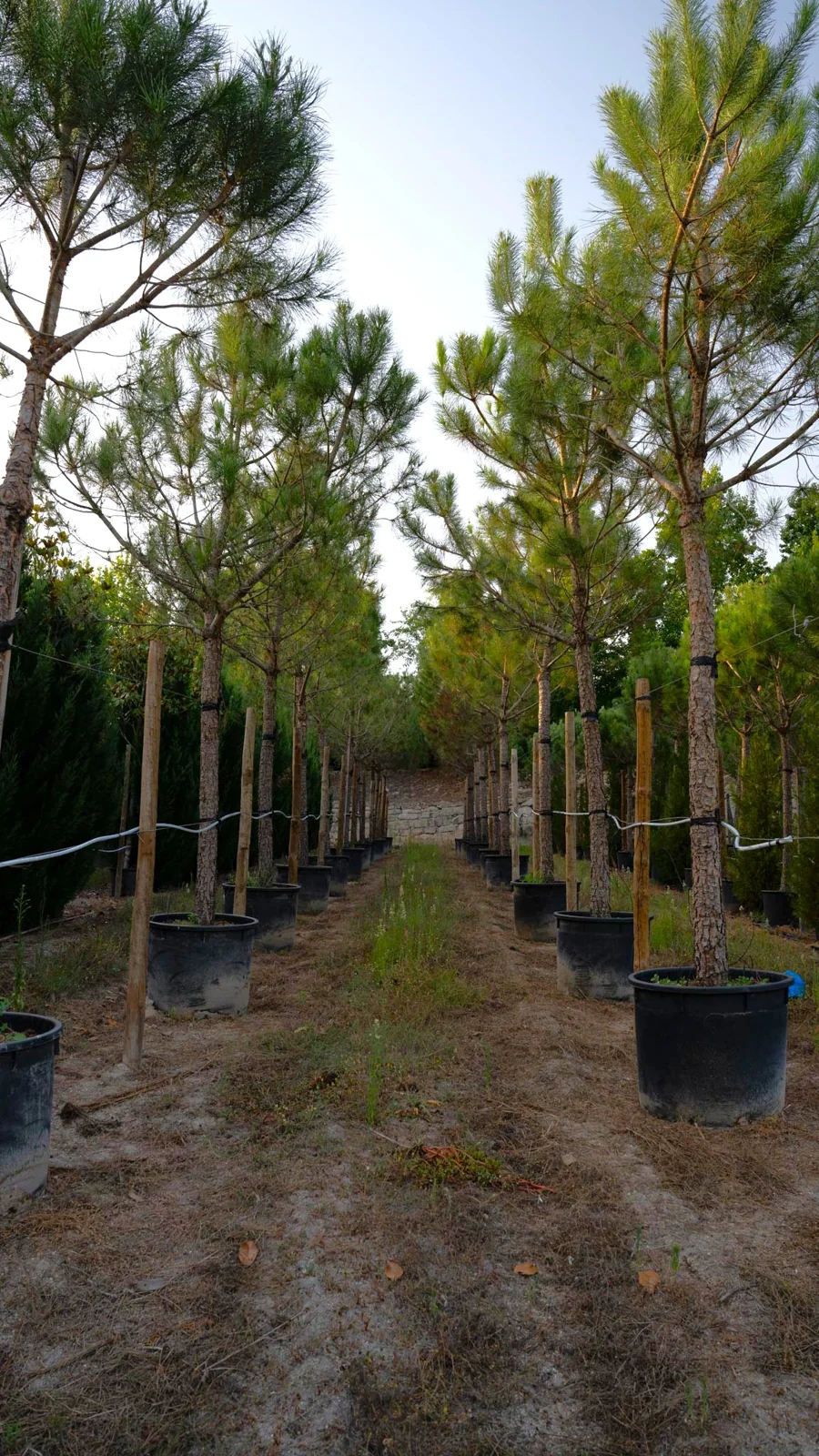
Borderline-hardy umbrella conifer for warm urban niches
Stone Pine · Pinus pinea
An evergreen specimen pine whose broad, flat crown defines Mediterranean landscapes, well suited on German projects to the mildest urban Klimaregionen and to sheltered sites with free-draining substrate where its sculptural presence carries the scheme.
About this Species
The mature stone pine (Pinie) develops the umbrella-shaped canopy (Habitusform) that has anchored Italian and Iberian landscapes for two millennia. Trunks carry thick, deeply fissured red-brown bark; paired needles ten to twenty centimetres long give a soft dark-green texture above. Typical dimensions in cultivation are twelve to twenty metres of height…
Read more
Show less
The mature stone pine (Pinie) develops the umbrella-shaped canopy (Habitusform) that has anchored Italian and Iberian landscapes for two millennia. Trunks carry thick, deeply fissured red-brown bark; paired needles ten to twenty centimetres long give a soft dark-green texture above. Typical dimensions in cultivation are twelve to twenty metres of height over eight to fifteen metres of spread, the crown widening progressively with age.
Winterhärte is the central question. Pinus pinea is reliably hardy to roughly minus twelve degrees Celsius on established trees in sheltered, free-draining positions, with minus ten degrees Celsius as a more conservative working limit in open sites; young trees in the first three years are noticeably more vulnerable and routinely lose shoots below those figures. The species is realistic only for the mildest German Klimaregionen, including the Upper Rhine valley (Oberrheingraben), the Lower Rhine basin (Niederrheinische Bucht), and protected urban heat-island sites within them. It should not be specified for the northern German lowlands (norddeutsche Tiefebene), for projects east of the Elbe, or for the pre-Alpine foothills (voralpenland).
Standortansprüche are otherwise undemanding. The species performs on sandy to loamy free-draining soils, tolerates calcareous substrates to around pH eight once established, and reads slightly acidic conditions as optimal. Drought and coastal salt are handled well, the deep root system supporting its long Mediterranean use for coastal dune consolidation. The crown is wind-damage prone in exposed positions, which argues for sheltered urban courtyards, walled gardens, and inner-city Stadtbaum niches over windward street alignments.
Disease pressure in cultivation includes Diplodia pinea, red band needle blight (Mycosphaerella pini), and the recently emerging Pestalotiopsis pini on shoots and trunks; the species is not listed on the GALK-Straßenbaumliste and is not a candidate for the Klima-Artenmatrix outside the warmest urban niches. Where the Klimaregion supports it, the tree functions as a long-lived solitary feature for Kurpark settings, hotel courtyards, and Mediterranean-styled private gardens. Maintenance is low once the crown is set; specify with the hardiness caveats written into the Pflanzliste.



Advice on this species
Want to know more about Pinus pinea?
Tell us about your project and we'll advise you on this species — where it thrives, which size makes sense, and what to expect once planted.
- Produção própria
- Exemplares adultos
- Resposta em 1–2 dias
Sem compromisso · orçamento personalizado