

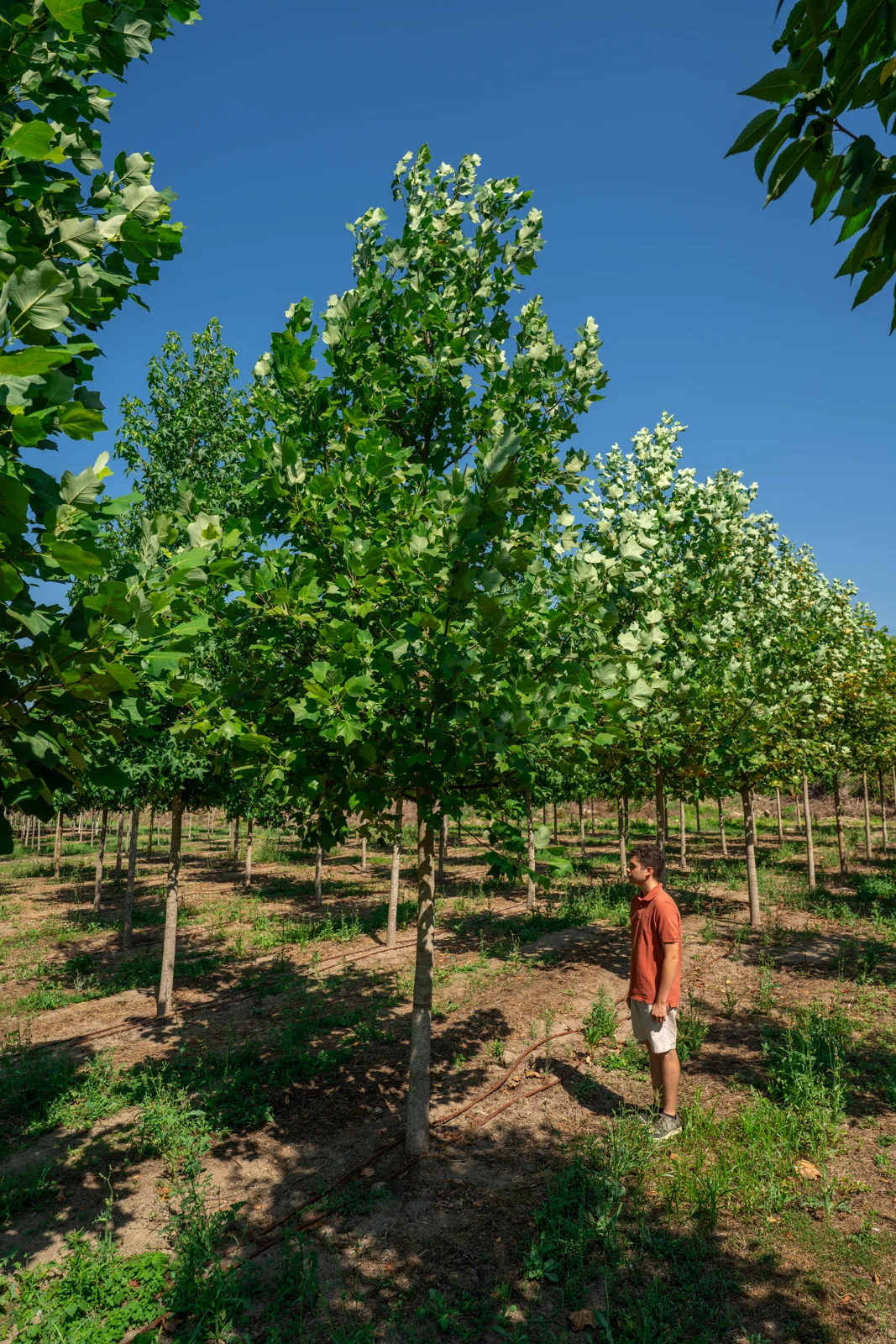
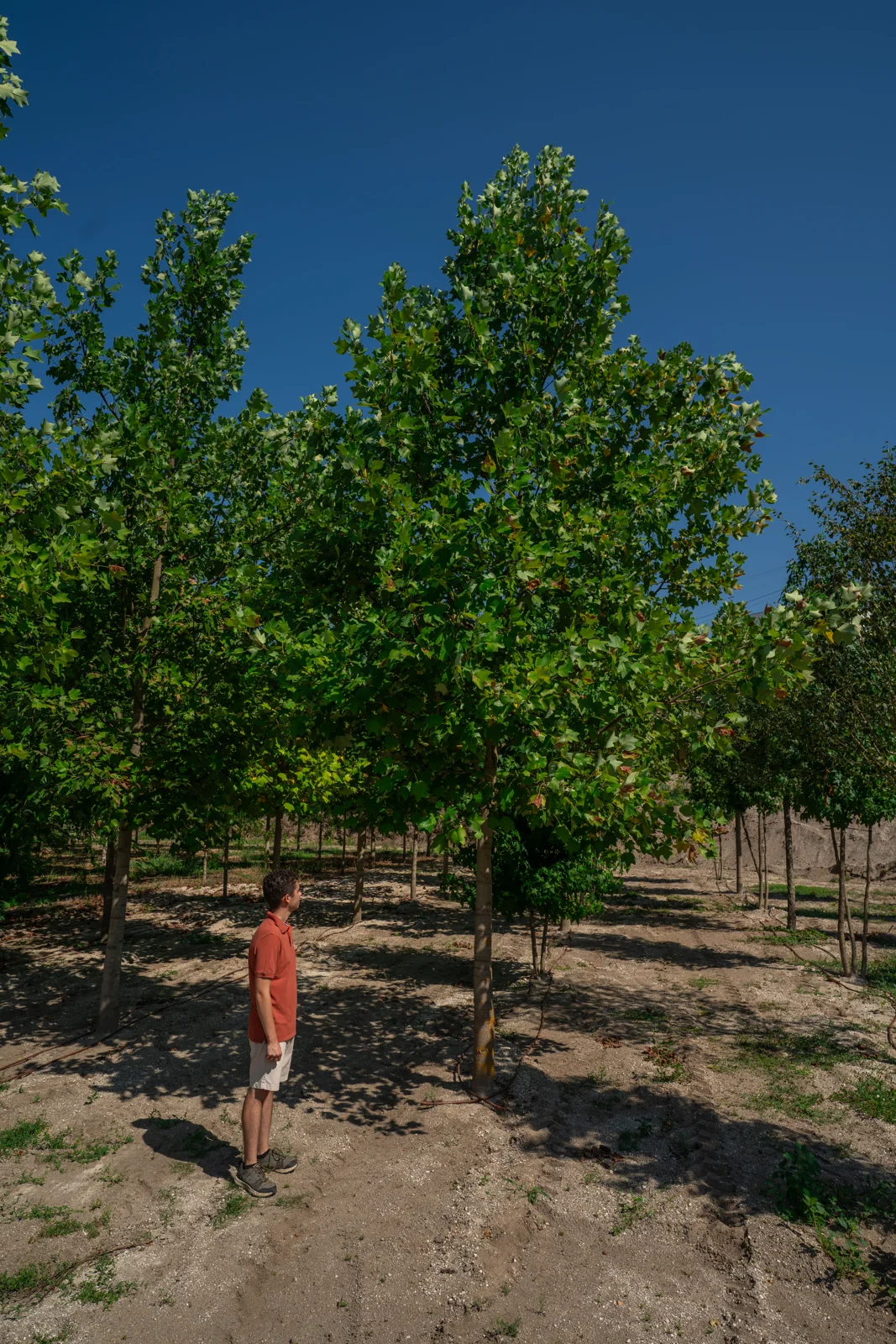
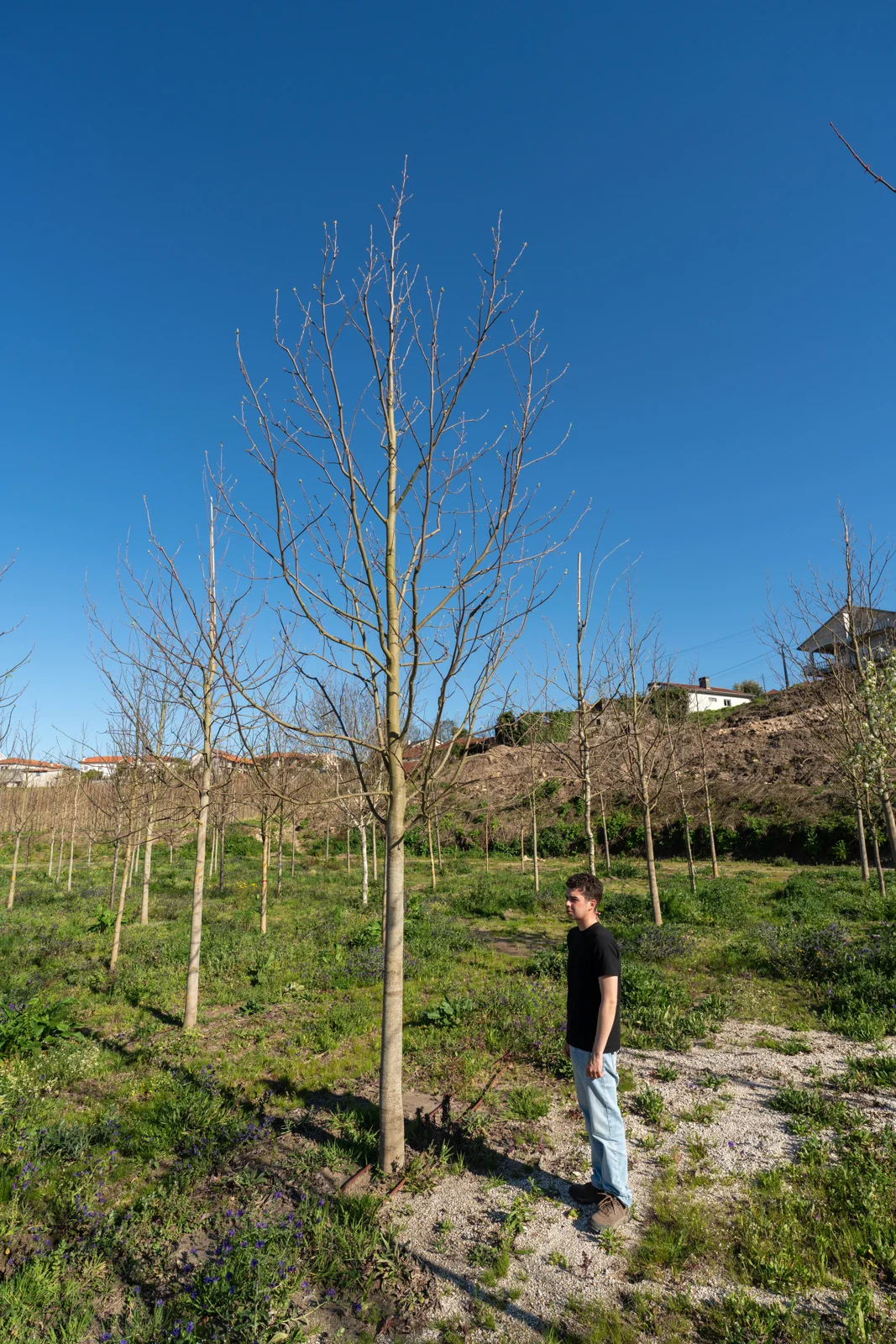
Fast-growing large-park shade tree for deep moist sites
Tulip Tree · Liriodendron tulipifera
A large deciduous shade tree (Tulpenbaum) from eastern North America, fully winter-hardy across all German Klimaregionen. It delivers rapid height gain on deep, moist soils and performs best at park and campus sites with generous root volume and water.
About this Species
Winter hardiness (Winterhärte) is not a constraint for this species in Germany. Native to a continental range extending from southern Ontario to the Great Lakes states, Liriodendron tulipifera tolerates winter minima well below minus 30 degrees Celsius. It performs reliably from the Upper Rhine valley (Oberrheingraben) through the northern German lowlands…
Read more
Show less
Winter hardiness (Winterhärte) is not a constraint for this species in Germany. Native to a continental range extending from southern Ontario to the Great Lakes states, Liriodendron tulipifera tolerates winter minima well below minus 30 degrees Celsius. It performs reliably from the Upper Rhine valley (Oberrheingraben) through the northern German lowlands (norddeutsche Tiefebene) and into the pre-Alpine foothills (Voralpenland) without frost protection at any stage of establishment.
The limiting factor is site, not climate. The species requires deep, moist, well-drained loamy soils with a slightly acidic to neutral pH. It has low tolerance of soil compaction and restricted root volumes, which effectively rules out confined street tree pits. Salt tolerance is low, making it unsuitable for roadside planting where winter de-icing is routine. On waterlogged clay or sites prone to ponding it will not establish. These site requirements (Standortansprüche) place it outside the scope of the GALK street tree list (the definitive German street tree recommendation list, maintained by the working group of German municipal parks departments) and exclude it as a Zukunftsbaum candidate for heat-stressed urban planting. Its role is in parks, campus grounds, large institutional landscapes, and open residential estates where root space and soil moisture are not limiting.
Growth rate is rapid. On suitable sites, height increments of 60 to 80 centimetres per year in the establishment phase are realistic, with mature heights of 25 to 35 metres. The crown form (Habitusform) is upright-conical in youth, broadening with age to a high oval. The trunk is characteristically straight and self-pruning, often branch-free to considerable height in sheltered positions. Fleshy roots within the Magnoliaceae are easily damaged during transplanting; early spring planting before leaf-out, following DIN 18916 soil preparation standards, reduces establishment losses.
Foliage is distinctive: four-lobed leaves with a truncated apex, bright green through summer, turning golden yellow in autumn. The tulip-shaped flowers appear in May and June, greenish yellow with an orange band at the base, but sit high in the crown and are often inconspicuous on mature specimens. During prolonged dry spells, inner leaves yellow and drop prematurely, a drought-stress response that is cosmetically significant in public settings. Aphid infestations can produce honeydew and secondary sooty mould on foliage and surfaces below the canopy, a management consideration for trees overhanging paths or seating areas.
For large-scale park planting on deep loams with reliable moisture, the species offers a combination of rapid establishment, strong vertical structure, and clean autumn colour that few other large deciduous trees can match at comparable growth rates.



Advice on this species
Want to know more about Liriodendron tulipifera?
Tell us about your project and we'll advise you on this species — where it thrives, which size makes sense, and what to expect once planted.
- Produção própria
- Exemplares adultos
- Resposta em 1–2 dias
Sem compromisso · orçamento personalizado