

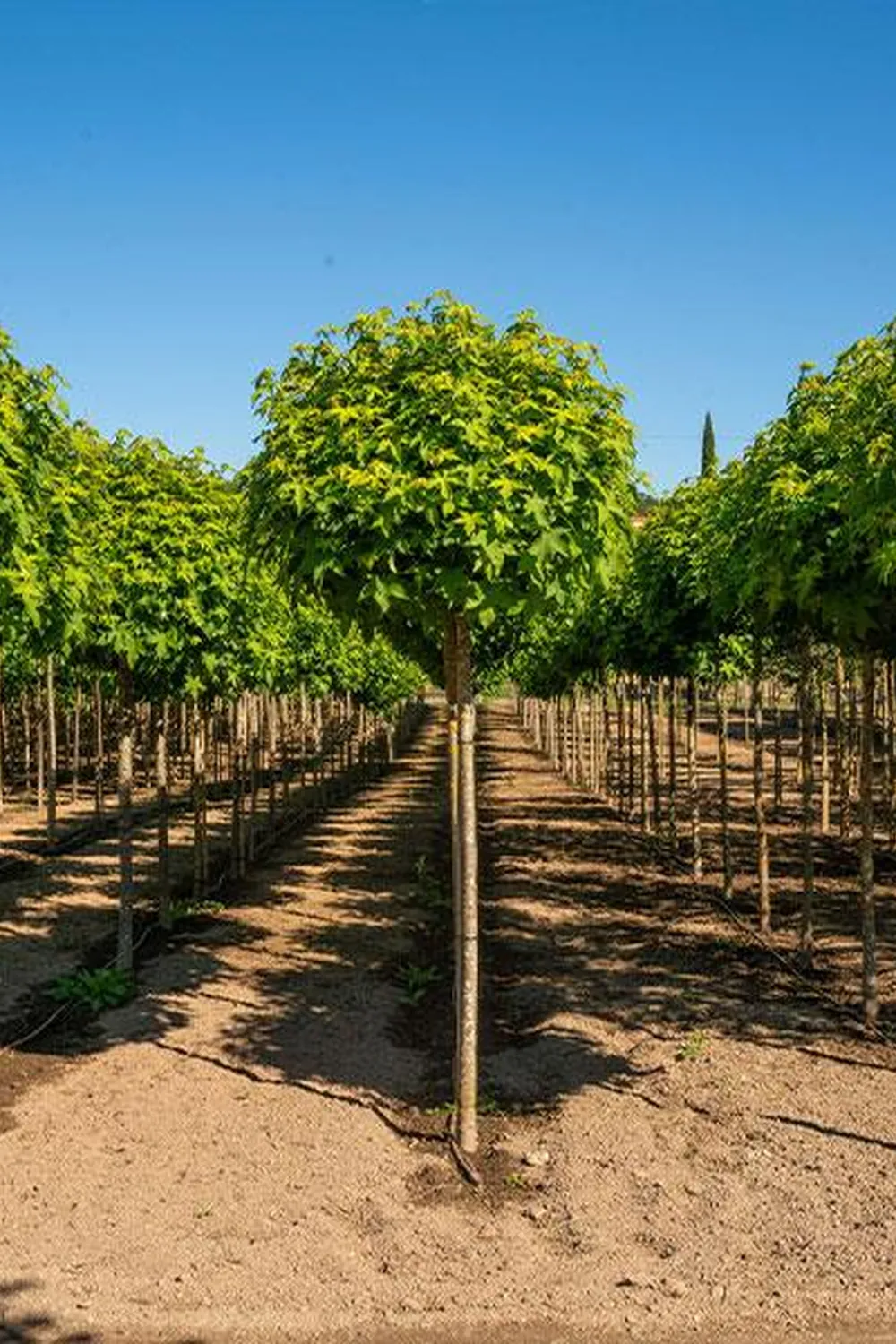
Compact Stadtbaum candidate for confined urban sites
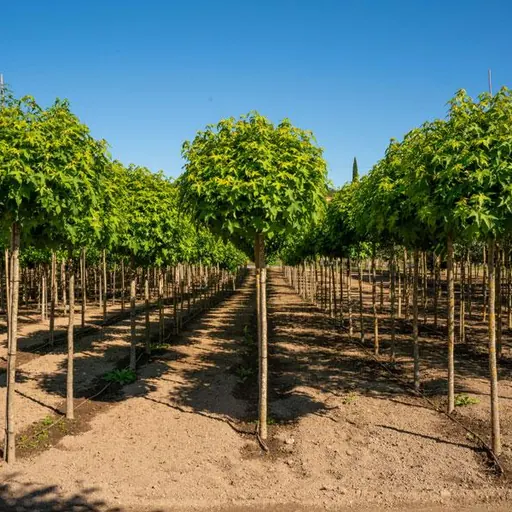
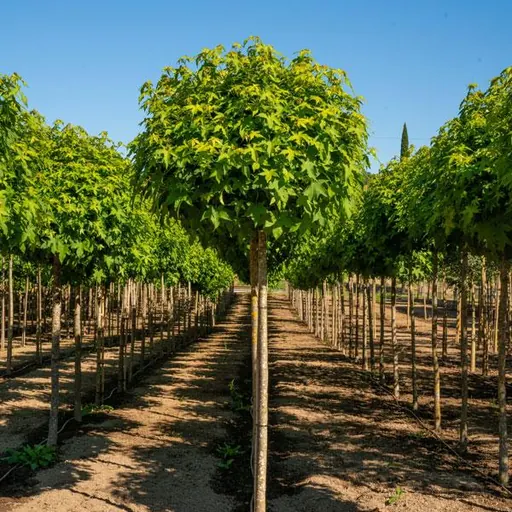
Sweet Gum ‘Globosa’ · Liquidambar styraciflua ‘Globosa’
A dwarf, rounded form of Liquidambar styraciflua grafted onto species rootstock, suited to constrained German urban planting situations where the standard species cannot fit. Reliably hardy across most Klimaregionen, with the autumn colour of the parent species.
Key Facts
About this Cultivar
'Globosa' carries the ornamental character of Liquidambar styraciflua on a markedly smaller frame: a dense, naturally symmetrical globose crown reaching three to five metres in height and similar spread at maturity, without the formative pruning the species requires to hold a clean leader. The palmate, deeply lobed leaves run glossy green through spring and…
Read more
Show less
'Globosa' carries the ornamental character of Liquidambar styraciflua on a markedly smaller frame: a dense, naturally symmetrical globose crown reaching three to five metres in height and similar spread at maturity, without the formative pruning the species requires to hold a clean leader. The palmate, deeply lobed leaves run glossy green through spring and summer, then turn through yellow, orange, red and purple in autumn. Slow to moderate growth keeps the crown legible in confined sites and reduces the long-term pruning liability on street-tree contracts.
Winter hardiness (Winterhärte) follows the parent species, which tolerates minima approaching minus 25 degrees Celsius in sheltered positions on free-draining soil; minus 20 degrees Celsius is a conservative working limit in open sites. The cultivar performs across the Oberrheingraben (Upper Rhine valley), the Niederrheinische Bucht (Lower Rhine basin), Berlin and the norddeutsche Tiefebene (Northern German lowlands), and remains workable in the voralpenland (pre-Alpine foothills) below roughly 400 metres elevation. The first three winters after planting are the risk window for young wood; established specimens harden off reliably.
Site requirements (Standortansprüche) favour deep, fresh, free-draining soils on the acid to neutral side; performance drops on strongly calcareous substrates where iron chlorosis becomes the limiting factor. Full sun is required to develop the full autumn colour spectrum that justifies the specification. The species tolerates compacted urban soils and short drought periods once established, and is a candidate for inclusion on Klima-Artenmatrix evaluations as a heat-tolerant deciduous tree; this dwarf form extends that profile to sites where the species crown volume is unworkable.
'Globosa' fits roles where Acer platanoides 'Globosum' or Robinia pseudoacacia 'Umbraculifera' would otherwise be specified: residential streets with narrow profiles, courtyards, formal squares, and tree pits adjacent to building elevations. Sparse or absent fruiting on grafted stock removes the gumball litter problem that disqualifies the parent species from pedestrian and parking-bay contexts. The cultivar is not currently on the GALK-Straßenbaumliste, but its compact habit, hardiness profile and disease resistance support its candidacy where the standard species is too large.
Advice on this species
Want to know more about Liquidambar styraciflua 'Globosa'?
Tell us about your project and we'll advise you on this species — where it thrives, which size makes sense, and what to expect once planted.
- Produção própria
- Exemplares adultos
- Resposta em 1–2 dias
Sem compromisso · orçamento personalizado