

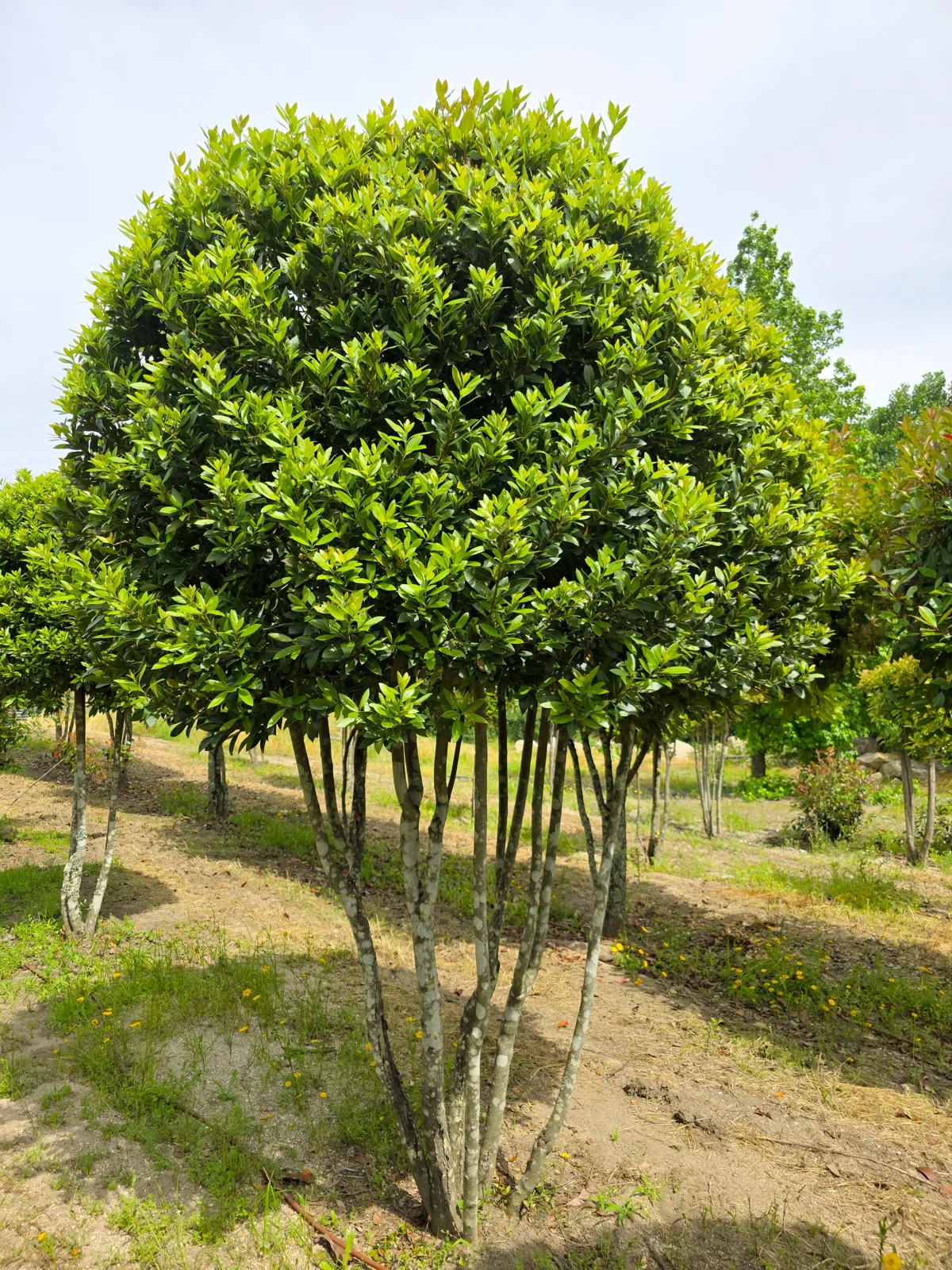
Evergreen Mediterranean accent for sheltered urban sites in mild Klimaregionen
Bay Laurel · Laurus nobilis
An evergreen Mediterranean broadleaf for sheltered urban courtyards and protected southern exposures, occupying a defined niche on German projects across the Oberrheingraben and Niederrheinische Bucht, where its clippable structure carries year-round.
About this Species
Winter hardiness (Winterhärte) defines the species more strictly than any other site factor. Reliable performance to approximately minus 10 to minus 12 degrees Celsius in sheltered positions on free-draining substrate; foliage browning begins around minus 8 degrees Celsius, and young wood is at risk below minus 12 degrees Celsius. The functional range is…
Read more
Show less
Winter hardiness (Winterhärte) defines the species more strictly than any other site factor. Reliable performance to approximately minus 10 to minus 12 degrees Celsius in sheltered positions on free-draining substrate; foliage browning begins around minus 8 degrees Celsius, and young wood is at risk below minus 12 degrees Celsius. The functional range is the Oberrheingraben (Upper Rhine valley), the Niederrheinische Bucht (Lower Rhine basin), and urban heat-island sites in Köln, Frankfurt am Main and Stuttgart. Marginal east of the Elbe, in the voralpenland (pre-Alpine foothills) above 400 metres, and across the open norddeutsche Tiefebene (northern German lowlands) without microclimatic protection.
Standortansprüche (site requirements) centre on drainage. Performs on free-draining loams and on calcareous substrates to roughly pH 8 once established, with moderate drought tolerance supported by an extensive but shallow root system that benefits from a stable mulch in the first three summers. De-icing salt tolerance is moderate, sufficient for proximity to lightly salted residential streets but not for primary Straßenbaum roles. Stadtbaumeignung is therefore best understood as confined urban planting, courtyards, sheltered plazas, container standards on entrance forecourts, not the GALK-Straßenbaumliste canon.
Habitusform is naturally conical to broadly columnar, frequently multi-stemmed from the base, reaching 5 to 12 metres at maturity with a 3 to 6 metre spread on favourable sites; the crown responds well to formative pruning. The leathery, aromatic foliage is the principal ornamental asset, holding density year-round and providing winter structure in a climate where leaf-off occupies half the visible year. Bears clipping well, which sustains its long European tradition as a topiary standard and pyramid for formal entrances.
Disease profile is generally clean in northern European cultivation. The main pressures are Trioza alacris (laurel psyllid), which curls and thickens leaf margins, and scale insects (Coccus hesperidum), both manageable under standard inspection regimes; root rot under Phytophthora is the principal soil-borne concern, reinforcing the drainage requirement. Not a Zukunftsbaum candidate in the open-canopy Stadtbaum sense, but a defensible specification for evergreen accent, screening, and clipped form on sheltered Mediterranean-microclimate sites where Buxus is compromised by Cydalima perspectalis and a broadleaf evergreen of comparable density is needed.



Advice on this species
Want to know more about Laurus nobilis?
Tell us about your project and we'll advise you on this species — where it thrives, which size makes sense, and what to expect once planted.
- Produção própria
- Exemplares adultos
- Resposta em 1–2 dias
Sem compromisso · orçamento personalizado