

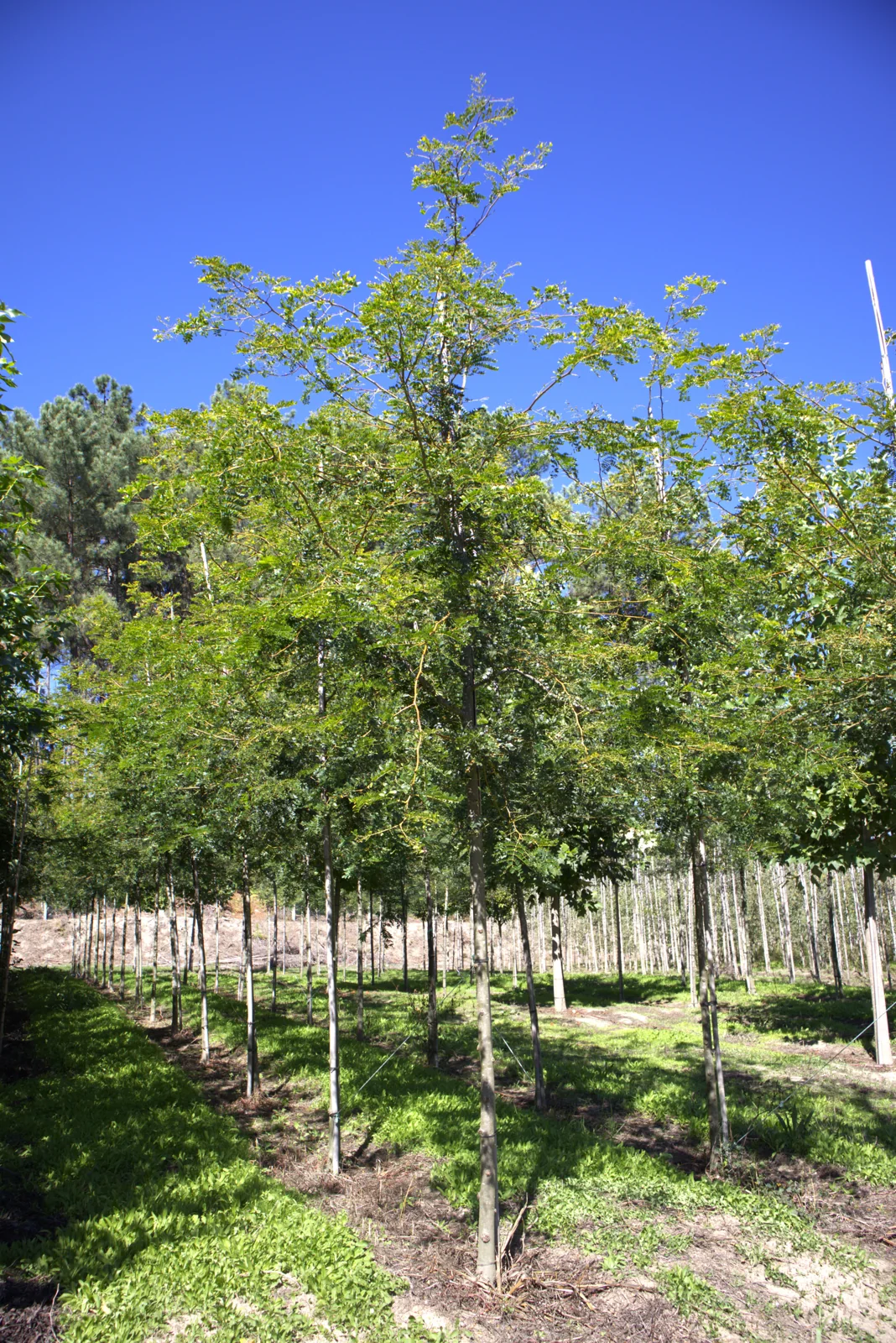
Frost-hardy Stadtbaum on the GALK list for compacted, salt-loaded streets
Honey Locust ‘Inermis’ · Gleditsia triacanthos ‘Inermis’
A tested Stadtbaum on the GALK-Straßenbaumliste, this thornless honey locust (Amerikanische Gleditschie) suits compacted urban substrates and de-icing salt across every German Klimaregion from the Oberrheingraben to the norddeutsche Tiefebene.
Key Facts
About this Cultivar
Winter hardiness (Winterhärte) for this species sits in a different category from the Mediterranean taxa that dominate this catalogue. Gleditsia triacanthos is native to the continental interior of North America and tolerates reliable winter minima below minus 25 degrees Celsius in open sites, with established trees recorded uninjured well below that. There…
Read more
Show less
Winter hardiness (Winterhärte) for this species sits in a different category from the Mediterranean taxa that dominate this catalogue. Gleditsia triacanthos is native to the continental interior of North America and tolerates reliable winter minima below minus 25 degrees Celsius in open sites, with established trees recorded uninjured well below that. There is no Klimaregion in Germany, including the cold continental winters east of the Elbe and the voralpenland above 400 metres, where the cultivar needs a hardiness caveat.
The cultivar's distinguishing trait is the absence of the long, branched thorns of the wild type, which is why it is the form historically specified in German Straßenbaum planting. All other characters, including the bipinnate foliage, the rounded to spreading Habitusform reaching 12 to 18 metres in height and 10 to 15 metres in spread, the late leaf flush, and the clear butter-yellow autumn colour, are species traits inherited from Gleditsia triacanthos. The compound leaflets cast a light, filtered shade (lichter Schatten) that permits understorey planting and turf beneath the canopy, a property few comparably hardy Stadtbäume share.
Stadtbaumeignung is the operative argument for specification. The cultivar tolerates compacted substrates, restricted Wurzelraum, calcareous soils to pH 8, and de-icing salt loads that compromise Acer platanoides and several Tilia. The deep, descending root system characteristic of the Fabaceae anchors firmly in heavy loam and tolerates the drought sequences observed across central Germany since 2018. It performs as a Zukunftsbaum candidate under the Klima-Artenmatrix, which is why it sits on the GALK-Straßenbaumliste and recurs in the Stadtbaum-Kanon alongside Sophora japonica, Quercus cerris, and the resistant Ulmus cultivars.
The known limits are honest ones. Heavy overplanting in the 1970s as a Fraxinus and Ulmus substitute exposed a susceptibility to Ganoderma root rots on stressed sites and to mimosa webworm and honeylocust plant bug, all manageable where the species is diversified rather than used as a monoculture. Specify it as one of three or four taxa on an alignment rather than the whole street, place it in full sun on free-draining substrate, and the planting holds its form for decades.
Advice on this species
Want to know more about Gleditsia triacanthos 'Inermis'?
Tell us about your project and we'll advise you on this species — where it thrives, which size makes sense, and what to expect once planted.
- Produção própria
- Exemplares adultos
- Resposta em 1–2 dias
Sem compromisso · orçamento personalizado