

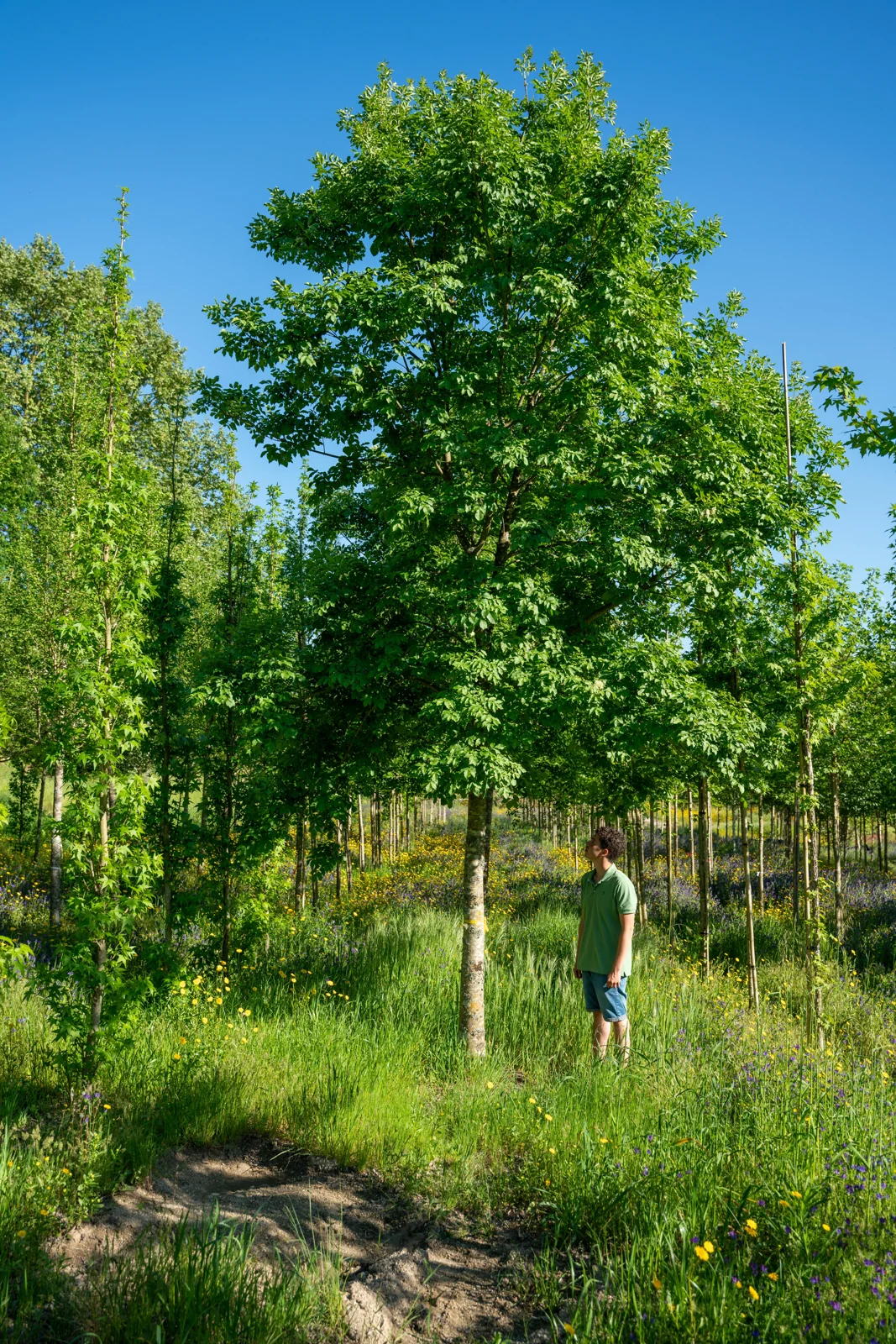
Drought-resilient Stadtbaum and Eschentriebsterben-tolerant Fraxinus substitute
Manna Ash · Fraxinus ornus
A compact 8 to 15 metre flowering ash (Blumenesche) from southern Europe and western Asia, specified in Germany as a heat-tolerant urban tree and a sound replacement where Fraxinus excelsior is compromised by ash dieback.
About this Species
Winter hardiness (Winterhärte) is the first qualification a German specifier needs. Established trees tolerate roughly minus 20 degrees Celsius on free-draining substrate in sheltered urban positions, with the Oberrheingraben (Upper Rhine valley), the Niederrheinische Bucht (Lower Rhine basin), the Kölner Bucht and the Rhine-Main conurbation giving reliable…
Read more
Show less
Winter hardiness (Winterhärte) is the first qualification a German specifier needs. Established trees tolerate roughly minus 20 degrees Celsius on free-draining substrate in sheltered urban positions, with the Oberrheingraben (Upper Rhine valley), the Niederrheinische Bucht (Lower Rhine basin), the Kölner Bucht and the Rhine-Main conurbation giving reliable performance. East of the Elbe and in the voralpenland (pre-Alpine foothills) above 400 metres the species becomes marginal, and young wood is at risk in the first three winters before bark hardens off.
The genus is under active phytosanitary pressure in Germany. Eschentriebsterben (Hymenoscyphus fraxineus) has compromised Fraxinus excelsior stock across much of the country, and Fraxinus ornus shows substantially lower susceptibility in European trials, which positions it as a defensible substitute on Pflanzlisten where a true Fraxinus character is required. Salt tolerance (Streusalztoleranz) is low, however: this is not a candidate for routinely salted primary roads, and it should be specified for squares, courtyards, and quieter alignments rather than winter routes.
Street-tree suitability (Stadtbaumeignung) is otherwise solid. The species carries the rounded, moderately dense Habitusform German practice expects of a Stadtbaum, tolerates compacted urban soils once established, and maintains canopy through the dry-hot summer pattern seen between 2018 and 2022. It is a credible Zukunftsbaum candidate for inner-city positions in the western lowlands, and aligns with the orientation of the Klima-Artenmatrix toward drought-tolerant southern European taxa.
Site requirements (Standortansprüche) are undemanding within the hardiness envelope: free-draining loams and calcareous substrates to pH 8, full sun, no waterlogging. Dense panicles of fragrant cream-white flowers open in May and June after the foliage, a feature absent from Fraxinus excelsior and useful where a Kurpark or representative square benefits from late-spring interest. Autumn colour is variable yellow to purplish, the bark stays smooth and dark grey into maturity, and the form reads cleanly under typical Straßenbaum pruning regimes.



Advice on this species
Want to know more about Fraxinus ornus?
Tell us about your project and we'll advise you on this species — where it thrives, which size makes sense, and what to expect once planted.
- Produção própria
- Exemplares adultos
- Resposta em 1–2 dias
Sem compromisso · orçamento personalizado