

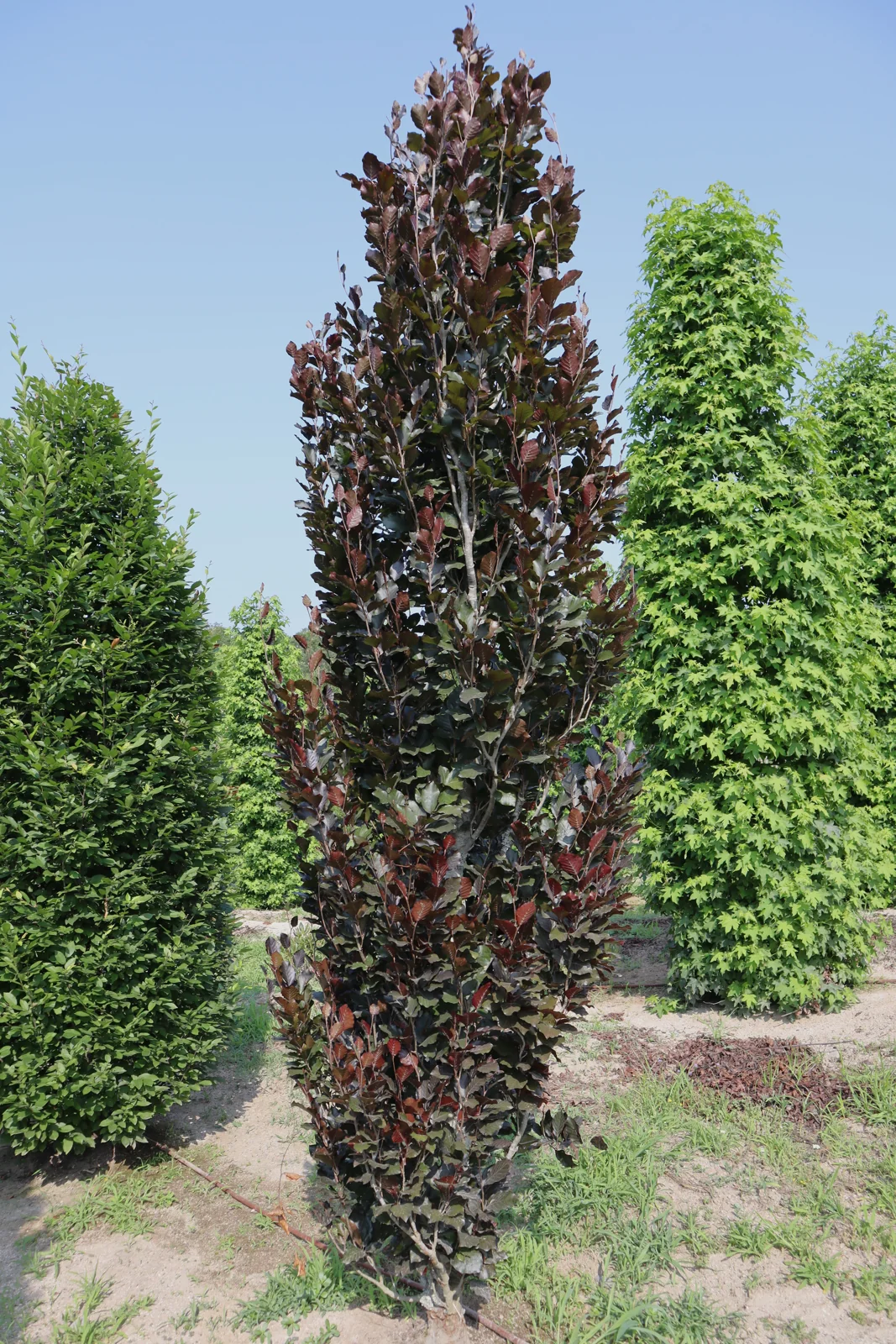
Columnar purple Rotbuche for confined formal compositions
European Beech ‘Dawyck Purple’ · Fagus sylvatica ‘Dawyck Purple’
A fastigiate purple-leaved selection of the native Rotbuche, suited to narrow planting envelopes across most of Germany and reliably hardy on cool, moisture-retentive sites with the soil depth and rainfall this beech rewards.
Key Facts
About this Cultivar
Fagus sylvatica 'Dawyck Purple' (Rotbuche) is a fastigiate selection from the Scottish 'Dawyck' line, with deep purple foliage shifting to copper before leaf fall. Mature dimensions reach 12 to 18 metres in height with a crown breadth of only 3 to 5 metres, giving a narrow, upright Habitusform that holds its outline without corrective pruning. The form…
Read more
Show less
Fagus sylvatica 'Dawyck Purple' (Rotbuche) is a fastigiate selection from the Scottish 'Dawyck' line, with deep purple foliage shifting to copper before leaf fall. Mature dimensions reach 12 to 18 metres in height with a crown breadth of only 3 to 5 metres, giving a narrow, upright Habitusform that holds its outline without corrective pruning. The form addresses a recurring problem on German projects: vertical accent and avenue rhythm on plots too narrow for a standard rounded Buchen crown.
Winterhärte derives from the parent species, native across the German Mittelgebirge and the voralpenland (pre-Alpine foothills). Established specimens tolerate minus 25 degrees Celsius on free-draining soils; the first three winters after transplant are the risk window, when young wood is more exposed on open eastern sites. Performance is reliable from the Niederrheinische Bucht (Lower Rhine basin) through the central uplands to the norddeutsche Tiefebene (Northern German lowlands). Continental winter minima east of the Elbe are not the limiting factor for this taxon.
The limiting factor is summer water. Fagus sylvatica is not a Zukunftsbaum candidate and does not appear on the climate-adapted shortlists maintained by the GALK working group or the Klima-Artenmatrix; the species is one of the German forestry community's principal concerns after the 2018 to 2022 drought sequence, which produced widespread canopy dieback in Buchenwald stands from Hessen to Brandenburg. Stadtbaumeignung is correspondingly narrow. The cultivar is not suited to confined root volumes, compacted urban soils, de-icing salt exposure, or heat-island street positions.
The defensible specification is for park, Kurpark, cemetery, and formal estate contexts on deep, fresh, well-drained loams (Standortansprüche close to those of mature Buchenwald soil), in sun to partial shade. The narrow purple column reads as a contrasting vertical in clipped Hainbuche (Carpinus betulus) frameworks, against light-leaved Eichen (Quercus robur, Q. petraea), or in alignments where space prohibits the typical 20-metre spread of the wild type. Disease pressure is low: no Cydalima, no Cameraria, no Eschentriebsterben analogue on Fagus, and beech bark disease remains minor at landscape scale.
Advice on this species
Want to know more about Fagus sylvatica 'Dawyck Purple'?
Tell us about your project and we'll advise you on this species — where it thrives, which size makes sense, and what to expect once planted.
- Produção própria
- Exemplares adultos
- Resposta em 1–2 dias
Sem compromisso · orçamento personalizado