

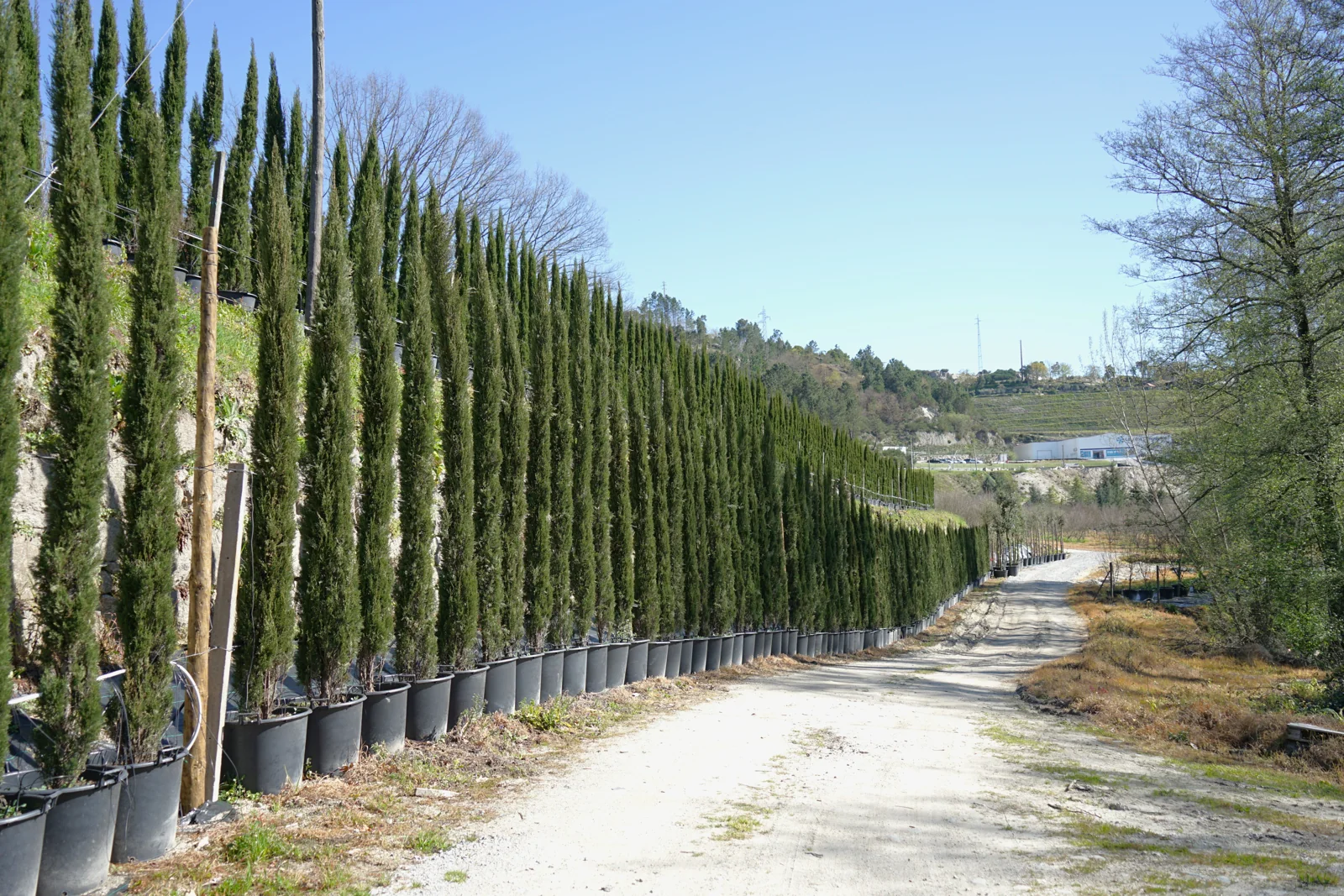
Narrow columnar accent for mild Klimaregionen
Italian Cypress ‘Stricta’ · Cupressus sempervirens ‘Stricta’
A strictly fastigiate selection of the Mediterranean cypress (Mittelmeer-Zypresse), specified as a vertical solitaire or rhythmic axis marker on German projects in the milder western Klimaregionen, where its winter performance can be defended on technical grounds.
Key Facts
About this Cultivar
Winter hardiness (Winterhärte) is the governing constraint. The cultivar is reliably hardy to roughly minus 15 degrees Celsius on free-draining substrate in sheltered urban positions; minus 12 degrees Celsius is the more conservative working limit on open sites. Young stock is exposed for the first three winters and benefits from a sheltered Standort until…
Read more
Show less
Winter hardiness (Winterhärte) is the governing constraint. The cultivar is reliably hardy to roughly minus 15 degrees Celsius on free-draining substrate in sheltered urban positions; minus 12 degrees Celsius is the more conservative working limit on open sites. Young stock is exposed for the first three winters and benefits from a sheltered Standort until the trunk has lignified.
Reliable performance is confined to the milder German Klimaregionen: the Oberrheingraben (Upper Rhine valley), the Niederrheinische Bucht (Lower Rhine basin), the Kölner Bucht, and protected urban heat-island sites in Frankfurt am Main, Stuttgart, and the western Ruhr conurbation. The cultivar is marginal east of the Elbe, in the norddeutsche Tiefebene without urban shelter, and above 400 metres in the voralpenland (pre-Alpine foothills); specification north and east of this envelope is not defensible.
The habit (Habitusform) is strictly columnar, reaching 15 to 20 metres in height with a crown width of only 2 to 3 metres at maturity. Branches are erect and densely packed, the foliage scale-like, dark green, and persistent through winter, which makes the cultivar useful for vertical structure during the long German leaf-off period. Growth is moderate when young and slows markedly with age; pruning is not required to maintain habit and should be avoided, as the species does not regenerate reliably from old wood.
Standortansprüche are straightforward: full sun, deep free-draining loam or sandy substrate, tolerance of calcareous soils to pH 8 once established, and good wind tolerance. Drought tolerance is high after establishment and aligns with the Klima-Artenmatrix logic behind Zukunftsbaum selection, though the cultivar is not a Stadtbaum candidate in the Straßenbaum sense: de-icing-salt exposure is only moderately tolerated and the GALK-Straßenbaumliste does not list it. The genus is moderately susceptible to cypress canker (Seiridium cardinale), which argues against dense single-cultivar avenues on warm, humid sites.
Advice on this species
Want to know more about Cupressus sempervirens 'Stricta'?
Tell us about your project and we'll advise you on this species — where it thrives, which size makes sense, and what to expect once planted.
- Produção própria
- Exemplares adultos
- Resposta em 1–2 dias
Sem compromisso · orçamento personalizado